How to Treat Internal Hemorrhoid Symptoms at Home

Many don't realize that the first streak of bright red blood after a bowel movement can reveal a bowel routine that has been irritating internal hemorrhoids for weeks.
You may be searching for how to treat internal hemorrhoid symptoms after noticing blood on toilet tissue, a feeling of fullness, or tissue that briefly appears during a bowel movement. The practical answer is staged care: calm the flare, soften and regulate stool, choose an OTC format that matches the symptom, and know exactly when home care has reached its limit.
Table of Contents
- The Moment You First Notice Something Feels Off
- Immediate Relief in the First 24 Hours
- Choosing Between Creams, Suppositories, and Sprays
- Building a Bowel Routine That Stops the Cycle
- Matching OTC Ingredients to Your Specific Symptoms
- Warning Signs That Mean It Is Time to See a Doctor
- A Simple 7 Day Starter Plan and What Comes Next
The Moment You First Notice Something Feels Off
You finish using the bathroom, glance at the tissue, and see bright red blood. Or perhaps there's no blood, but you feel pressure or an unfamiliar fullness inside the rectum. Anxiety arrives quickly, followed by embarrassment and a rushed search for answers.
That reaction is understandable. Hemorrhoidal disease leads to about 4 million office and emergency department visits each year, and roughly 75% of Americans experience hemorrhoidal symptoms at some point in life, according to a major U.S. clinical review in StatPearls' overview of internal hemorrhoids. Hemorrhoids were also found in 39% of patients undergoing routine colorectal cancer screening, while 55% of those cases were asymptomatic, as reported in the primary-care review linked in that source.
An internal hemorrhoid is an enlarged vascular cushion located above the dentate line, inside the rectal canal. That area has relatively few pain fibers, so bleeding may appear before pain. An external hemorrhoid sits below the line, under sensitive skin, and is more likely to throb or clot.
A simple way to picture the difference is a small water balloon just inside a doorway. That's like an internal hemorrhoid. A similar balloon stuck at the threshold is more like an external hemorrhoid, where contact and pressure can hurt more.

Use the grade to guide your next step
Internal hemorrhoids are commonly described in four grades:
- Grade I: Bleeding may occur, but the hemorrhoid doesn't prolapse.
- Grade II: The hemorrhoid comes down during a bowel movement and returns on its own.
- Grade III: The tissue prolapses and needs to be pushed back manually.
- Grade IV: The tissue remains outside and can't be pushed back.
Grade I symptoms often respond to a disciplined bowel routine and conservative care. Grade II symptoms deserve closer attention because recurrent prolapse can progress. Grades III and IV require a clinician's assessment rather than repeated home experiments.
For a fuller symptom overview, use this guide to internal hemorrhoid symptoms. The useful takeaway is simple: one episode doesn't automatically mean an emergency, but rectal bleeding should never be dismissed if it persists, changes, or comes with other warning signs.
Immediate Relief in the First 24 Hours
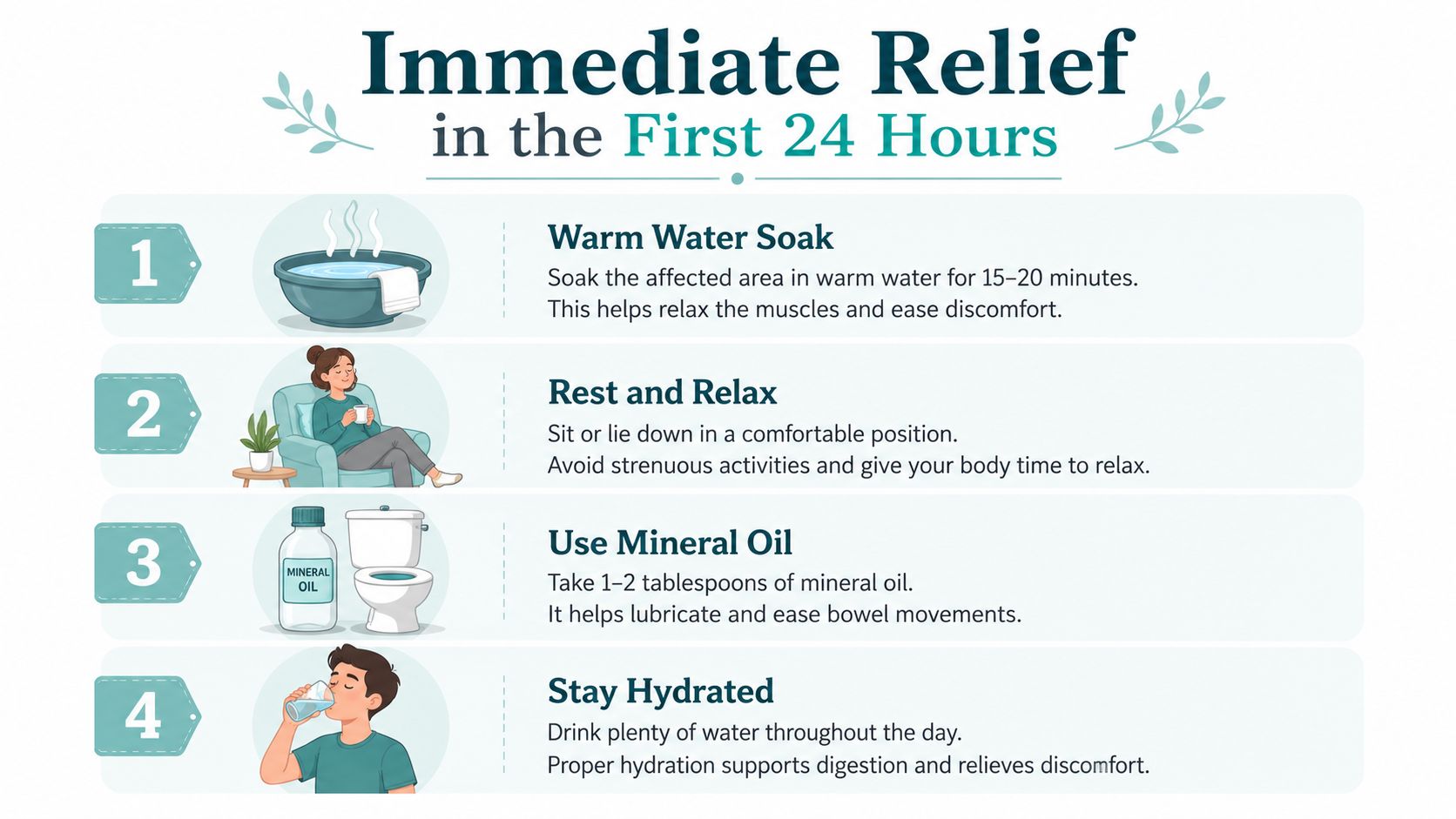
Start with comfort, then fix the bowel habit that triggered the irritation. These steps are designed to reduce friction, pressure, and swelling while you arrange appropriate care if symptoms continue.
- Soak in warm water. Take a sitz bath for 15 to 20 minutes with plain warm water at about 37 to 40 degrees Celsius. Submerge your hips fully, repeat it two to three times that day, and take another bath after a bowel movement when possible. Follow this sitz bath method at home rather than using water that feels hot or irritating.
- Clean without rubbing. Use a peri bottle or unscented wipes, then pat the area dry. Scrubbing can re-irritate swollen tissue. A Revivol-XR® Sitz Bath Soak Mix, Super Concentrated 20-in-1 Blend with Epsom Salt and Essential Oils contains Epsom Salt as one of 20 listed ingredients, including Dead Sea Salt, aloe vera, witch hazel, chamomile oil, calendula oil, and other botanical ingredients. It's for external use only, and the product instructions call for a small sensitivity test first. Don't swallow it, keep it away from children and eyes, and ask a physician before warm baths if you have diabetes.
- Lie on your left side. Short periods in this position can take gravitational pressure off the rectal veins. It's especially useful after bathing or a bowel movement.
- Apply a wrapped cold compress. Place it over clothing or a clean cloth for 10 minutes. Never put ice directly on skin.
- Use acetaminophen if needed. If throbbing develops, an OTC oral pain reliever such as acetaminophen may help when used according to its label. Check with a pharmacist or clinician if you have liver disease, take other medicines, or aren't sure it's appropriate.
The sitz bath and cleansing manage the immediate flare. The bowel routine is what prevents the next round.
This short video demonstrates the general sitz bath approach:
Choosing Between Creams, Suppositories, and Sprays
Internal hemorrhoids sit above the anal canal, so a cream placed only around the outside may not reach the source of internal symptoms. Creams still have a role, especially when tissue protrudes or the outer rim feels irritated.
| Format | Where It Reaches | Best For | Application Steps |
|---|---|---|---|
| Creams and ointments | Outer rim and visible prolapsed tissue | External irritation or tissue that briefly protrudes | After bathing, apply a thin layer with a clean finger or disposable pad, following the label |
| Suppositories | Inside the rectal canal | Internal bleeding, fullness, or irritation | Lie on your left side, insert past the sphincter according to the label, then remain reclined so the base can melt |
| Sprays and foams | Surface area without much touching | Tender areas, work, or travel | Shake if directed, hold the nozzle about 1 to 2 inches away, and apply 2 to 3 pumps according to the label |
Suppositories are usually the most practical OTC format for symptoms that are clearly internal. Follow the package directions closely, and use the suppository application guide if you're unsure about positioning or insertion.
For outer discomfort, Revivol-XR® Advanced Hemorrhoid Cream, 5% Lidocaine and Phenylephrine is labeled for temporary relief of pain, itching, burning, soreness, and discomfort. Its listed ingredients include lidocaine, phenylephrine HCl, glycerin, petrolatum, and aloe. Use it only as directed on the Drug Facts label. Stop and ask a doctor if symptoms worsen, bleeding occurs, or symptoms don't improve within 7 days.
Don't buy every format at once. Start with a sitz bath and bowel changes, then choose one product that matches the dominant symptom.
Building a Bowel Routine That Stops the Cycle
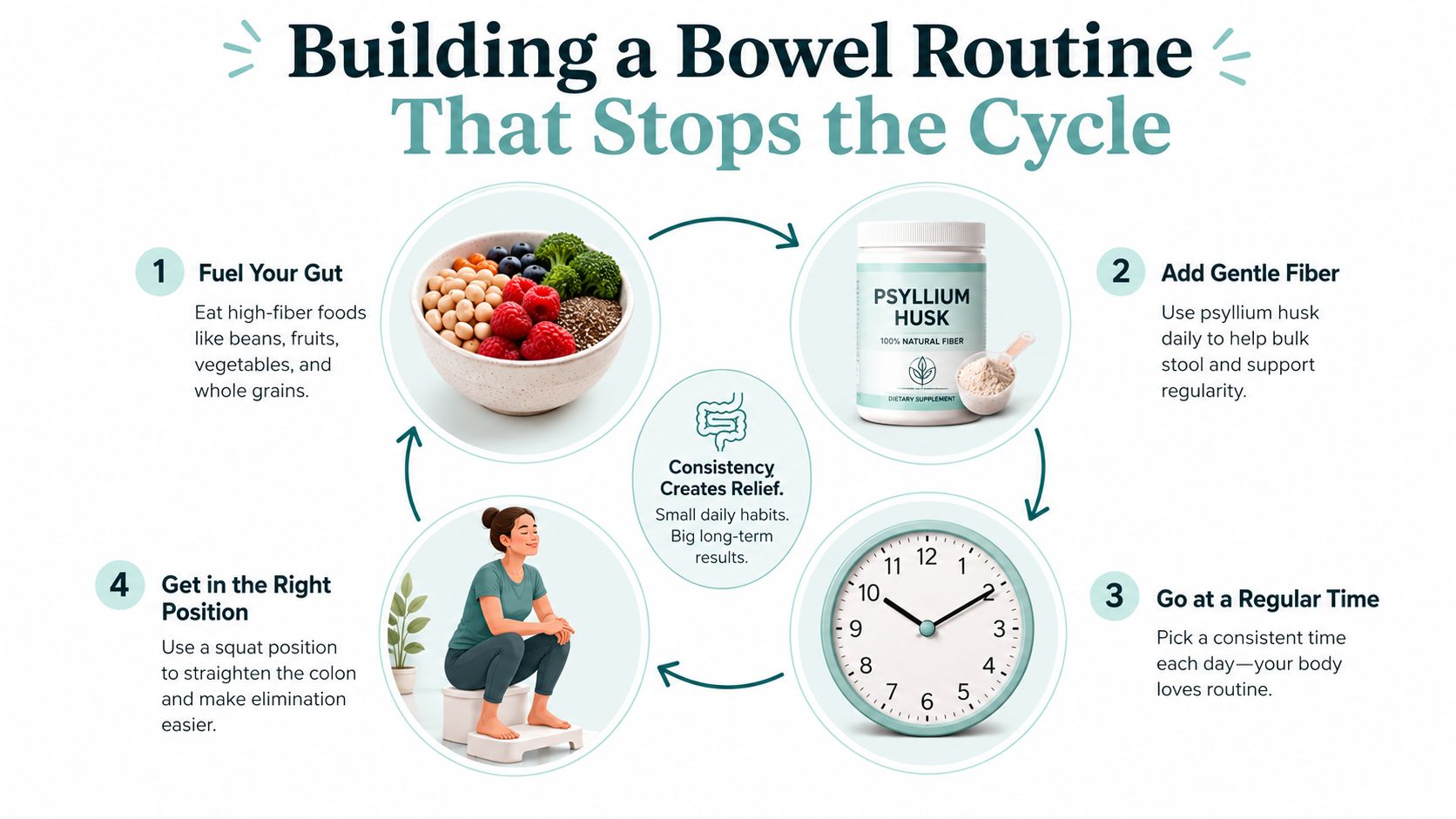
Straining is the habit to eliminate first. Fiber and water help, but they work best when paired with a predictable toilet routine.
Aim for 25 to 30 grams of fiber daily, starting with food such as beans, berries, oats, lentils, and prunes. If food alone isn't enough, psyllium husk or methylcellulose can be used as a backup at one tablespoon mixed in 8 ounces of water, morning and night. Increase gradually if your digestive system is sensitive.
Drink 8 to 10 cups of water spread across the day. Fiber without enough fluid can leave stool bulky and difficult to pass, which defeats the purpose.
Change your toilet position
Place your feet on a six-inch stool, keep your knees above your hips, lean slightly forward, and avoid prolonged sitting. Set a firm five-minute cap. If nothing happens, get up and try again later.
Practical rule: Don't force the bowel movement. Breathe slowly, relax your abdomen, and let stool softening do the work.
Keep the same routine for the next four to seven days. The point isn't to push harder. It's to make passing stool easier while reducing repeated pressure on the rectal cushions.
Matching OTC Ingredients to Your Specific Symptoms
OTC labels become easier to understand when you match one active ingredient to one dominant symptom. Don't layer several products because each sounds useful.
| Ingredient | Symptom It Treats | How It Works | Typical Use Window |
|---|---|---|---|
| Lidocaine | Sharp, burning, or throbbing discomfort | Temporarily numbs the treated area | Short-term use, according to the label |
| Phenylephrine | Swelling and prolapse discomfort | Acts as a vasoconstrictor to temporarily shrink swollen tissue | Often limited to 7 days, according to the label |
| Witch hazel | Itching and minor seepage | Acts as an astringent that can calm surface irritation | Short-term use as directed |
| Zinc oxide, petrolatum, and lanolin | Raw or stool-irritated tissue | Coats and shields the skin from further irritation | During the healing period, according to the label |
Lidocaine pairs naturally with a warm sitz bath when pain is the main complaint. Phenylephrine may fit swelling or tissue that feels enlarged, while witch hazel pads are more useful for surface itch than deep internal pressure.
Use this matching rule: pain gets lidocaine, swelling gets phenylephrine, raw tissue gets a protectant, and itch gets an astringent. A focused choice is needed, not all four categories.
Read the entire Drug Facts label before use. Some products aren't appropriate with certain medical conditions, medicines, pregnancy, or breastfeeding without professional advice.
Warning Signs That Mean It Is Time to See a Doctor
The common mistake is treating every episode of rectal bleeding as a hemorrhoid flare and continuing home care indefinitely. Use clear limits instead.
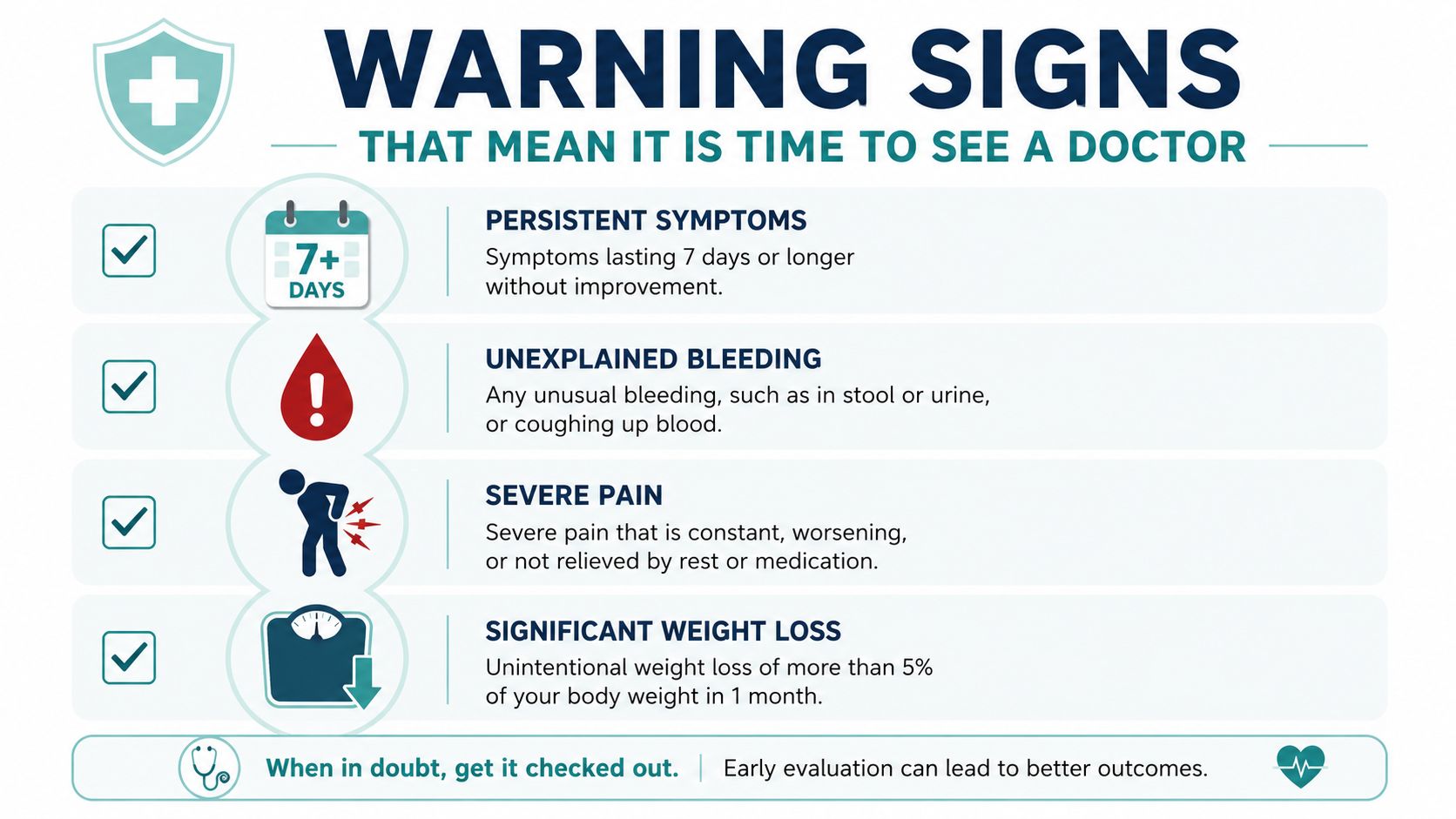
Seek medical evaluation if you have:
- Bleeding beyond 7 days: Home care hasn't resolved the bleeding within the product's labeled timeframe.
- Changing blood: Blood becomes darker, contains clots, or appears in a larger amount.
- Heavy bleeding: Blood soaks the toilet bowl or continues rather than stopping.
- Non-reducible prolapse: Tissue stays outside and can't be gently pushed back.
- Severe pain: Pain interrupts sleep, escalates quickly, or feels out of proportion to a routine bowel movement.
- Fever with tenderness: A temperature above 100.4°F paired with anal tenderness needs prompt assessment.
- Possible anemia: Dizziness, pallor, unusual weakness, or a rapid heartbeat can signal significant blood loss.
Grade III and Grade IV prolapse, thrombosed veins, and suspected anemia need in-person evaluation, often within 24 to 48 hours. Go sooner for sudden heavy bleeding, faintness, or severe worsening symptoms.
A primary-care clinician can begin the evaluation. A gastroenterologist or colorectal surgeon may be appropriate for persistent bleeding, recurrent prolapse, or symptoms that don't respond to conservative care. Office procedures such as rubber band ligation, injection sclerotherapy, and infrared coagulation are used for persistent Grade I to III internal hemorrhoids. Rubber band ligation is generally preferred over infrared photocoagulation because it has a lower failure rate, and reviews report an overall success rate of about 80% in appropriate cases, as summarized by the American Academy of Family Physicians.
Home treatment isn't failure. It's the first stage. Persistent symptoms mean the next stage deserves professional help.
A Simple 7 Day Starter Plan and What Comes Next
The week has one purpose: calm irritation while making bowel movements easier and less forceful.
Day 1: Take a 15-minute sitz bath three times, cleanse gently, and begin psyllium at one tablespoon daily if appropriate for you. Spread water through the day rather than drinking it all at once.
Days 2 and 3: If the label and your health history allow it, use a phenylephrine suppository at bedtime and lidocaine cream before bowel movements. Raise water intake toward 64 ounces and keep fiber near 25 to 30 grams. Follow product directions exactly, and ask a clinician or pharmacist first if you're pregnant, breastfeeding, or taking prescription medicine.
Days 4 and 5: Make the bowel routine the priority. Use timed toilet sits capped at 5 minutes, place your feet on a stool, lean forward, and choose stool-friendly foods such as oats, prunes, and lentils instead of foods that seem to worsen constipation or irritation.
Days 6 and 7: Reassess bleeding, prolapse, and pain. Write down what improved, what stayed the same, and whether tissue still needs manual reduction. Persistent bleeding, worsening pain, or prolapse that won't reduce should move you from self-care to a clinic visit.
Think of the next month as habit-building, not a promise of a cure. Keep fiber, fluids, gentle cleansing, and a no-straining rule in place, and don't keep extending home treatment when symptoms are stubborn.
Revivol-XR offers OTC comfort options such as topical lidocaine and phenylephrine formulations, along with a sitz bath soak for external soothing support. Review the labels carefully and visit Revivol-XR to compare options, while contacting a healthcare provider for persistent, severe, or bleeding symptoms.