How Long Do Hemorrhoids Bleeding Last by Type

Small, bright-red bleeding with uncomplicated hemorrhoids often eases within a few days once hard stools and straining ease, but there's no single duration. Bleeding that lasts past about a week, keeps returning, or becomes heavier needs a clinician rather than another round of home treatment.
You may be staring at a red streak on the toilet paper, wondering whether to wait or make an appointment. Even painless bleeding deserves attention, and its pattern matters more than a countdown.
Table of Contents
- How Long Do Hemorrhoids Bleeding Last
- Bleeding Timelines by Hemorrhoid Type
- Why the Blood Stops and Returns
- Three Bleeding Patterns People Actually See
- Bleeding Patterns That Need a Doctor
- Gentle Care While a Small Bleed Settles
- Prevention and Your Follow-Up Plan
- Common Questions About Hemorrhoid Bleeding
How Long Do Hemorrhoids Bleeding Last
A hard bowel movement can leave bright-red blood that looks frightening even when the amount is small. Say you notice a streak after straining, then much less after your next, softer stool. That downward trend is more reassuring than bleeding that stays the same or returns repeatedly, but it doesn't confirm the cause.
NHS Inform's hemorrhoid guidance says symptoms often clear after a few days, either on their own or with simple pharmacy care. For minor bleeding associated with irritation, the practical expectation is improvement as bowel movements become easier, not a guaranteed stop date.
Watch the direction: Less blood and easier bowel movements are useful signs. A quiet day between episodes isn't proof that the cause has resolved.
Notice more than the calendar
Internal hemorrhoid bleeding is often painless and linked to passing stool. A painful external lump, bleeding after a procedure, and symptoms after childbirth follow different courses.
Keep a short record of:
- Amount: A streak on paper, drops, or enough blood to change the toilet water.
- Color: Bright red, dark red, or black-looking stool.
- Timing: During a bowel movement, afterward, or between bathroom visits.
- Progress: Clearly decreasing, unchanged, worsening, or returning.
Persistent, unexplained, or repeated bleeding needs assessment because other bowel conditions can look similar. Heavy bleeding or bleeding with faintness isn't something to monitor at home.
Bleeding Timelines by Hemorrhoid Type
How long hemorrhoid bleeding often lasts
| Situation | Usual bleeding pattern | Often eases | Next step |
|---|---|---|---|
| Minor internal hemorrhoid | Bright-red blood on paper, coating stool, or in the bowl with a bowel movement | A few days once stools soften and straining stops | Watch briefly if clearly improving, use gentle care, and seek advice about unexplained bleeding |
| Thrombosed external hemorrhoid | Small bleeding for a few days if the skin opens; pain peaks at 48 to 72 hours | Pain often improves over 7 to 10 days; one study reported median improvement at 5 days and resolution at 8 days, with a range of 1 to 45 days | Comfort care, and call a clinician if pain or bleeding worsens |
| After rubber band ligation | Mild bleeding immediately or later as treated tissue sloughs | Delayed bleeding risk around 10 to 14 days | Urgent care for large-volume or heavy bleeding |
| Postpartum hemorrhoids | Anal symptoms separate from vaginal lochia | Days to several weeks; many regress within 6 to 8 weeks | Don't assume heavy vaginal bleeding is hemorrhoidal |
| Repeated episodes | Stops after one stool, then returns with another hard stool | Acute spells may last about 4 days, but recurrence can happen weeks or months later | Reassess triggers and get checked if bleeding keeps returning |
The North Cumbria NHS hemorrhoid guidance describes the external-hemorrhoid and banding timelines above, including pain peaking at 48 to 72 hours and delayed post-banding bleeding around 10 to 14 days. The 2024 American Society of Colon and Rectal Surgeons guideline also summarizes a retrospective study of 504 patients managed without surgery for external hemorrhoidal thrombosis: median symptom improvement occurred after 5 days and complete resolution after 8 days, with a range of 1 to 45 days.
Bleeding time isn't the same as healing time
A thrombosed external hemorrhoid contains a blood clot beneath the skin around the anus. If the overlying skin opens, a little bleeding may occur while the lump remains sore. The symptom-resolution figures describe overall symptoms, not continuous bleeding throughout recovery.
A median is the middle result in a study, not a deadline for an individual. Don't use the longest reported recovery time as permission to tolerate worsening pain or ongoing blood loss.
Minor internal hemorrhoids have a different pattern. Blood may appear only with a bowel movement, so someone can feel comfortable between bathroom visits while still noticing repeated streaks. Our guide to care options for internal hemorrhoids explains why bowel habits and clinical assessment both matter.
Procedures and childbirth need separate expectations
After rubber band ligation, delayed bleeding can happen when treated tissue separates. Feeling well immediately afterward doesn't eliminate that later risk. Follow the treating team's discharge instructions, and don't dismiss substantial bleeding as an expected part of recovery.
Postpartum recovery adds another distinction: hemorrhoid symptoms and vaginal bleeding aren't the same thing. The postpartum row describes improvement in hemorrhoidal symptoms, not an acceptable duration of unexplained rectal bleeding or heavy vaginal blood loss.
These ranges describe common courses. They don't establish that bleeding is hemorrhoidal, and they don't override warning signs.
Why the Blood Stops and Returns
Think of a swollen hemorrhoidal cushion being rubbed by hard stool, loosely like a swollen vein that gets scraped. The comparison helps explain irritation, but hemorrhoids aren't ordinary varicose veins, and seeing blood doesn't identify its source.
The stop-and-start pattern is easier to understand as a sequence.
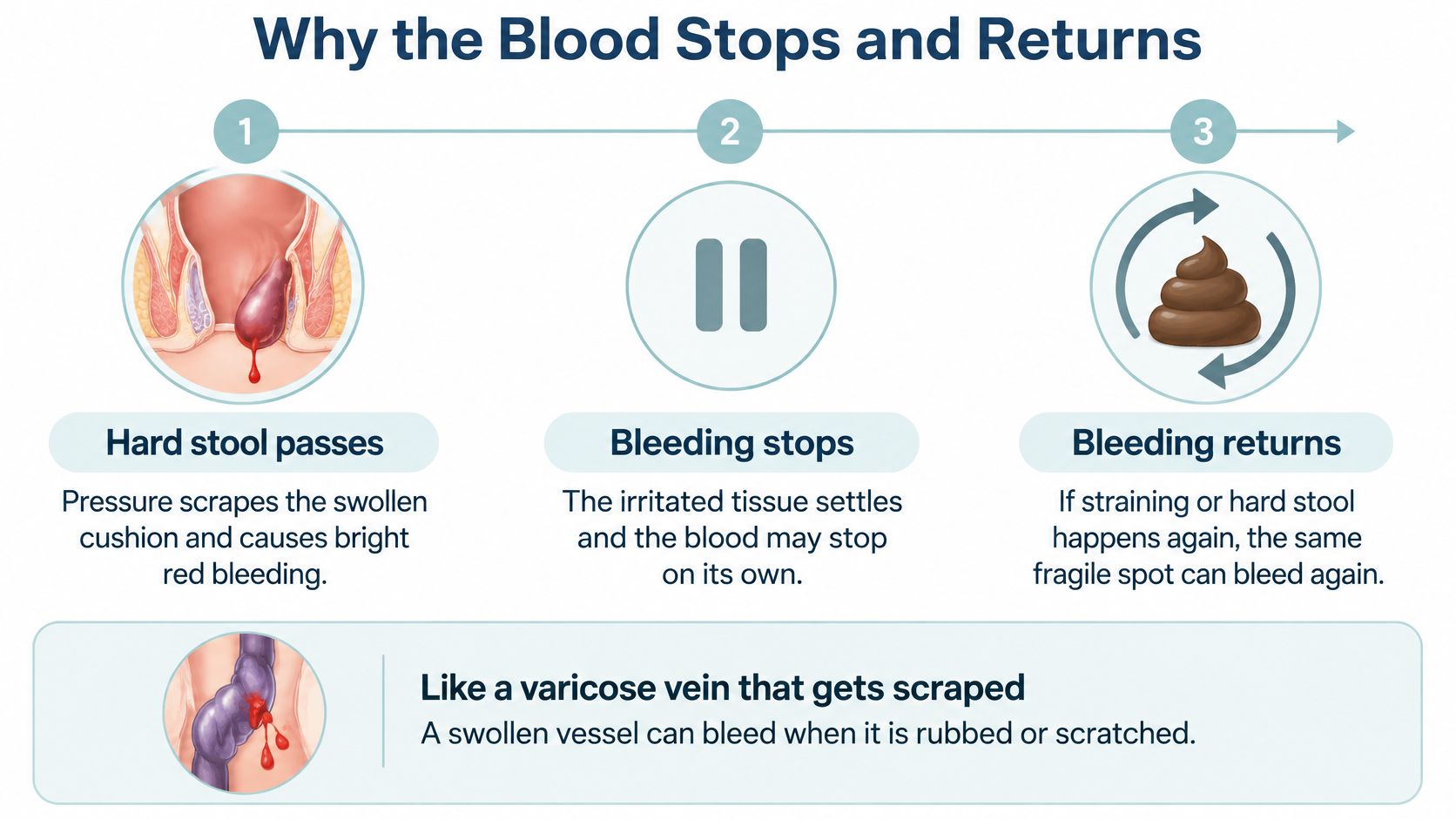
Internal hemorrhoids can produce painless, bright-red blood during or immediately after a bowel movement. Once stool has passed, the immediate rubbing and pressure stop, so bleeding may stop too. Another hard bowel movement can irritate the same fragile area again.
The 2024 American Society of Colon and Rectal Surgeons guideline gives no universal number of days for hemorrhoid bleeding. It recommends recording bleeding severity and duration and examining the person because rectal bleeding can't safely be assumed to come from hemorrhoids.
An episode and a relapse answer different questions
“How long did today's bleeding last?” isn't the same as “Has the problem gone away?” A person may stop seeing blood between bowel movements while the underlying irritation remains.
Common reasons for another episode include:
- Hard stools: The same tissue is rubbed again.
- Straining: Repeated pressure continues during bowel movements.
- Long toilet sitting: Phone scrolling can extend time spent bearing down.
- Pregnancy-related pressure: Recovery may continue after delivery.
- Prolapsing tissue: Tissue that repeatedly protrudes may stay irritated.
Keep a brief diary of the date, amount, and likely trigger while arranging advice for recurring bleeding. You don't need a perfect measurement. Descriptions such as “small streak after hard stool” or “blood without a bowel movement” give a clinician useful information.
This video offers another way to understand hemorrhoid symptoms and care.
Stopping today doesn't prove the cause has resolved. Repeated episodes deserve evaluation rather than an indefinite cycle of waiting for the next quiet day.
Three Bleeding Patterns People Actually See
These examples describe possible patterns, not diagnoses. The useful question in each case is whether symptoms are settling or whether something has changed enough to need care.
A streak after a hard stool
An office worker notices a small red streak after pushing through a hard bowel movement. The next visit is clear, but another streak appears after another difficult stool.
That pattern can fit local irritation, including internal hemorrhoids. Improvement means easier bowel movements, smaller amounts of blood, and no new symptoms. If the streaks keep returning, the person should arrange an appointment rather than deciding that each episode starts a new waiting period.
A symptom-free bathroom visit is encouraging. Repeated bleeding still needs an explanation.
A tender lump with a little bleeding
Someone notices a sudden, painful lump at the anal rim. Later, a small spot of blood appears on their underwear.
A thrombosed external hemorrhoid is one possible explanation, particularly if the skin has opened, but a clinician needs to assess a new painful lump. An improving course means tenderness and swelling gradually settle instead of becoming more intense.
Don't squeeze, puncture, or try to drain the lump. Increasing pain, substantial bleeding, or feeling unwell moves this situation away from home observation.
Blood during postpartum recovery
A new parent sees blood while using the bathroom and can't tell whether it came from the anus or vagina. With soreness, pads, and disrupted routines, that uncertainty is understandable.
NHS guidance on the body after birth explains that vaginal discharge called lochia may continue for a few weeks, gradually turn brownish, decrease, and stop. Hemorrhoid symptoms may also improve over days to several weeks, but these are separate processes.
Tell a midwife about large clots. Sudden or very heavy vaginal blood loss, faintness, or a racing heartbeat requires urgent medical attention, because postpartum hemorrhage is different from hemorrhoidal bleeding.
If the source is unclear, contact the maternity team instead of guessing. For anal symptoms, improvement means less discomfort and diminishing blood with bowel movements. For vaginal bleeding, the important trend is a gradual reduction, not sudden heavy loss.
Bleeding Patterns That Need a Doctor
One small, improving streak after a hard stool is different from blood mixed throughout stool or bleeding that keeps returning. The decision is about pattern, amount, and accompanying symptoms, not whether you can endure another day.
MedlinePlus's hemorrhoid guidance recommends contacting a clinician when symptoms persist after one week of home treatment and specifically advises evaluation for rectal bleeding. That's a stop-and-ask point, not a promise that a cream should have stopped the blood.
When hemorrhoid bleeding is no longer a home watch
| Pattern | Why it matters | Action |
|---|---|---|
| One small bright-red streak after a hard stool, clearly less the next day | Can fit local irritation | Watch briefly while stools soften and seek advice if unexplained |
| Still bleeding or no better after 7 days of home care | Continuing self-treatment may delay diagnosis | Contact a clinician |
| Blood in the stool for 3 weeks | Needs an identified cause | Book an evaluation, sooner if other symptoms appear |
| Blood mixed through stool, or a lasting bowel-habit change over 3 weeks | May not be a hemorrhoid | Get assessed |
| Black, tarry, or foul-smelling stool | Can signal bleeding higher in the digestive tract | Seek prompt medical care |
| Dizziness, weakness, large clots, or nonstop bleeding | Can mean serious blood loss | Urgent care |
| Heavy vaginal bleeding, faintness, or fast heartbeat after birth | May be postpartum hemorrhage | Emergency care, not hemorrhoid care |
NHS Wales's rectal bleeding guidance advises assessment if blood in stool continues for 3 weeks, and sooner for significant pain, unexplained weight loss, unusual fatigue, abdominal pain or a lump, black or dark-red stool, or bloody diarrhea. That longer threshold isn't a reason to wait when bleeding persists despite home care or any warning sign appears.
Don't let a presumed diagnosis delay care
Continuous or heavy bleeding, large clots, dizziness, weakness, fainting, or a rapid heartbeat needs urgent help. Severe pain also warrants prompt assessment.
Tell the clinician if you take blood thinners, have a family history of colorectal cancer, or are older and experiencing a new bleeding pattern. Don't stop prescribed blood-thinning medicine on your own.
This visual separates brief observation from patterns that need medical attention.
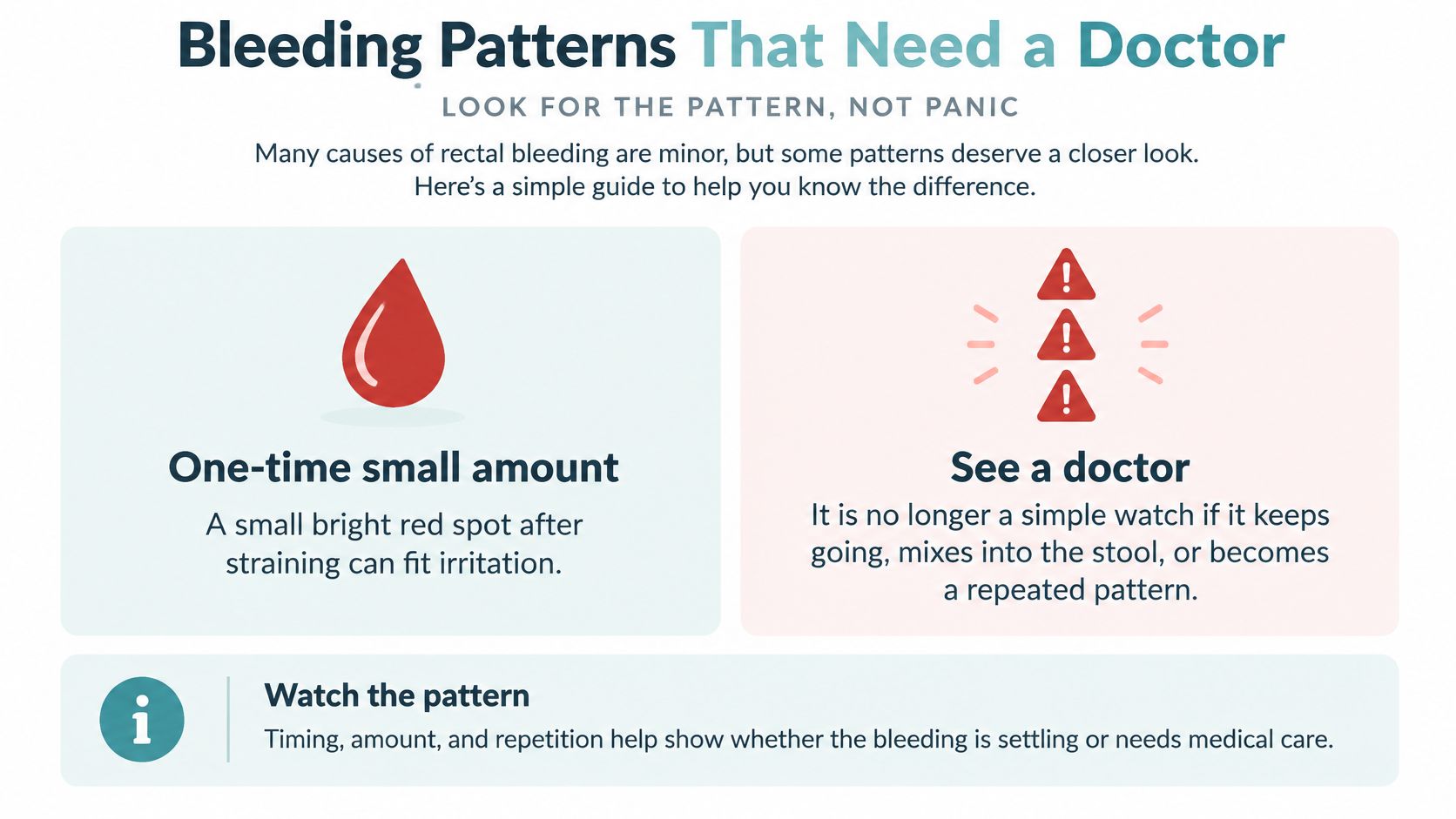
A clinician may examine the area and decide whether further testing, such as a scope, is appropriate. Hemorrhoids shouldn't be accepted as the explanation without considering other causes, including inflammatory bowel disease and colorectal or anal cancer.
If you're unsure where to start, our guide to which healthcare professionals treat hemorrhoids explains the options.
Gentle Care While a Small Bleed Settles
Gentle hygiene can reduce discomfort while a small, bright-red episode is already easing. It doesn't establish the diagnosis, and it isn't a substitute for asking a healthcare provider about bleeding.
Don't start a medicated cream to stop rectal bleeding. Products discussed below are for temporary external comfort, and their bleeding warnings still apply.
- Clean without scrubbing. Use warm water and, if tolerated, mild soap, then rinse thoroughly. A soft, fragrance-free wipe is another option, but stop if it stings or irritates the skin.
- Pat the area dry. Use a soft cloth or tissue instead of repeated rubbing. Don't try to remove every trace of moisture by wiping harder.
- Use a comfortably warm sitz bath. A shallow soak can feel soothing. Avoid hot water, then dry the skin carefully.
- Ask before adding medication when bleeding is present. A pharmacist or clinician can help distinguish comfort care from symptoms that need examination.
The routine should stay gentle and easy to monitor.
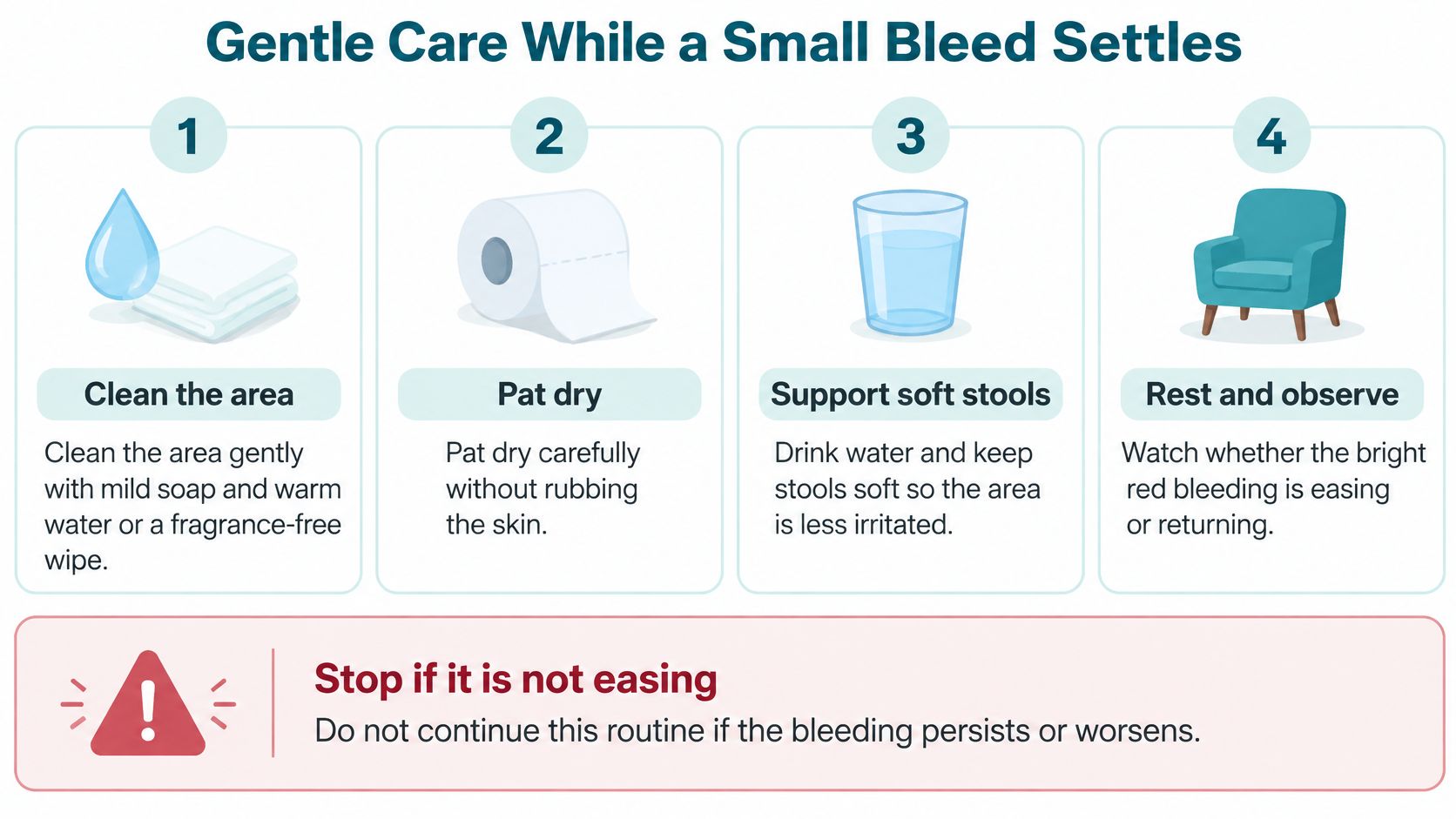
External comfort isn't bleeding treatment
For external soreness, burning, or itch when use is appropriate, Revivol-XR® Advanced Hemorrhoid & Fissure Cream provides temporary soothing comfort. Its formula contains 5% lidocaine for temporary numbing, 0.25% phenylephrine as a vasoconstrictor, glycerin and petrolatum to coat irritated skin, and aloe and witch hazel for a soothing application feel.
It doesn't stop bleeding, diagnose its cause, or cure an underlying condition. Because the label says to stop use and ask a doctor if rectal bleeding occurs, don't use it to self-manage an active bleeding episode.
When a healthcare professional advises that use is appropriate, soak first, clean and dry the skin, then apply a thin layer externally. Our directions allow application up to 4 times daily, or as directed by a healthcare professional. Never put it inside the rectum with fingers or an applicator.
Know when to stop
Stop use and ask a doctor if bleeding occurs, symptoms worsen, there's no improvement within 7 days, or an allergic reaction develops. Increasing redness, irritation, swelling, or pain also calls for reassessment.
Pregnant or breastfeeding readers should ask a health professional before using any anorectal product. Check the label's medical-condition and medication warnings, especially if you have heart disease, high blood pressure, thyroid disease, diabetes, or take prescription medicines for blood pressure or depression.
Prevention and Your Follow-Up Plan
Relief from an episode and prevention of another episode aren't the same outcome. A 2025 randomized study published in Annals of Coloproctology reported a median acute bleeding duration of 4 days in both treatment groups, but recurrent bleeding differed: 7.8% versus 0% at one month, and 23.5% versus 7.0% at three months, depending on adjunctive treatment.
Those results don't predict your recovery. They illustrate why a short initial episode doesn't guarantee that bleeding won't return.
Build a routine that makes bowel movements easier:
- Keep stools soft: Include fiber and adequate fluid unless your clinician has restricted them. Use our guide to what to eat when you have hemorrhoids for food ideas.
- Respond to the urge: Don't repeatedly postpone bowel movements.
- Leave the phone outside: Keep toilet visits brief instead of sitting and scrolling.
- Move between sitting periods: Short walks can help break up desk time.
- Avoid pushing: Ask about constipation management if passing stool regularly requires effort.
Soothing care may improve comfort, but it doesn't prevent every recurrence or prove what caused the blood. If a small episode resolves, maintain the bowel routine rather than extending medication unnecessarily.
If blood returns, record the trigger and book a check. Persistent, severe, heavy, recurring, or unexplained bleeding belongs with a healthcare provider, not an endless restart of over-the-counter care.
Common Questions About Hemorrhoid Bleeding
Is a little blood on toilet paper always hemorrhoids?
No. A small bright-red streak can fit hemorrhoidal irritation, but other conditions can cause rectal bleeding too. Tell a clinician if it's unexplained, keeps returning, changes appearance, or comes with other symptoms.
Can hemorrhoid bleeding last more than a week?
It can, but that doesn't make continued home treatment the right choice. If bleeding persists or symptoms aren't improving after a week of home care, contact a healthcare provider. Seek help sooner for heavier bleeding, significant pain, or feeling faint or weak.
How long does bleeding last after rubber band treatment?
Mild bleeding may happen immediately or later when the treated tissue separates. Follow your procedure team's instructions about the delayed bleeding window and whom to contact. Large-volume or heavy bleeding needs urgent medical care, even if you were told some spotting could occur.
Revivol-XR offers products for temporary soothing relief and comfort from hemorrhoid-related soreness, burning, and itch, not for stopping rectal bleeding. Visit Revivol-XR to review comfort-care options and their Drug Facts labels, and contact a healthcare provider before continuing self-care for persistent, severe, recurring, or unexplained bleeding.