Hemorrhoid Treatment Los Angeles What to Try First

Hemorrhoids generate nearly 4 million office and emergency-department visits annually in the United States, according to a National Institutes of Health review, so searching for hemorrhoid treatment in Los Angeles puts you in very ordinary company. The important decision isn't which cream to buy first, but whether your symptoms fit home comfort care, a scheduled examination, or same-day attention.
By Revivol-XR Editorial Team
Table of Contents
- Why Los Angeles Readers Look Up Care First
- Match Your Symptoms to the Right First Step
- Run a One Week Home Relief Plan
- Care for Pregnancy and Postpartum Lumps
- Know When Bleeding Needs a Clinician
- Office Care Before an Operating Room
- Choose a Los Angeles Clinician With a Short Script
Why Los Angeles Readers Look Up Care First
Hemorrhoidal disease leads to more than 2.2 million outpatient evaluations per year in the United States, according to the American Society of Colon and Rectal Surgeons clinical guideline. This is mainstream digestive-health care, not a strange private problem you need to explain away.
Say you've spent the morning at a desk and the afternoon in Los Angeles traffic. After a difficult bowel movement, you notice itching, a tender lump, or a bright red streak on the paper. You're uncomfortable, but you're also unsure whether calling a specialist means signing up for surgery.
That search usually contains several separate worries. You want comfort tonight, a sensible answer about bleeding, and a clinician who'll explain your options without rushing.
The right first step follows the symptom, not the embarrassment.
Comfort and diagnosis are different jobs
A soothing product may help irritated skin feel better. It can't confirm what caused a lump or explain where blood came from. That distinction matters because hemorrhoids, fissures, and other anorectal problems can overlap in how they feel.
For mild symptoms, softer stools and shorter toilet visits are useful starting points. Persistent bleeding, substantial pain, or tissue that keeps protruding calls for a different kind of help.
- For immediate comfort: Focus on bowel habits, gentle cleansing, and warm water.
- For uncertainty: Arrange an examination rather than repeatedly changing products.
- For persistent prolapse: Ask about office treatment before assuming an operation is necessary.
You don't need the perfect medical vocabulary before calling. Describing what you notice, when it happens, and whether it's changing is enough to begin. This article offers education, not a diagnosis, and it doesn't promise a cure.
Match Your Symptoms to the Right First Step
First step by hemorrhoid symptom pattern
| What you notice | Usual pattern | Start here | Leave home care when |
|---|---|---|---|
| Itch or a hard tender lump near the anus | Possible external hemorrhoid | Fiber, fluids, short toilet time, warm soak, and a short, label-directed OTC course | No improvement after a brief home trial, rash, or worsening pain |
| Bright red blood on stool, paper, or in the bowl | Often internal hemorrhoids, but not proof | Gentle bowel care and contact a clinician about bleeding | Bleeding persists, the source isn't clear, or bowel habits change |
| Tissue slips out and goes back on its own | Prolapse that reduces itself | Improve bowel habits and arrange colorectal review if it repeats | Bleeding or prolapse continues despite consistent bowel care |
| Tissue must be pushed back or stays out | More advanced prolapse | Colorectal clinician, not another course of cream alone | Pain, bleeding, or tissue that won't return inside |
| Sharp pain during a bowel movement | More suggestive of an anal fissure | Softer stools and a clinical check | Severe pain, bleeding, or no improvement |
| Lump late in pregnancy or just after birth | Possible pressure-related hemorrhoid or fissure | Fluids, fiber, warm soaks, and ask the OB clinician before OTC use | Severe pain, a hard clot-like lump, or ongoing bleeding |
The National Institute of Diabetes and Digestive and Kidney Diseases symptom guide describes anal itching and hard, tender lumps as typical external symptoms, while internal hemorrhoids more often cause bleeding or prolapse. These patterns guide the next step; they don't establish a diagnosis.
This visual highlights the difference between starting with bowel care and moving toward an office assessment.
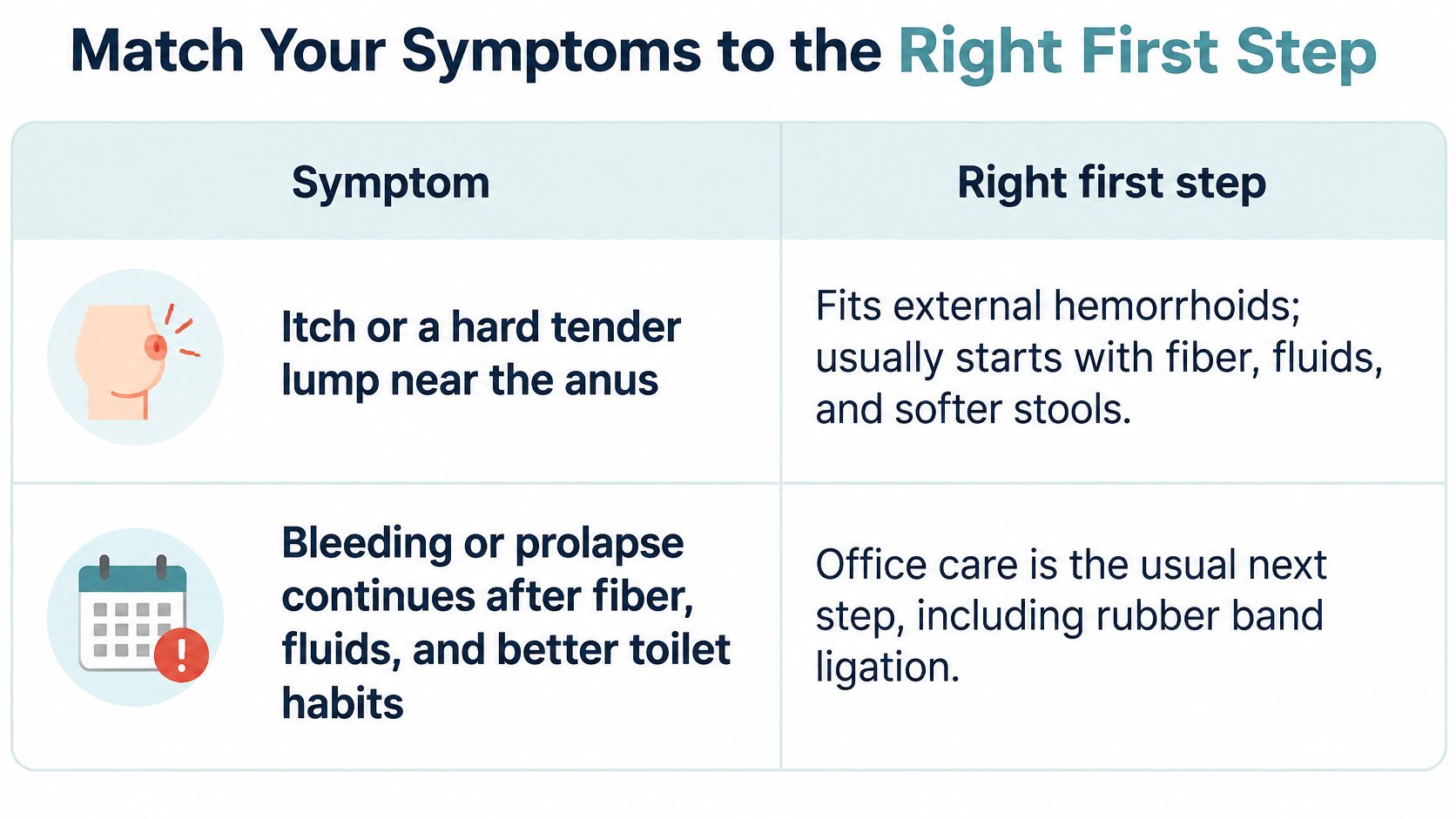
Read the pattern without guessing the diagnosis
An itchy external lump may make sitting uncomfortable, but a sudden increase in pain changes the decision. Don't assume every painful lump needs only more numbing cream.
Bright red blood can look reassuring because it seems to come from close to the opening. Its color still doesn't tell you the cause with certainty, so note it and contact a healthcare provider rather than using symptom relief as a test.
Prolapse means tissue comes through the anal opening. Whether it returns by itself or remains outside is useful information for the clinician; you don't need to assign it a medical grade yourself.
Sharp, cutting pain during stool passage deserves its own description. Calling everything hemorrhoid pain can hide a fissure-like pattern that needs a different assessment.
Pregnancy and recent childbirth also change product decisions. Start with your obstetric clinician rather than assuming a familiar OTC product is automatically appropriate.
Choose the row that best matches today's symptoms. Use the home plan for mild discomfort without urgent warning signs, not as a reason to postpone assessment of bleeding or significant pain.
Run a One Week Home Relief Plan
Start with stool consistency and bathroom habits. The NIDDK's hemorrhoid treatment guidance recommends fiber, fluids, less straining, shorter toilet visits, and warm baths. Over-the-counter products are generally used for about one week; consult a healthcare professional if symptoms persist.
Use this checklist to keep bowel care at the center of your routine.
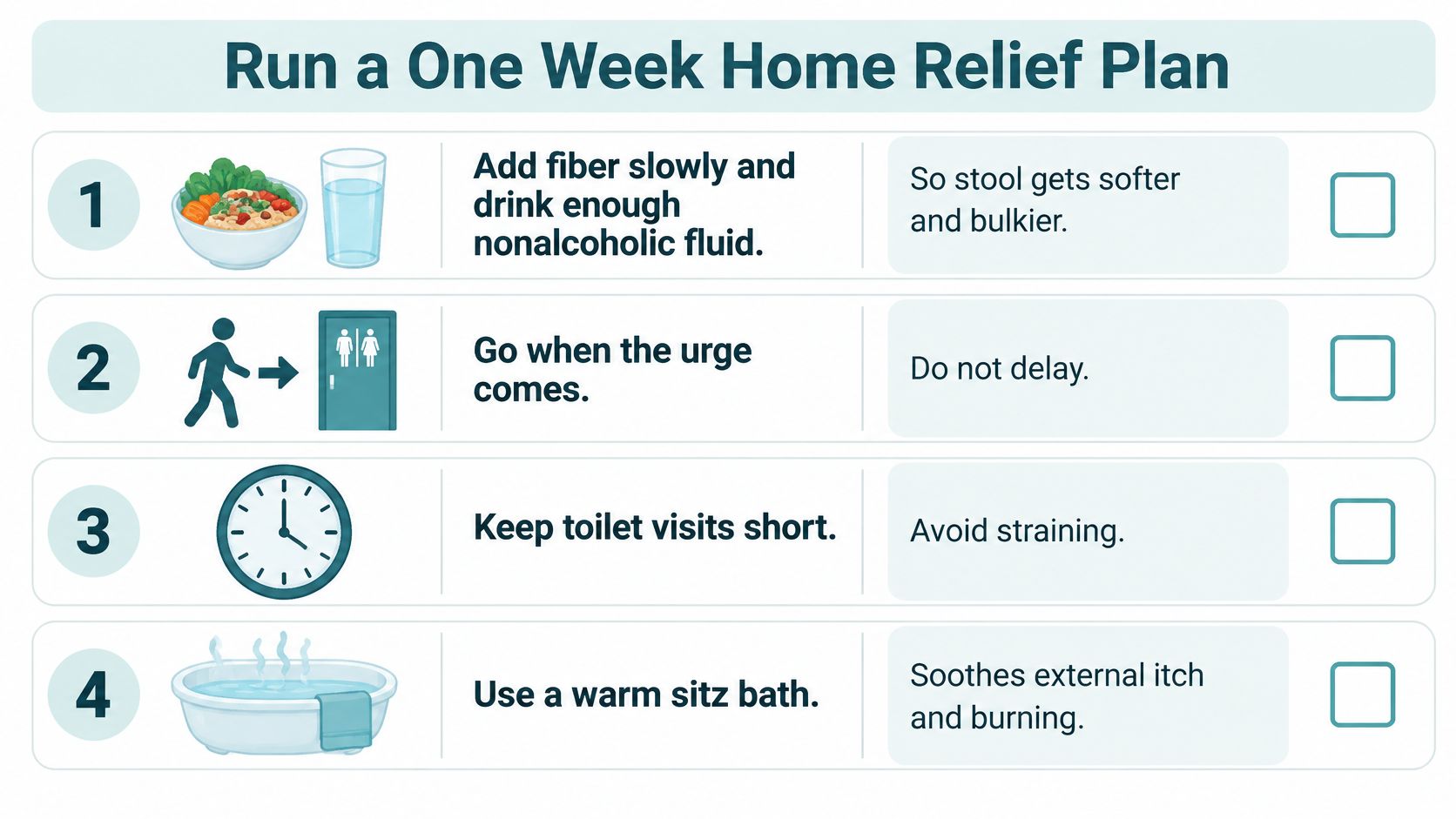
Make bowel movements easier
- Add fiber gradually and drink adequate fluids. Try oatmeal at breakfast, beans with lunch, or fruit instead of a low-fiber snack. Increase fiber slowly to avoid an abrupt change. If you have a prescribed fluid restriction, follow your clinician's guidance.
- Go when the urge comes and avoid pushing. Keep your phone away from the toilet so a bowel movement doesn't turn into an extended sitting session. If stool won't pass easily, don't keep bearing down. Hard stool and repeated pressure can continue to irritate the area.
- Use comfortably warm water. A sitz-bath basin or clean bathtub can provide a warm soak several times a day for comfort. Plain water is a reasonable starting point; hot water and fragranced additions aren't necessary. A soak doesn't identify the source of rectal bleeding.
Keep external care gentle
- Clean without scrubbing. Wash with mild soap and warm water, rinse thoroughly, and pat dry. Avoid rubbing with a towel or repeatedly wiping to feel completely clean. More friction can irritate the area.
- Use an OTC product only as its label directs. Revivol-XR® Advanced Hemorrhoid & Fissure Cream costs $26.99 for a 1.5 oz tube. It contains 5% lidocaine for temporary relief, 0.25% phenylephrine to help temporarily reduce swelling, and skin protectants. After cleansing, spread a thin layer over the affected external area. Stop using the cream and ask a doctor if rectal bleeding occurs, the condition worsens or does not improve within 7 days, or an allergic reaction occurs.
- Check before adding medicines. Ask a pharmacist whether a fiber supplement or stool softener fits your situation. Before using the cream, consult a health professional if you're pregnant or breastfeeding. Ask a doctor or pharmacist if you take prescription medicine for high blood pressure or depression. The cream's label also advises medical consultation for heart disease, high blood pressure, thyroid disease, diabetes, or prostate-related difficulty urinating.
For another explanation of hemorrhoid care, use this video alongside the written steps.
Tonight, keep it simple: drink appropriate fluids, make a small fiber increase, and take a warm soak. Severe pain, ongoing blood, or troublesome prolapse calls for medical advice rather than extra days of self-treatment.
Care for Pregnancy and Postpartum Lumps
A new lump around childbirth can feel like one more problem during an already demanding recovery. It deserves attention without the assumption that every lump needs removal.
In a clinical study of 280 women, 123 women, or 43.9%, developed a perianal condition during pregnancy or after delivery; hemorrhoids alone affected 114 women, or 40.7%. The same study reported both hemorrhoids and a fissure in 2.5%, a fissure alone in 0.71%, and symptom onset in the third trimester in 61%, after delivery in 34.1%, and one month after delivery in 3.3%.
Why the timing matters
A clinical review of pregnancy and postpartum perianal disease describes hemorrhoids and anal fissures in about 40% of pregnant and postpartum women, with hemorrhoids reported in 37.9% after a first pregnancy, 38.4% after two pregnancies, and 40% after three or more. That review places 61% of onsets in the third trimester and 34% on the first or second day after delivery.
These findings describe study populations, not your personal likelihood or diagnosis. They help explain why clinicians take late-pregnancy and early-postpartum anal symptoms seriously.
Constipation, previous hemorrhoids or fissures, and delivery-related pressure are useful parts of your history. Tell your obstetric clinician about iron supplements, prescription pain medicines, and any difficulty passing stool.
A postpartum lump is a reason to ask for guidance, not proof that you need a procedure.
Put recovery and product safety together
- Start with stool comfort: Keep fiber, fluids, and an individualized bowel plan consistent rather than waiting until stool becomes painful.
- Reduce pressure: Avoid straining and extended toilet sitting. Warm soaks may make external discomfort easier to manage.
- Check every product: Ask the obstetric clinician before using an OTC cream while pregnant or breastfeeding. Familiar ingredients aren't automatically suitable for every person.
- Escalate significant symptoms: Severe pain, a hard clot-like lump, or continuing bleeding warrants same-day clinical advice or assessment.
A review of postpartum prevention and care notes that surgery is usually deferred during pregnancy, with conservative measures emphasized first. Many symptoms improve after delivery, but persistent prolapse or bleeding still deserves review.
Our guide to relief for hemorrhoids after childbirth offers additional recovery-focused guidance to discuss with your maternity care team.
Know When Bleeding Needs a Clinician
Treat new or recurring rectal bleeding as a question for a clinician, not a settled explanation. Before the visit, note when it happens, what the blood looks like, and whether your bowel habits or symptoms have changed. A symptom log gives the clinician a clearer picture than a single episode recalled from memory.
Prepare for the conversation
The American Academy of Family Physicians guideline summary supports considering colonoscopy when there is no obvious bleeding source, abdominal pain, new or worsening constipation, or continued bleeding after hemorrhoid treatment. Adults over 45, people with colorectal cancer risk factors, and those with new or changing symptoms may need particular attention.
Bring a list of prescription medicines, over-the-counter products, and supplements. Mention any personal or family history of colorectal cancer or polyps, and describe changes in bowel habits or abdominal discomfort. If you take an anticoagulant or antiplatelet medicine, don't stop it on your own. Ask the prescribing clinician what to do, and use these questions about hemorrhoids and blood thinners to prepare for that conversation.
You can ask what the examination is meant to check and what findings would lead to further testing. An anoscopy uses a small viewing instrument to examine the anal canal for internal hemorrhoids and other local abnormalities. A colonoscopy examines farther into the colon and may be considered when the history or examination leaves the bleeding source uncertain.
Safety rule: Heavy bleeding, fainting, dizziness, marked weakness, or severe constant pain needs urgent assessment.
Seek same-day care for significant symptoms. Heavy bleeding with faintness or weakness calls for emergency care; don't drive yourself if you feel faint. A brief home trial may suit mild discomfort, but persistent bleeding still deserves clinical evaluation.
Office Care Before an Operating Room
Persistent bleeding or prolapse after consistent bowel care usually opens a conversation about office treatment. For suitable internal hemorrhoids, a clinician may discuss an office procedure such as rubber-band ligation.
During banding, the clinician places a small elastic band around the base of the internal hemorrhoidal tissue. The band cuts off its blood supply, so the tissue shrivels and separates. Healing leaves scar tissue that helps hold the lining in position.
This visual shows where an office assessment fits between conservative care and an operation.
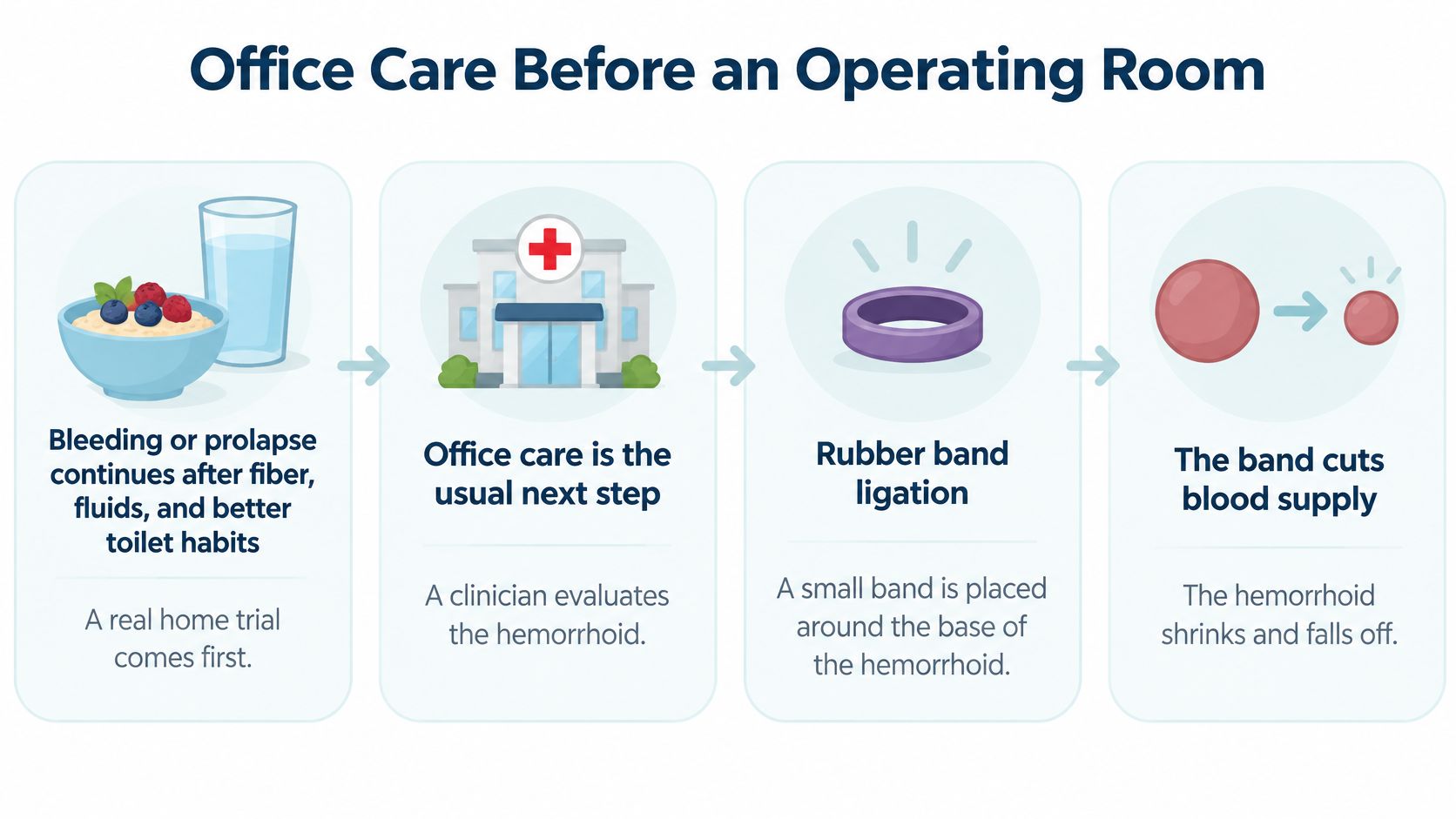
Why placement and tissue type matter
The band must sit above the dentate line, an anatomical boundary inside the anal canal. Tissue below it has a different pain supply, so incorrect placement can cause substantial pain. Banding is performed by a clinician, never at home.
The American Society of Colon and Rectal Surgeons management guideline recommends office procedures for most symptomatic grade I or II hemorrhoids and selected grade III cases that have not responded to conservative treatment. It identifies banding as the most effective office-based option.
These grades describe internal hemorrhoid behavior, especially prolapse. They are not a pain score, and you do not need to grade your symptoms before making an appointment.
A painful thrombosed external hemorrhoid, an external hemorrhoid containing a clot, is a different problem. It needs a timely examination because internal banding does not address every type of hemorrhoid.
Ask about the purpose before the price
Ask the clinician what symptoms an office procedure is meant to address and how it compares with an operation for your situation. Surgery may be considered for substantial external disease, more advanced combined disease, or symptoms that remain troublesome despite other care.
For a local cost reference, MDsave's published cash listing gave a 2024 hemorrhoidectomy price near Los Angeles, ZIP 90017, of $7,341. This is a published cash listing, not a personal quote or a current guarantee.
Before agreeing to a procedure, ask:
- What is included? Check whether the quoted amount covers the clinician, facility, anesthesia, and follow-up.
- What will insurance cover? Confirm network status, authorization requirements, and your expected share directly.
- Why this procedure? Ask which symptom it should address and whether an office option is appropriate.
There is no banding price to compare here. The first decision is whether persistent bleeding or prolapse after conservative care warrants a discussion about office treatment.
Choose a Los Angeles Clinician With a Short Script
Which Los Angeles clinician to call
| Setting | Best fit | What to expect | Not the best first stop when |
|---|---|---|---|
| Primary care | Mild itch, a small lump, or a first look at bleeding | History, examination, and referral if needed | Heavy bleeding or fainting |
| OB clinician | Pregnancy or the weeks after birth | Individualized bowel plan and a check before OTC use | You need emergency bleeding care |
| Gastroenterologist | Unexplained bleeding, screening questions, or changing bowel habits | Assessment of whether colonoscopy is needed | You mainly need a procedure-focused prolapse assessment |
| Colorectal surgeon | Prolapse, bleeding after home care, or a procedure question | Anoscopy and possible office treatment | Symptoms are mild and brand new |
| Urgent care or emergency care | Heavy bleeding, dizziness, or severe constant pain | Same-day evaluation | You only need a routine fiber plan |
These roles overlap. Some gastroenterologists perform banding, and colorectal surgeons also provide nonsurgical care. The office's actual services matter more than assumptions about the specialty name.
Book the visit that answers your question
Search the clinician type plus Los Angeles, then confirm the office sees anorectal problems. Ask whether anoscopy or banding is available when appropriate, or whether the appointment is consultation only.
With traffic, childcare, and time off work to consider, a short call can prevent an unnecessary second trip. Confirm insurance requirements before booking, especially if you need a referral.
Use this phone script, filling in your own details:
- Duration: “My symptoms started around ___ and are improving, staying the same, or getting worse.”
- Bleeding: “I've noticed bright red blood, darker blood, or no blood.”
- Pain: “The pain happens during bowel movements, continues afterward, or is mainly itching.”
- Prolapse: “Tissue comes out and returns itself, needs help returning, or stays out.”
- Pregnancy or birth: “I'm pregnant, recently gave birth, or neither applies.”
- What you've tried: “I've used these medicines and bowel-care steps, including OTC products for ___ days.”
For more help understanding specialty names, see our guide to who treats hemorrhoids.
Common questions before booking
Can I start with primary care?
Yes. Primary care can assess a first episode, examine the area, and refer you when the findings call for specialist care.
Does a colorectal surgeon appointment mean surgery?
No. The appointment may lead to bowel-care changes, additional testing, or office treatment rather than an operation.
Should a postpartum lump go straight to a surgeon?
Usually, your obstetric clinician is a practical first contact. Significant pain or bleeding changes the urgency, so explain those symptoms when you call rather than waiting for a routine postpartum visit.
The best first appointment is the one that answers your immediate question safely. You don't need to arrive certain that you have hemorrhoids.
Revivol-XR offers OTC options for temporary soothing relief and comfort alongside practical education about anorectal symptoms. Visit Revivol-XR to review product labels and comfort-care information while choosing the right Los Angeles care setting for your symptoms. Consult a healthcare provider for persistent, severe, or bleeding symptoms rather than extending self-care alone.