Hemorrhoids and Blood Thinners: When to Call

Hemorrhoids and blood thinners do not mean you stop the medicine yourself. Small bright-red streaks still need a report to your clinician, while heavy, black, maroon, or dizzying bleeding needs urgent care.
The advice circulating on message boards gets this backwards. Someone posts about pink toilet paper, three strangers say to skip a pill until it settles, and the poster feels handled. That's the most dangerous piece of hemorrhoid advice a person on an anticoagulant can follow. The thinner didn't create the hemorrhoid, a skipped dose won't tell you whether the bleeding even comes from a hemorrhoid, and the gap you open in your clot protection is real.
What decides your next move is the pattern of the bleeding, the name of the drug, and the reason you're on it. Those three things carry more weight than the color of the blood. This guide walks through which bleeds need a call tonight, which need an emergency department, why a red streak doesn't prove its own source, and how a colorectal team picks treatment when your medicine can't safely be paused.
Table of Contents
- Bleeding Patterns That Need a Call
- Whether to Keep Taking Your Blood Thinner
- Comfort Steps That Do Not Replace a Call
- Why Blood Thinners Change Hemorrhoid Bleeding
- Procedures When the Medicine Cannot Stop
- What to Tell Your Clinician Next
Bleeding Patterns That Need a Call
A blood thinner can turn a small hemorrhoid streak into something that keeps spotting for hours, and stopping the pill on your own can be more dangerous than the streak. The pattern in front of you decides which of those two problems you're dealing with. Color alone won't do it.
Bright-red blood on the paper can still be a hemorrhoid. Paper is not a diagnosis, and that distinction matters more, not less, when your blood clots slowly. The University of Michigan anticoagulation guidance tells patients to report rectal bleeding to both their regular clinician and their anticoagulation-management team. It separates small amounts of bright-red blood on toilet paper from patterns that need attention quickly: bright-red blood in the toilet water, maroon stool, or black, tar-like stool. The same guidance notes your clinician may want to check your INR, a blood test that measures how quickly your blood clots, along with other testing to find where the blood is coming from.
Read that as a decision, not a description. A streak on paper is a phone call. Blood in the bowl is a same-day visit. Black stool is the emergency department.
Rectal bleeding on a blood thinner and what to do
| What you see | How urgent | What to do now | Do not do |
|---|---|---|---|
| Small bright-red streaks on toilet paper only | Report promptly | Call your clinician and anticoagulation team the same day | Don't assume it's only a hemorrhoid, and don't skip the call |
| Bright-red blood in the toilet water | Same-day or urgent | Seek same-day medical care | Don't wait for the next routine visit |
| Maroon stool | Urgent | Get urgent evaluation for a source that may not be a hemorrhoid | Don't treat it as a simple flare |
| Black, tar-like stool | Emergency | Go to emergency care | Don't blame iron pills or food without a clinician |
| Clots, bleeding that won't stop, dizziness, weakness, fainting, or a racing heart | Emergency | Call emergency services | Don't drive yourself if you feel faint |
| Bleeding after a recent banding, injection, or hemorrhoid surgery, even days later | Urgent | Contact the surgeon or go to emergency care | Don't restart, skip, or double a dose on your own |
Three scenes, not diagnoses
One dime-sized streak, one calm person. Say a 68-year-old on apixaban for atrial fibrillation sees a single dime-sized bright-red streak, feels completely well, and had a soft stool that morning. The move is a same-day call to the prescriber and the anticoagulation team, with the usual dose kept unless someone says otherwise. Not a skipped pill, and not a wait for the annual visit.
Dizziness with blood in the bowl. Now picture someone with a mechanical heart valve on warfarin who feels lightheaded and sees bright-red blood in the toilet water. That's emergency care. A mechanical valve doesn't forgive a missed dose, and the lightheadedness hints at more lost volume than a streak suggests.
Bleeding after banding, days later. Someone on clopidogrel had a rubber band placed on Monday, felt fine all week, and notices blood on Saturday. That's a call to the surgeon the same day. The banded tissue dies and separates after several days, and that's the window when a slow clotter bleeds. Feeling good on Wednesday says nothing about Saturday.
The drug changes the plan, not just the color. The same red streak means a phone call for one person and an emergency visit for another, because the drug name and the clot risk behind it are half the triage.
Save the row that matches what you saw. Screenshot it. Bring your medicine bottle with the label readable to the call, because a good half of the triage happens the moment the clinician hears which drug and which dose.
Whether to Keep Taking Your Blood Thinner
Hemorrhoids and blood thinners do not automatically mean you stop the drug or get a reversal drug. That one line contradicts most of what a nervous search turns up at two in the morning, and it's the line worth keeping.
The checklist below is the version to screenshot before you fall down a forum hole.
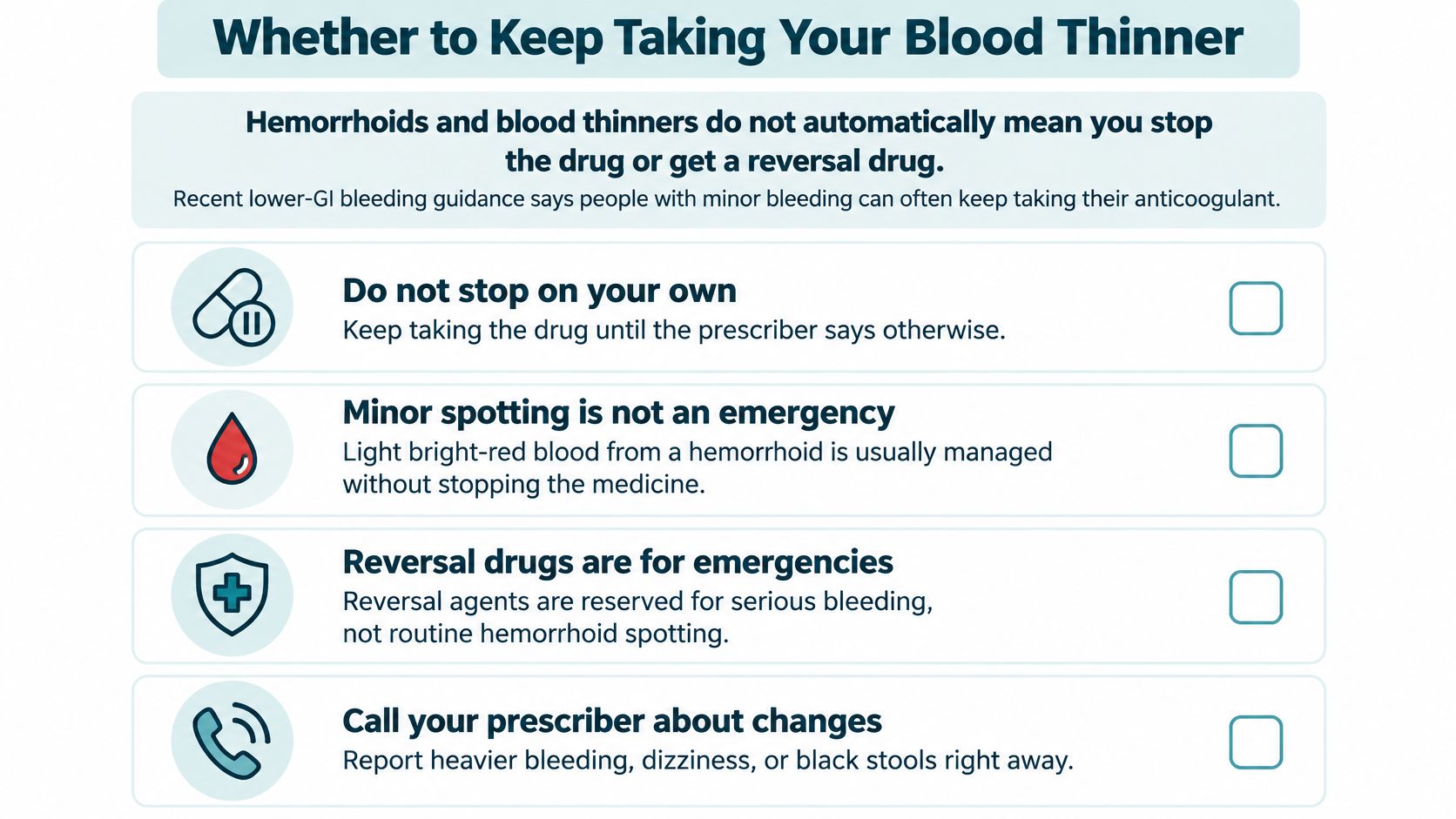
Recent guidance on managing acute lower gastrointestinal bleeding supports a more careful version of that idea. People with minor bleeding who are unlikely to need a hospital procedure may keep taking oral anticoagulation when it's medically necessary. Heavier bleeding generally means holding treatment at admission. Anticoagulation is typically restarted once bleeding stops, because resumption lowers the risk of thromboembolism and death. Reversal agents belong to selected, usually life-threatening bleeding, not to a routine hemorrhoid streak.
The three questions your clinician asks
- How heavy is the bleed? A streak that stops on its own is a different event from blood in the bowl with clots and dizziness.
- Which drug, which dose? Warfarin is tracked by an INR target. Apixaban, rivaroxaban, and dabigatran clear at different speeds. Aspirin and clopidogrel work on platelets instead of the clotting cascade.
- Why are you taking it? Atrial fibrillation, a prior clot, a mechanical heart valve, and a recent stent are the four reasons a pause can turn dangerous fast.
Say the names out loud, exactly as printed: warfarin and your INR target, apixaban, rivaroxaban, dabigatran, aspirin, clopidogrel, and any combination your prescriber built. Combination therapy is where risk stacks.
Skipping a dose to see whether the blood stops isn't a home test. It's an experiment on the one person whose clot risk nobody can measure from a bathroom, and the result tells you nothing about the source.
| Bleeding situation | Usual medication move | Why | Who decides |
|---|---|---|---|
| Minor streaks, unlikely to need a hospital procedure | Continue oral anticoagulation when medically necessary | A pause can raise clot risk | Prescribing clinician |
| Heavier bleeding that needs hospital admission | Hold treatment on admission in most cases | Active bleeding is the immediate danger | Hospital team |
| Bleeding has stopped | Restart, because resumption lowers thromboembolism and death risk | A long pause has its own harm | Prescriber with the care team |
| Life-threatening bleeding | Reversal only in selected cases, not for a routine hemorrhoid streak | Reversal isn't routine hemorrhoid care | Emergency clinicians |
| Skipping or doubling a dose at home to see if the blood stops | Do not | A missed dose isn't a home test | Call the prescriber instead |
What you can do tonight takes three minutes. Keep the usual dose unless a clinician already changed it. Write down the exact time of your last dose. Then call the prescriber's office, not a friend or a forum.
Comfort Steps That Do Not Replace a Call
Home care is comfort. It is not a fix for the bleed, and it is never a reason to delay the call described above. Nothing in this routine changes the medication plan.
- Keep the prescribed blood thinner unless the prescriber changes it. The dose stays exactly where it is while the conversation happens.
- Soften the stool with fluids, fiber from food, and a stool softener your clinician approves. Straining is what nicks the surface in the first place.
- Cap toilet time at a few minutes and leave the phone outside the bathroom. Long sits under pressure do more damage than many realize.
- Clean gently. Warm water or a soft lotion, then pat dry. Scrubbing irritated skin makes the itch worse and keeps it going.
- Take a warm soak. A few inches of warm water for about ten to fifteen minutes settles spasm and cleans the area, and this warm sitz bath routine explains the setup. Our Revivol-XR® Sitz Bath Soak Mix mixes Epsom salt with 19 other ingredients, including Dead Sea salt, witch hazel, aloe vera, and chamomile oil, in a pre-measured pouch you add to the water.
- If a clinician approves an external OTC product, use it on the outside only, exactly as the Drug Facts label directs.
A protectant plus a soothing botanical feel, like aloe or witch hazel in a monograph hemorrhoid cream, can coat irritated skin. Lidocaine can temporarily numb pain and itch. Phenylephrine products that shrink tissue carry extra warnings for heart disease, high blood pressure, thyroid disease, diabetes, and some blood-pressure or depression medicines, so ask before you use one.
Two lines on the label that matter more than the marketing. Stop and ask a doctor if bleeding occurs, symptoms worsen, or nothing improves within 7 days. Never insert cream with a finger or any device.
Comfort care buys you a calmer day. It never substitutes for the call.
Why Blood Thinners Change Hemorrhoid Bleeding
Start with the vein, not the pill
Hemorrhoids are swollen vein cushions in and around the anal canal, closer to varicose veins than to a growth. Everyone has that tissue, and it helps control bowel movements until pressure stretches it. A hard stool dragged across the surface, or a long strain that pushes the cushion out, leaves a small nick and bright-red blood on paper or in the bowl.
What the medicine actually does
The word "blood thinner" covers two different families. Anticoagulants such as warfarin, apixaban, rivaroxaban, and dabigatran slow the clotting cascade, the chain of proteins that turns a soft plug into a firm clot. Antiplatelets such as aspirin and clopidogrel make platelets less sticky, so the first plug forms poorly.
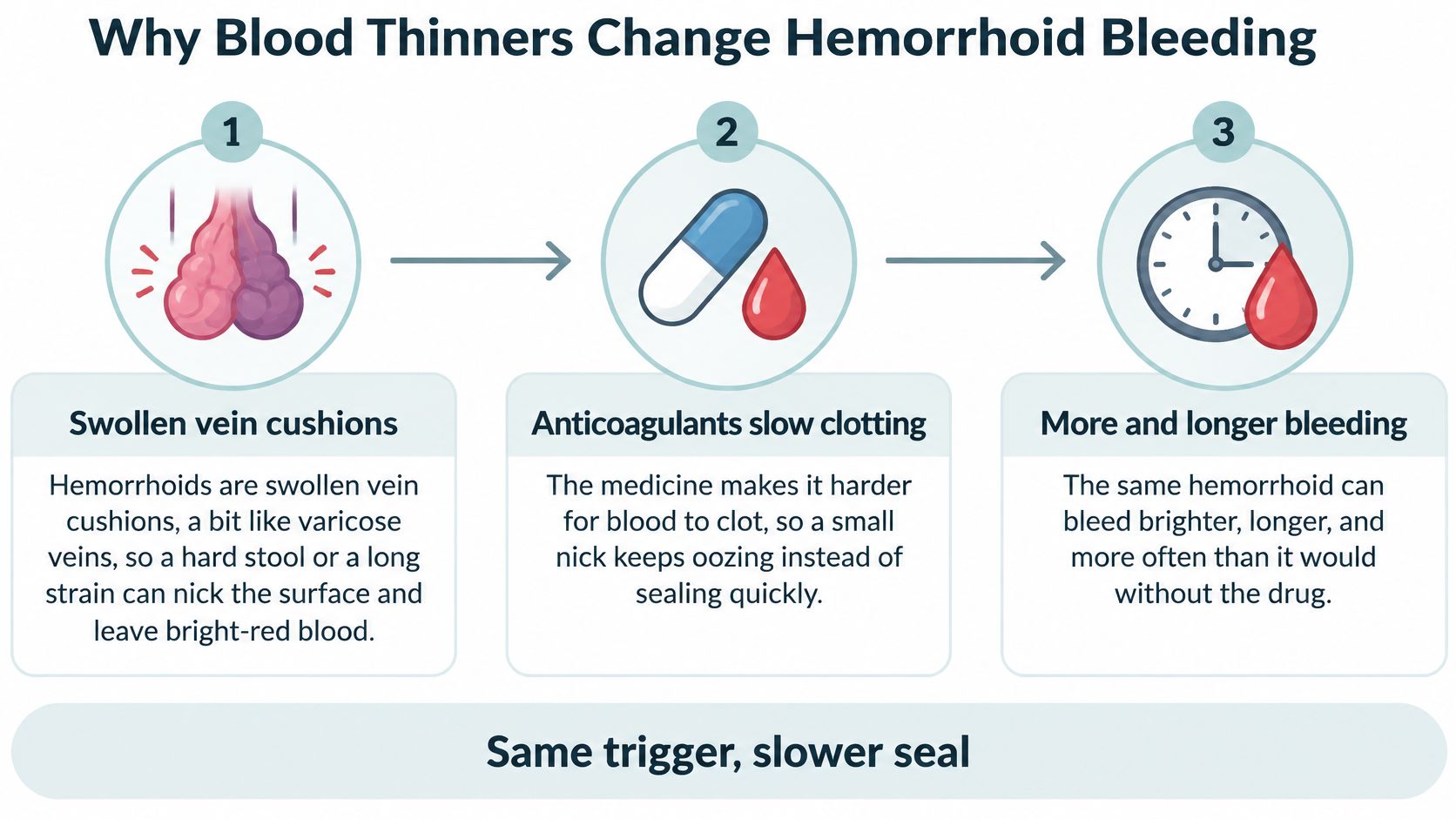
Neither drug creates a hemorrhoid. Both make an existing nick seal slower, ooze longer, and look heavier than it would have a year ago. Which drug you take, and at what dose, changes how long that takes.
And here's the part that gets lost: the pill did not name the source. An anal fissure, a colorectal polyp, inflammatory bowel disease, diverticular bleeding, and colorectal cancer all produce blood that looks similar on paper. On a blood thinner, those look-alikes matter more, not less, because they can bleed more too.
Common enough to matter
Bright-red streaks get waved off partly because hemorrhoids are everywhere. A 2025 systematic review and meta-analysis estimated a global pooled point prevalence of 25.92%, meaning roughly one in four people met that study's definition at a given point in time. That's a lot of people seeing red on a Tuesday and deciding it's nothing.
A cream can soothe local itch or soreness. It cannot tell a hemorrhoid from another source, and it cannot read your INR. If you want the plain-language walkthrough of how clinicians think about clotting speed, this short explainer is worth four minutes:
Procedures When the Medicine Cannot Stop
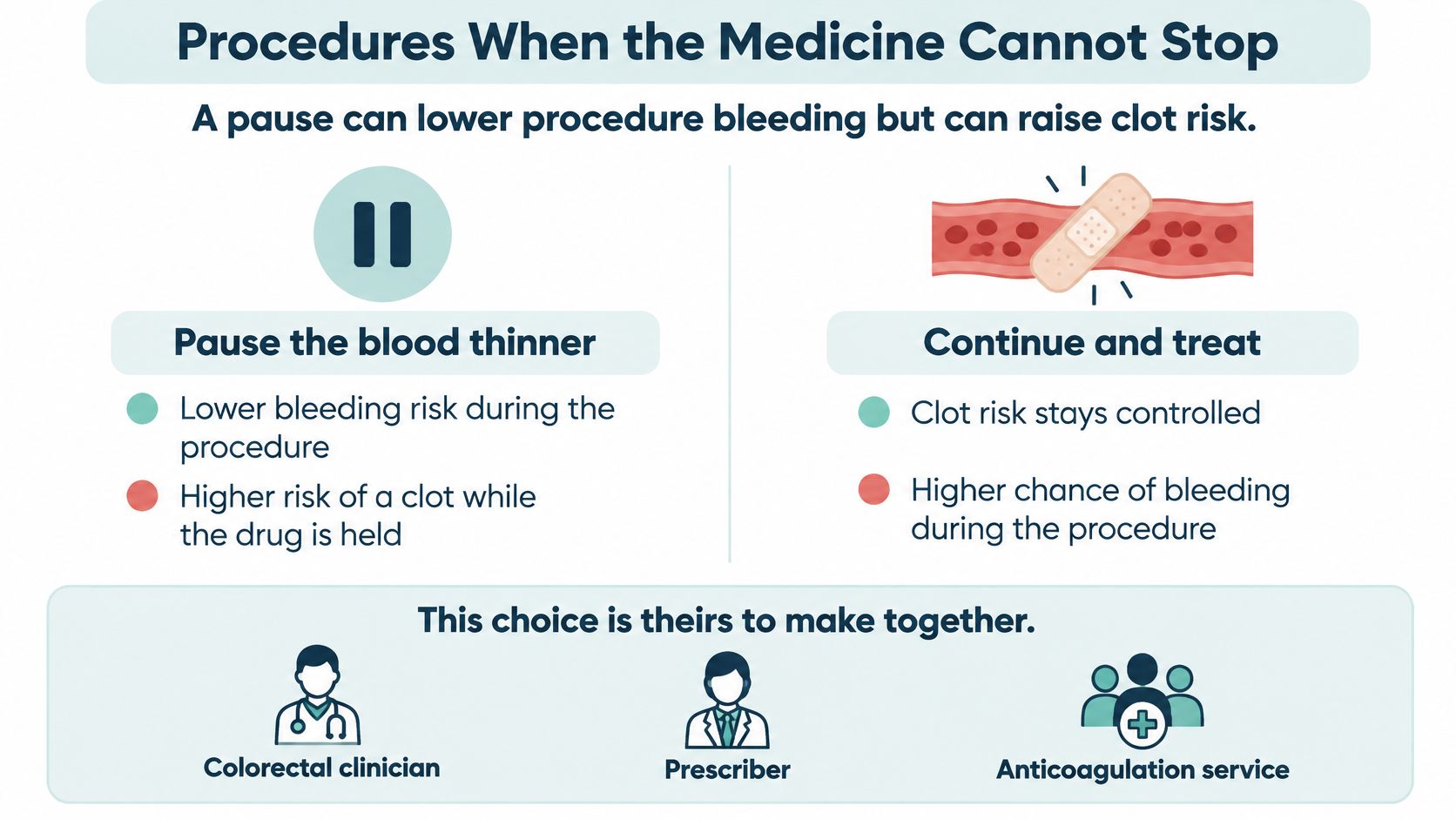
This choice isn't yours to make alone, and it isn't the surgeon's either. It belongs to the colorectal clinician, the prescriber, and sometimes an anticoagulation service, working from one tradeoff: a pause can lower bleeding during the procedure, and the same pause can raise clot risk in atrial fibrillation, after a prior clot, or with a mechanical valve.
The infographic below frames what each side of that tradeoff costs.
| Option | Usual fit | Bleeding concern on a blood thinner | Who decides |
|---|---|---|---|
| Conservative care | Low-grade symptoms, mild bleeding, high clot risk | Lowest procedure risk because there's no wound or ligation scab | Clinician, after the bleeding source is considered |
| Injection sclerotherapy | Selected people who need treatment and can't pause medicine | The 2024 ASCRS guidance suggests it may be considered in selected anticoagulated patients | Procedural team with the prescriber |
| Rubber-band ligation | Often used when medicine can be managed around the visit | May raise major bleeding risk, and it's relatively contraindicated for many anticoagulant or antiplatelet users because the scab can bleed days later | Clinician, not a walk-in choice |
| Hemorrhoidectomy or other surgery | Higher-grade or refractory disease | Antithrombotic use is linked to more postoperative and delayed bleeding, and restart timing is individualized | Surgeon, prescriber, and sometimes an anticoagulation service |
The 2024 American Society of Colon and Rectal Surgeons guidance notes that anticoagulant and antiplatelet therapy may increase the risk of major bleeding after rubber-band ligation, that the timing of stopping and restarting remains uncertain, and that injection sclerotherapy may be considered in selected anticoagulated patients. A 2025 international consensus goes further and calls banding relatively contraindicated in anticoagulant or antiplatelet users, naming polidocanol foam, ALTA, or sclerobanding as possible options for stubborn bleeding when the medicine can't be stopped, while saying plainly that stronger evidence is still needed.
Why delayed bleeding is the one to plan for
After banding, a scab forms over the treated tissue and separates days later. That's the classic bleed, and it arrives when the person already feels fine. In a series of 113 patients undergoing proctological surgery, secondary bleeding occurred in 39% of patients on antithrombotic medication versus 2.4% of those not on it, with a median onset on postoperative day 5 and a range of 0 to 11 days. In that same series, direct oral anticoagulants came with the greatest bleeding severity and aspirin with the lowest.
Larger numbers point the same direction. A review of 1,152 hemorrhoid procedures from 2016 through 2018 found postoperative bleeding in 5.92% of patients on antithrombotic medication versus 2.66% of those not on it. And a 10-year retrospective analysis of 1,469 hemorrhoidectomies reported delayed bleeding in 5.2% of cases, with anticoagulation carrying an adjusted odds ratio of 4.5 (95% confidence interval, 2.1 to 10.0). In that review, 47% of delayed bleeding events needed another operation.
Why you can't copy a restart date
One finding looks backwards until you see the trap. Restarting a novel oral anticoagulant later than 3 days after surgery was linked to bleeding in 61.5% of patients versus 10.5% with an earlier restart. That's confounding by indication: clinicians delay the restart precisely because the patient looks higher risk. Which means a restart day from an article is not a plan. Compare your own choices across hemorrhoid treatment options only with your team in the room.
Your job is narrow and useful. Hand over the exact names and doses, and let the team decide interruption, bridging, and restart.
What to Tell Your Clinician Next
Picture the same person on the same toilet at midnight. The useful move isn't a silent dose change. It's a clear report that lets someone who knows your clot risk make a fast call.
Bring this to the conversation:
- Every blood thinner and antiplatelet, with dose and the exact time you last took it
- Other drugs and supplements, including anything you bought without a prescription
- A photo or written note of stool color, because memory is unreliable at 2 a.m.
- Any dizziness, fainting, or clots you noticed, even if it passed
- Prior banding, injection, or hemorrhoid surgery, with the date
- Pregnancy or a recent birth, since that changes the options
- How long the symptoms have lasted, and whether they're improving
Ask three things directly: what's the likely source of this bleeding, should this exact medicine continue, and is any office procedure safe without a pause. The ASCRS evidence-based guideline summary is blunt that patients should supply the exact names and doses of warfarin, apixaban, rivaroxaban, dabigatran, aspirin, or clopidogrel before any hemorrhoid procedure. If you're still deciding which clinician handles hemorrhoid care, start with the prescriber who manages the blood thinner.
Once that conversation is done, external soreness is a separate, smaller problem. Revivol-XR® Advanced Hemorrhoid & Fissure Cream is an OTC monograph product built for temporary soothing relief, with 5% lidocaine, 0.25% phenylephrine, and glycerin and petrolatum protectants. It goes on outside skin only, up to 4 times a day unless a professional directs otherwise. It isn't for anyone with a history of allergic reaction to local anesthetics or vasoconstrictors, and it doesn't treat, cure, or prevent bleeding or any disease.
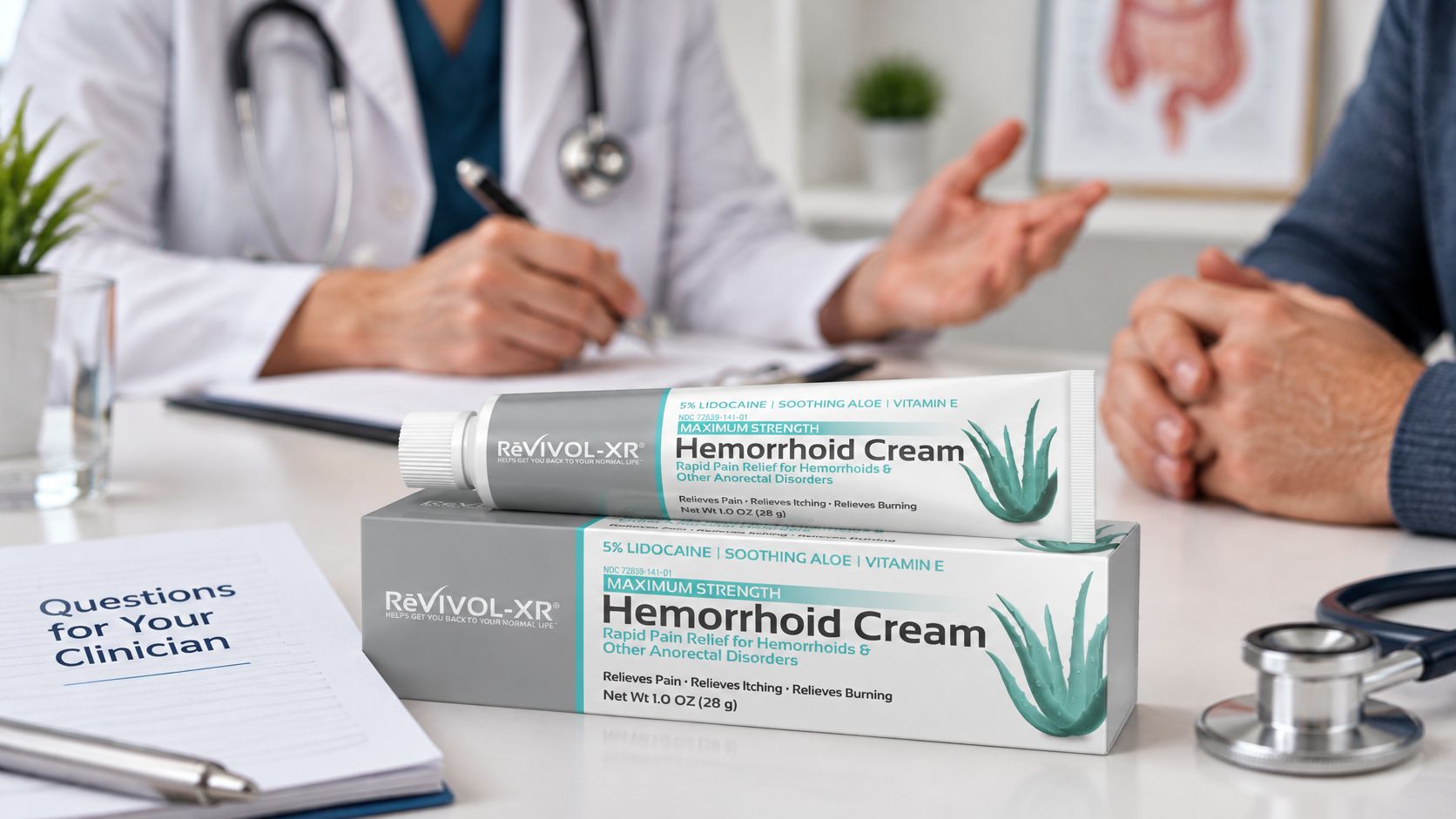
Stop using it and ask a doctor if rectal bleeding occurs, the condition worsens or doesn't improve within 7 days, or an allergic reaction develops. Hemorrhoid.com is a LegitScript certified healthcare merchant, and articles here run under the shared byline Revivol-XR Editorial Team rather than a claim of individual doctor review.
Make the call before the next dose decision, not after.
If you're looking for temporary comfort while you sort out the bigger question with your clinician, Revivol-XR makes OTC products for exactly that in-between stretch: a soothing sitz soak, a protectant cream with 5% lidocaine, and a numbing option for sore external skin. None of them diagnose or treat the source of bleeding, and none of them replace the call. Start with Revivol-XR and bring the product label to your next appointment so your clinician can see everything you're using.