Best OTC Hemorrhoid Treatment Suppositories Worth Trying

Many hemorrhoid suppository buyers start by selecting a brand name, only to find it doesn't address the specific symptom causing them sleepless nights.
If you're comparing the best OTC hemorrhoid treatment suppositories, start with the location and pattern of your discomfort, not the box design. Internal pressure, post-bowel-movement pain, irritation, pregnancy, and postpartum recovery each call for a different trade-off.
Table of Contents
- What Internal Hemorrhoid Pain Actually Feels Like
- How OTC Hemorrhoid Suppositories Work Inside the Body
- Active Ingredients Compared Side by Side
- How to Insert a Suppository the Right Way
- When a Suppository Beats a Cream or Wipe
- Pregnancy and Postpartum Suppository Safety
- How to Choose the Right Suppository for Your Symptoms
- Suppository FAQs and When to See a Provider
What Internal Hemorrhoid Pain Actually Feels Like
Internal hemorrhoid discomfort often feels like an unfamiliar ache sitting just inside the rectum. You may notice pressure, burning, fullness, or a dull throbbing after a bowel movement, while the skin around the opening looks relatively normal. That's why an external cream can feel disappointing when the main problem is farther inside.
Internal and external symptoms can overlap, but the pattern still gives useful buying clues. Internal irritation may cause a sensation of incomplete emptying, pressure during sitting, or discomfort that flares after straining. External irritation tends to feel more like surface itching, rawness, swelling, or stinging when clothing or toilet paper touches the skin.
Bright red blood on toilet tissue or in the toilet can occur with hemorrhoids, but it shouldn't automatically be dismissed as routine irritation. Mayo Clinic's guidance on hemorrhoid symptoms and rectal bleeding advises medical evaluation when bleeding occurs during bowel movements or symptoms don't improve after home care. Large amounts of bleeding, dizziness, lightheadedness, or faintness require urgent attention.
Common triggers
Straining and constipation can increase pressure around the anal and rectal veins. Long periods of sitting may also make pressure and irritation more noticeable. Pregnancy adds physical pressure and can make constipation harder to manage, while childbirth can add another period of strain.
Pregnancy-related symptoms often cluster late in pregnancy and soon after delivery. A PubMed-indexed study identifies constipation, a personal history of hemorrhoids or fissures, a newborn birthweight above 3800 g, and pushing during delivery for more than 20 minutes as risk factors. The study on pregnancy and postpartum hemorrhoids and fissures is useful context for anyone whose symptoms appeared around childbirth.
The practical buying rule is simple: choose a suppository because your symptoms are internal and situation-specific, not because a package calls itself the best.
| Symptom pattern | Format that usually makes more sense | Why |
|---|---|---|
| Internal pressure or fullness | Suppository | Delivers the product inside the rectum |
| Surface itching or raw skin | Cream or wipe | Coats the external area more easily |
| Sharp pain after a bowel movement | Suppository plus external numbing support may be considered | Addresses internal and surface discomfort separately |
| Pregnancy or postpartum symptoms | Provider-guided product choice | Ingredient safety and diagnosis matter |
How OTC Hemorrhoid Suppositories Work Inside the Body
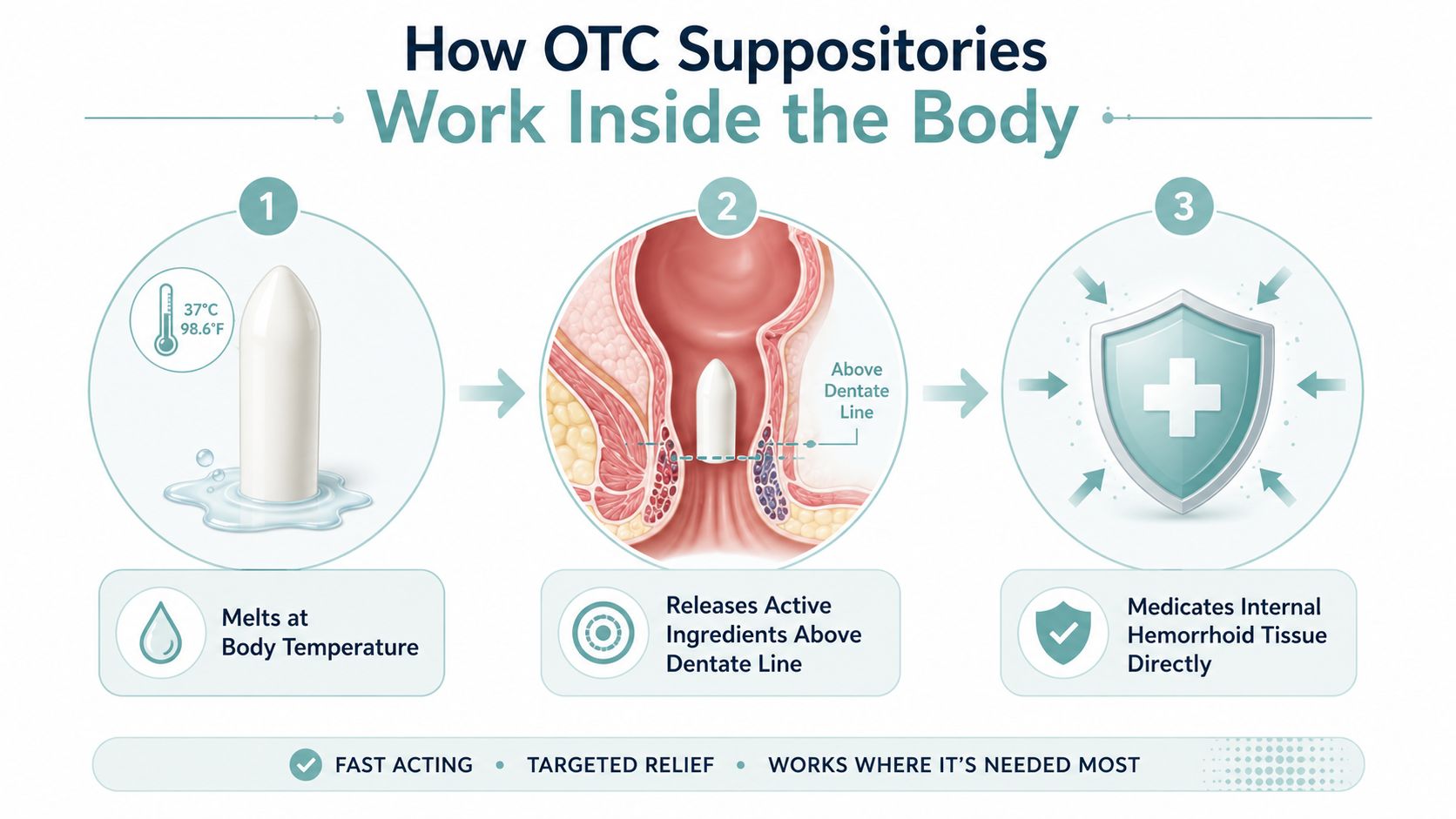
A suppository is a solid rectal dosage form designed to soften or melt after insertion. Its base helps carry the active ingredients into the rectal area, where internal symptoms occur. Creams and wipes mainly coat skin at or around the anal opening, so they may not provide the same contact with internal tissue.
Many phenylephrine-based OTC suppositories use 0.25% phenylephrine hydrochloride in a cocoa butter base. U.S. labeling describes temporary relief of itching, burning, and discomfort, along with protection for irritated anorectal tissue. It does not establish lasting resolution of the underlying hemorrhoid problem, as shown in the DailyMed labeling for a phenylephrine hemorrhoid suppository.
The base matters. Cocoa butter can soften with body heat and leave a protective coating, while other bases may be firmer or easier to handle when cool. Retention is also practical. A product that melts quickly may feel messy if you insert it immediately before walking around or having a bowel movement.
Suppositories versus external products
A suppository is most logical when pressure, internal irritation, or post-bowel-movement discomfort is the central complaint. A cream may be easier for external soreness, and a wipe may be more convenient for gentle cleansing, but neither format is automatically better for internal symptoms.
For a broader explanation of the delivery format, see how a suppository works for hemorrhoids. If you need external symptom support instead, Revivol-XR® Advanced Hemorrhoid Cream - 5% Lidocaine + Phenylephrine (Vasoconstrictor) - Fast Relief of Burning, Itching, Discomfort contains 5% lidocaine, 0.25% phenylephrine hydrochloride, glycerin, and petrolatum for temporary external symptom relief. Use it only according to its Drug Facts label.
Active Ingredients Compared Side by Side
Treat the active ingredient as the decision point. A suppository containing a vasoconstrictor serves a different purpose from one built mainly around a protective base. A numbing ingredient may be more useful for pain, while an astringent may suit irritation and moisture.
Phenylephrine products are designed to temporarily constrict blood vessels and reduce the sensation of swollen tissue. The key caution is relevant for people with conditions such as high blood pressure, heart disease, thyroid disease, diabetes, or prostate-related urination difficulty. Read the Drug Facts label and ask a pharmacist or healthcare provider before use if any warning applies to you.
Lidocaine is a topical anesthetic used for temporary numbing. It may suit burning or pain that dominates the symptom picture, but numbness can also make it harder to judge whether discomfort is worsening. Witch hazel and similar astringent ingredients are generally chosen for soothing and tightening sensations, while protectants form a barrier between irritated tissue and stool.
| Active ingredient | What it does | Best for | Key caution |
|---|---|---|---|
| Phenylephrine | Temporarily constricts blood vessels and supports relief from swollen-tissue symptoms | Internal pressure, fullness, and swelling sensations | Ask a pharmacist or provider if you have blood-pressure, heart, thyroid, diabetes, or urination concerns |
| Lidocaine | Temporarily numbs localized discomfort | Burning or pain after a bowel movement | Follow the label and seek advice if pain persists or worsens |
| Witch hazel or another astringent | Soothes irritation and provides an astringent effect | Itching, moisture, and mild surface or internal irritation | Stop if irritation develops |
| Protectants such as cocoa butter, lanolin, or zinc oxide | Coats and shields irritated tissue | Stool-related irritation, dryness, and nighttime comfort | They protect and soothe, but don't address every swelling or pain pattern |
A combination product can cover several symptoms, but more ingredients also mean more warnings to review. OTC products may combine witch hazel, phenylephrine, and lidocaine, as shown in this DailyMed-listed hemorrhoid spray formulation. More active ingredients don't automatically make a product the right choice for you.
How to Insert a Suppository the Right Way
Good technique makes a noticeable difference. The goal is gentle placement, enough retention time for the base to soften, and careful adherence to the product label.
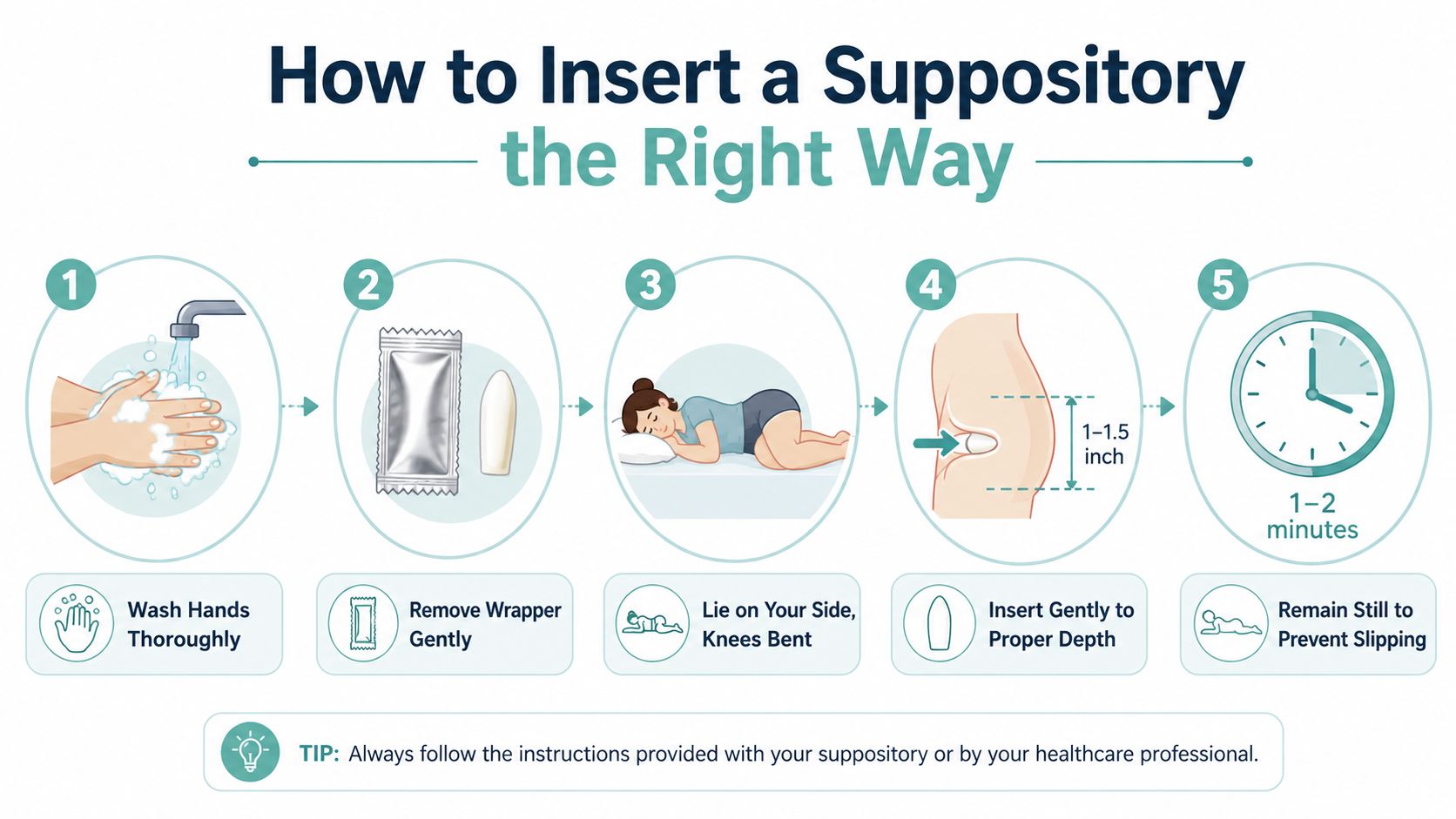
- Use the bathroom first. Insert after a bowel movement when possible, not immediately before one.
- Wash your hands and clean the area gently. Pat dry rather than rubbing.
- Remove the wrapper carefully. If the suppository feels soft, cool storage can firm it. Follow the package storage instructions.
- Lie on your side with your knees bent. This position relaxes the area and makes insertion easier.
- Use a small amount of water-based lubricant if needed. Avoid forcing the suppository or using anything that irritates mucous membranes.
- Insert gently, around 1 to 1.5 inches. Stop if you feel sharp pain or strong resistance.
- Remain still for at least 10 to 15 minutes. Lying down or sitting helps reduce slipping and leakage.
Don't double the amount after a missed application. Many phenylephrine suppository labels allow use up to 4 times daily, often at night, in the morning, or after bowel movements, but your package directions control.
If insertion causes increasing pain, bleeding, or persistent discomfort, stop and ask a healthcare provider. For a visual walkthrough, read how to use a suppository for hemorrhoids.
When a Suppository Beats a Cream or Wipe
A suppository wins when the symptom sits inside. Internal pressure, fullness, and a recurring post-bowel-movement flare are stronger reasons to choose rectal delivery than simple external itching.
A cream wins when the skin itself is sore, cracked, or burning at the opening. A wipe is useful for gentle cleaning when dry toilet paper makes irritation worse, but it should not replace medical evaluation for unexplained bleeding.
| Symptom | Suppository | Cream | Wipe |
|---|---|---|---|
| Internal pressure | Strong match | Limited reach unless the label allows internal use | Poor match |
| External itching | Possible, if internal symptoms coexist | Strong match | Useful for gentle cleansing |
| Post-bowel-movement throbbing | Useful for internal discomfort | Useful for surface pain | Helpful only for cleaning |
| Overnight flare | Convenient if retained before bed | Convenient for external symptoms | Usually less suitable |
| Pregnancy or postpartum symptoms | Requires ingredient review | Requires ingredient review | Can support gentle hygiene |
When combining formats makes sense
A person with internal swelling and external burning may reasonably discuss using a suppository for internal symptoms and a lidocaine cream externally. Apply the suppository first, then use the external product only as directed. Don't insert an external-only cream into the rectum unless its label specifically permits that route.
Postpartum recovery can make this distinction especially useful. A new parent may have internal pressure from hemorrhoids, surface soreness from delivery, constipation, or a fissure-like sharp pain. Those symptoms deserve careful assessment rather than a random stack of products.
The comparative evidence also argues against overselling suppositories. In one randomized study, a phenylephrine suppository control produced a 32.7% complete response at day 5, compared with 75.5% for recombinant streptokinase, a 42.8 percentage-point difference reported in the comparative clinical study. That supports a clear view: phenylephrine suppositories are symptom-directed OTC support, not a guaranteed fix for acute disease.
Pregnancy and Postpartum Suppository Safety
Pregnancy changes the buying decision. A product that seems routine for an adult who isn't pregnant may deserve a pharmacist or obstetric provider review during pregnancy or breastfeeding.
The evidence base isn't equally strong for every hemorrhoid ingredient. One review reports that tribenoside combined with lidocaine can be used in pregnant women after the first trimester and in postpartum women, while an NIH-hosted review notes that reproductive safety data are lacking for common hemorrhoid compounds. Read the discussion in the review of hemorrhoid treatment during pregnancy before treating “natural” or OTC language as proof of safety.
A cautious ingredient approach
Phenylephrine is a vasoconstrictor, so don't assume it belongs in a pregnancy routine without provider approval. Protectant-focused products may be a simpler conversation, but even cocoa butter, witch hazel, zinc oxide, and lidocaine should be checked against the specific label and your personal circumstances.
Constipation control matters as much as the product. Keep stools soft according to your provider's advice, drink fluids if medically appropriate, avoid prolonged straining, and ask whether a stool softener is suitable. A suppository can reduce discomfort, but it won't remove the trigger that keeps aggravating the area.
A pregnancy hemorrhoid treatment guide can help you prepare questions for your OB or midwife. External soothing can also be part of postpartum comfort, but a sitz product is not interchangeable with a rectal suppository. The Sitz Bath Soak Mix is described as an external bath-water additive containing Epsom salt, Dead Sea salt, witch hazel, aloe vera, calendula, and other listed oils. Patch test first, follow its external-use directions, and avoid it if your clinician advises against warm baths.
My recommendation for pregnancy and early postpartum use: don't choose by popularity. Choose the least complicated formula that matches the symptom, and confirm the active ingredients with a healthcare professional before insertion.
How to Choose the Right Suppository for Your Symptoms
Use a symptom-first decision path. Don't begin with a brand comparison because brands often share the same active profiles and delivery limitations.
| Symptom pattern | Best active profile | Why it fits | Use frequency |
|---|---|---|---|
| Internal pressure or fullness | Phenylephrine-based formula | Targets temporary relief from swollen-tissue sensations | Follow the product label, often up to 4 applications daily for labeled phenylephrine products |
| Burning or pain after a bowel movement | Lidocaine support, with a protectant or soothing suppository when appropriate | Numbing and barrier support address different discomfort patterns | Follow each product's label separately |
| Irritation from stool contact | Cocoa butter, zinc oxide, or another protectant | Creates a coating that helps shield irritated tissue | Use only as directed |
| Mild itching and irritation | Witch hazel or another astringent profile | Suits soothing-focused care | Follow the label and stop if irritation worsens |
| Pregnancy or postpartum discomfort | Provider-approved protectant or other approved option | Safety depends on the ingredient, timing, and individual history | Confirm with an OB, midwife, pharmacist, or other provider |
Match the timing
Nighttime discomfort favors a product that stays in place while you're resting. Symptoms that reliably follow a bowel movement call for timing after you finish, clean gently, and dry the area.
Sharp pain isn't always a hemorrhoid symptom. A fissure can cause severe pain during or after a bowel movement, and a painful lump may need a different evaluation. Don't keep adding OTC products when the pattern is becoming more intense or less familiar.
Know when to stop
Call a provider instead of continuing self-treatment if bleeding is more than a small streak, if blood is mixed into stool, or if you feel dizzy or faint. Also seek advice when symptoms worsen or fail to improve within the time stated on the label.
A Taiwan nationwide cohort found that among pregnant women treated for hemorrhoids, 93.2% used topical therapy, while 1.8% required a procedure or surgery, according to the cohort study on hemorrhoid care during pregnancy. That supports conservative care as the usual starting point, but it doesn't make every symptom appropriate for self-treatment.
Suppository FAQs and When to See a Provider
Do hemorrhoid suppositories need refrigeration?
Usually, no. Follow the storage instructions on the package. Cool storage may make a soft cocoa butter base easier to handle, but excessive heat can make insertion messy. Never use a product that has changed in color, smell, or texture.
Can suppositories and creams be used together?
They can sometimes be used in the same session, but only when both labels allow it. Insert the suppository first, allow it to settle, then apply an external cream to surface irritation. Don't use an external-only cream inside the rectum.
How long should I use a suppository?
Use the product for the shortest period that provides useful temporary relief, and follow its label. If you need continuous treatment beyond the label's stated period, or symptoms keep returning, ask a provider rather than extending the course on your own.
When does bleeding need medical attention?
Seek prompt medical advice for clots, blood mixed into stool, repeated bleeding, dizziness, faintness, or symptoms that suggest significant blood loss. Mayo Clinic also advises evaluation when bleeding occurs during bowel movements or home care hasn't helped. OTC suppositories manage symptoms, they don't replace an evaluation for rectal bleeding, prolapsed tissue, fissure-like pain, or another cause.
If you're pregnant, recently postpartum, taking medicines for blood pressure or depression, or managing a chronic condition, ask a healthcare professional before choosing an active ingredient. Persistent, severe, or bleeding symptoms deserve medical care.
Revivol-XR offers temporary external relief through a formula containing 5% lidocaine, 0.25% phenylephrine hydrochloride, glycerin, petrolatum, and soothing botanical ingredients. Visit Revivol-XR to compare its external cream and other hemorrhoid comfort options, then follow the Drug Facts label and seek provider advice for persistent, severe, or bleeding symptoms.