Best Fiber Supplement: Types, Doses and What Helps

In a 2022 pooled analysis of 16 randomized trials, 66% of people taking fiber improved compared with 41% of those on control, and the benefit was clearest with psyllium and pectin at doses above 10 grams a day for at least four weeks.
That result is promising, and it has limits. Fiber works like a sponge and a schedule: it holds water in the stool and makes bathroom trips more regular, which can reduce the straining that keeps irritated tissue angry. It can help prevent the next flare, but it cannot reverse a hemorrhoid that is already swollen or prolapsed.
The right choice still depends on three things: the symptom you want to fix, how much gas and bloating you can tolerate while your gut adapts, and your health context, including pregnancy, medicines, and digestive conditions.
Table of Contents
- Which Fiber Supplement Fits Your Goal
- What the Trials Show and What Fiber Does for Hemorrhoids
- Pregnancy, Postpartum and Medication Checks
- What to Check on a Fiber Supplement Label
- How to Start a Fiber Supplement Without Gas
- Common Questions About Fiber Supplements
- Build Your Fiber and Comfort Plan This Week
Which Fiber Supplement Fits Your Goal
If your main problem is hard stools or days without a bowel movement, psyllium husk is the best-supported starting point. It has the deepest trial record for constipation, it forms a gel that keeps stool soft rather than watery, and it's the fiber most often studied in adults with chronic constipation. The front of the bottle rarely tells you any of that.
Choosing a fiber is a matching exercise. Shoppers looking for a fiber supplement often have one of four problems, and each one points at a different product.
| Fiber type | Best fit | Constipation evidence | Gas and bloating |
|---|---|---|---|
| Psyllium husk | Hard stools, straining, infrequent bowel movements | Strongest, the only supplement with evidence of effectiveness in the AGA/ACG review | Moderate, mostly during the first weeks |
| Methylcellulose | Bulk without much fermentation | Limited trial data | Low |
| Inulin | Prebiotic support for gut bacteria | Limited and uncertain for constipation | High, because it ferments in the colon |
| PHGG | Softer stools and regular bowel movements | Some supporting trials, less than psyllium | Moderate |
On the label, each of these should be named plainly: psyllium husk, methylcellulose, inulin, or partially hydrolyzed guar gum. When a product hides its fiber inside a "proprietary blend," you can't match it to a symptom, and you can't tell whether the dose you're taking resembles the doses used in trials.
Pick by symptom, not by label. Brand, flavor, and the number of grams per serving printed on the front tell you nothing about whether the fiber will do the job you need done. A 12 gram blend built on inulin and a 5 gram psyllium powder are not interchangeable, and the higher number isn't automatically an upgrade.
One piece of vocabulary helps before you shop. All four types soften or bulk stool to some degree, which is why fiber sits inside a wider conversation about how to choose a stool softener and when a stool softener is the better tool. Fiber builds volume. A stool softener pulls water into the stool. Many people with hemorrhoids need the first and benefit from understanding the second.
Write down your main symptom, whether that's hard stools, infrequent bowel movements, gas, or bloating, and find its row in the table before you compare a single product. That one line decides more than any review score.
What the Trials Show and What Fiber Does for Hemorrhoids
The strongest single figure in this whole topic comes from a 2022 systematic review and meta-analysis of fiber supplements in chronic constipation. Researchers pooled 16 randomized controlled trials covering 1,251 adults. Among people with usable response data, 311 of 473 taking fiber improved, against 134 of 329 on control treatments. That's 66% versus 41%, a relative risk of 1.48 (95% CI 1.17 to 1.88; P = 0.001), as reported in the 2022 review of fiber supplementation trials.
Stool frequency moved as well, with a standardized mean difference of 0.72 (95% CI 0.36 to 1.08; P = 0.0001). Two conditions did most of the work: benefits were clearest for psyllium and pectin, and they appeared when people took more than 10 grams of fiber a day for at least four weeks. That timeline deserves attention, because it's longer than many people give a supplement before deciding it failed.
The review also cautioned that the trials were heterogeneous. Populations, doses, and products varied enough that no individual should read 66% as a personal promise.
Why Psyllium Leads the Comparisons
For adults with chronic idiopathic constipation, psyllium is the fiber supplement with the strongest comparative clinical support among commonly evaluated options. The joint AGA/ACG guideline recommends fiber as a conditional first-line option, particularly when dietary fiber intake is low, and notes that psyllium is the only evaluated supplement with evidence of effectiveness, while evidence for bran and inulin remains limited and uncertain, according to the AGA/ACG guideline on fiber in constipation.
In pooled randomized trials, psyllium increased spontaneous bowel movements by about 2.32 per week versus control (95% CI 0.86 to 3.79) and improved the likelihood of global symptom relief (RR 1.86; 95% CI 1.49 to 2.30). Changes in stool consistency were not statistically clear, which is a useful reality check. Psyllium helps people go more often and feel better overall without a clean, measurable shift on every scale.
Methylcellulose and partially hydrolyzed guar gum sit on thinner trial ground than psyllium, so treat them as reasonable fallbacks rather than first choices. Expect some flatulence when you start psyllium, and raise the dose in steps rather than treating a higher gram count as better.
What Fiber Does for Hemorrhoids, and What It Cannot Do
Fiber's job in hemorrhoid care is upstream. A stool that holds water and bulk passes with less pushing, and less pushing means less pressure on the swollen veins around the anal canal. Plenty of people have spent years treating a constipation problem with a cream.
What fiber can't do is shrink tissue that's already swollen. There are no large trials of fiber supplements in hemorrhoid patients specifically, so the honest claim is narrower: a softer, more regular stool means less straining and less irritation over weeks, not a cure for existing hemorrhoids. If an internal hemorrhoid is already prolapsed or bleeding, fiber is background support alongside treatment. Our guide to treating an internal hemorrhoid covers what to do about the tissue itself.
Four habits carry much of the benefit, and none of them require a supplement:
- Keep intake steady. A little every day beats a large dose twice a week, because the gut adapts to a consistent load.
- Drink water through the day, not only with the dose. Psyllium without enough fluid can make constipation worse rather than better.
- Answer the urge when it arrives. Delaying trains the bowel to hold, and the stool gives up water in the meantime.
- Don't turn the toilet into a chair. Long sits with a phone in hand put direct pressure on the veins you're trying to protect.
The honest takeaway: the strongest evidence means the best fit for constipation, not for every digestive goal. If you came to fiber for cholesterol, blood sugar, or microbiome diversity, that's a different question with different answers.
Pregnancy, Postpartum and Medication Checks
"Drink more water" is fine advice that answers almost nothing. The main question for a lot of readers is whether a fiber supplement is the right next step at all, and for some situations it isn't the first move.
The NIH Office of Dietary Supplements advises people who take supplements alongside medications to consult a healthcare professional and monitor for side effects or problems, and it advises caution with supplements during pregnancy or nursing beyond a standard prenatal supplement, as laid out in the NIH Office of Dietary Supplements consumer FAQ. That isn't a warning to avoid fiber. It's a prompt to make the decision with someone who knows your history.
Who Should Check Before Starting
Fiber can slow the absorption of some medicines, so many pharmacists advise spacing a fiber dose a couple of hours away from certain prescriptions. Ask specifically about yours, including thyroid medication, diabetes medication, and anything with narrow dosing windows. A fiber supplement taken at the same time every day is easier to schedule around doses than one taken randomly.
Pregnancy is its own case. Fiber from food first, then a supplement only after your prenatal or obstetric provider agrees, because dose and fluid needs shift as pregnancy progresses. After delivery, the priorities are fluids and gentle fiber while the body recovers, and postpartum constipation deserves its own plan rather than a generic one. Our guide to postpartum constipation walks through that sequence.
| Situation | Fiber approach | Check first |
|---|---|---|
| Pregnant | Fiber from food first, supplement only after provider approval | Prenatal provider, since NIH advises caution beyond a standard prenatal |
| Postpartum or breastfeeding | Gentle fiber, steady fluids, slow increases | Provider if bleeding, severe pain or no improvement |
| Taking prescription or OTC medicines | Fiber on a regular schedule, timed around medicine doses | Pharmacist or prescriber about spacing doses |
| Age 50 or older with new changes in bowel habits | Start only after a provider checks the change | Provider before adding fiber for new or changing symptoms |
| Severe abdominal pain, vomiting or unable to pass gas | No supplement until evaluated | Urgent medical care |
Those last warning signs matter more than any product choice. Severe abdominal pain, vomiting, an inability to pass gas, blood that isn't clearly explained by a known condition, or symptoms that persist despite weeks of effort all call for medical evaluation, not another scoop. Fiber doesn't replace diagnosis or treatment.
What to Check on a Fiber Supplement Label
Before you read a single label, write down your daily fiber target so you know what the supplement needs to cover. Then run the label through this list.
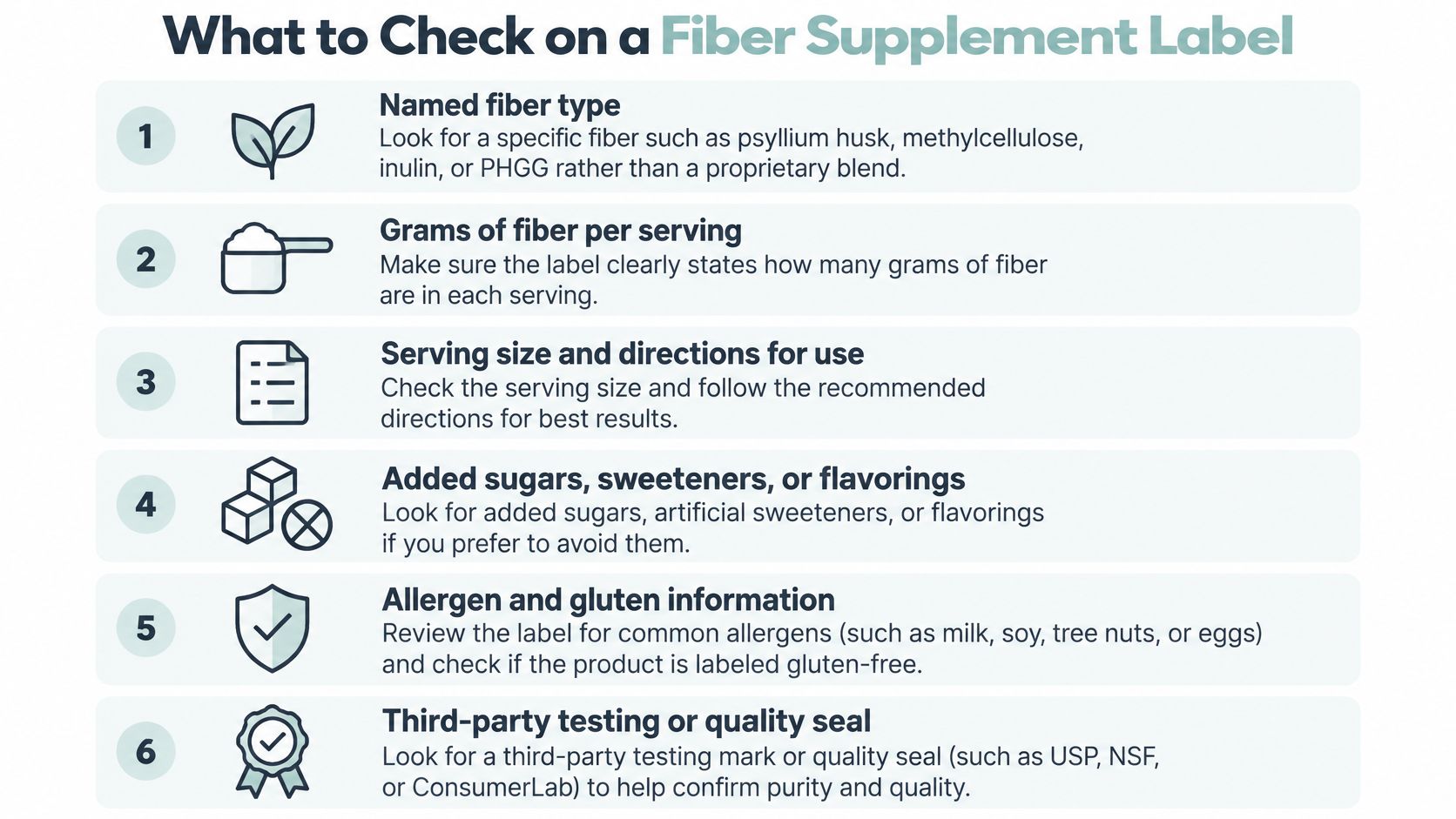
- The fiber type, named. Psyllium husk, methylcellulose, inulin, or PHGG should appear as an ingredient, not as part of a proprietary blend. You can't dose what you can't identify.
- Grams per serving and the serving size. A product with 6 grams per scoop and a product with 6 grams per two scoops are different products. Do the math for your target daily dose.
- Added sugar, sugar alcohols, and sweeteners. Sugar alcohols can add gas on top of the gas the fiber already causes, which is the last thing a sensitive gut needs in week one.
- Sodium, if it's a flavored drink mix. A powder you take twice a day can become a meaningful sodium source.
- Directions that say a full glass of water and a low starting dose. A label with neither is telling you something about the company.
- A clear statement about who should check with a provider first, including people who are pregnant, take medicines, or have a known digestive condition.
- Price per serving, not price per tub. Package sizes vary enough that the bigger container isn't always the better value.
Read the directions line first. Any product promising a cure or dramatic results within days is describing something a fiber supplement doesn't do.
The best product isn't the one with the most stars or the biggest number on the front. It's the one that matches the fiber type and dose you worked out before you walked into the aisle.
How to Start a Fiber Supplement Without Gas
Adults generally need 22 to 34 grams of total dietary fiber per day, with the right amount varying by age and sex, according to the NIDDK guidance on fiber and constipation. That number includes food and supplements together, which is the point: a supplement closes a gap. It doesn't replace meals.
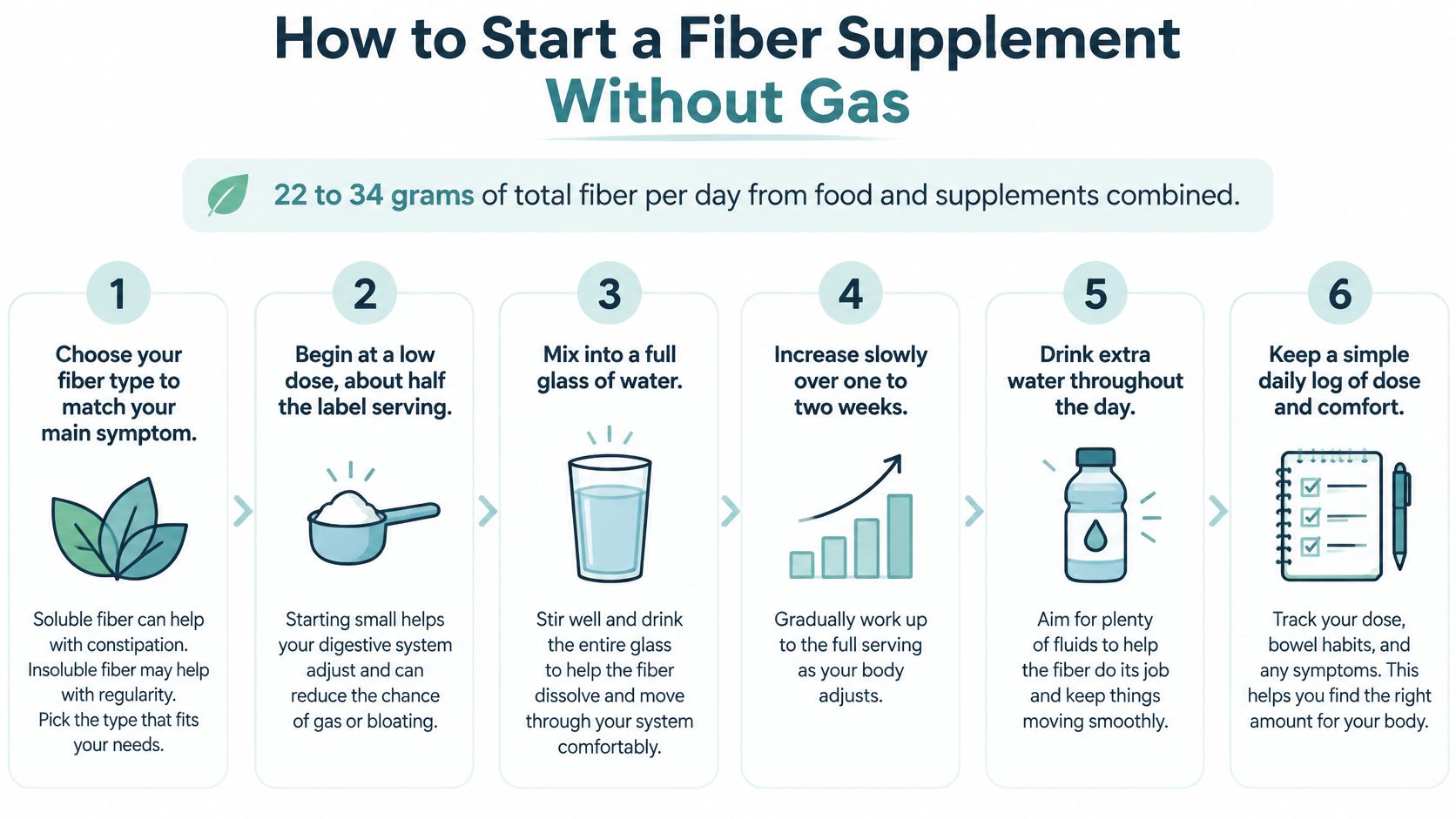
Here's the sequence that keeps many from quitting in frustration:
- Estimate your current intake. Take one typical day of eating and add up roughly how much fiber it holds. Those who think they eat a lot may discover they're closer to half the target.
- Find the gap. Subtract that estimate from your 22 to 34 gram target. The difference is what the supplement needs to cover, not the whole target.
- Start low. Begin with about half the label serving for the first week. Your gut bacteria need time to adapt to a new load, and the first week is when gas shows up.
- Mix it and drink it promptly. Psyllium thickens within a minute or two, so stir it into a full glass of water and drink it before it turns into a paste.
- Raise in small increments. NIDDK notes that increasing intake by approximately 2 to 3 grams per day may help reduce gas and bloating, so step the daily dose up by roughly that much at a time and hold each new level for about a week, as described in the NIDDK guidance on fiber and IBS symptoms.
- Keep fluids steady all day, not just with the dose. Water spread across the day does more than a single large glass.
- Hold the target for four weeks before you judge the result. That's the window where the trial benefits showed up.
A short video walkthrough is a good companion to the list above.
Slower is the strategy. If you feel worse after a fast jump, the fix is to step back down, not to quit fiber altogether.
Common Questions About Fiber Supplements
Can I take a fiber supplement every day long term?
Yes, for most adults with a steady routine. Keep fluids up, watch for changes in tolerance, and review it with a provider if you have a medical condition or take daily medication.
What if I miss a dose?
Skip it and take the next dose at your usual time. Doubling up to catch up is how people end up with cramps and a very uncomfortable evening.
Should I take it in the morning or at night?
Pick one consistent time and keep it. Regular timing matters more than the exact hour, though spacing the dose away from medicines still matters.
Can children use fiber supplements?
Ask a pediatric provider first. Appropriate dosing depends on the child's age and weight, and food sources are the better starting point.
Does a supplement replace a high-fiber diet?
No. A supplement helps close a gap, while food remains the main source of fiber and everything that comes with it.
Build Your Fiber and Comfort Plan This Week
One plan, one week. Pick the fiber type that matches your main symptom from the table, begin at a low dose, and mix it into a full glass of water at the same time each day.
Then keep a simple log. Four columns are enough: date, dose, stool consistency in your own words, and gas or comfort rated one to three. Fill it in for four weeks. The log does something no product review can, because it shows whether your stools went from hard and pellet-like to soft and easy, or whether nothing changed at all.

Fiber works on the stool. It does nothing for tissue that's already irritated, and that's where a topical plan earns its place alongside it. Revivol-XR Advanced Hemorrhoid & Fissure Cream is built for soothing relief and comfort for external hemorrhoid and fissure discomfort, not as a replacement for the fiber work above. Apply it to clean, dry skin after a sitz bath, up to four times per day or as directed by a healthcare professional. It is for external use only and must never be inserted into the rectum.
The four week rule: judge the plan at week four, not day four. Fiber is a slow tool.
Start the log today, with the dose you're taking this week. If nothing changes after four weeks of steady effort, or if bleeding or severe symptoms appear at any point, book a visit with a healthcare provider. Waiting on a plan that isn't working isn't a plan.
Fiber softens the stool and takes pressure off the tissue, and a topical cream handles the surface discomfort that's already there while you wait for the fiber to work. Revivol-XR Advanced Hemorrhoid & Fissure Cream is for external use only, applied to clean, dry skin after a sitz bath, up to four times per day or as directed by a healthcare professional. Keep the fiber log going and keep the cream within reach for flare-ups, and let the two work on the same week rather than one at a time.