Anal Fissure Treatment at Home: A Practical Guide

People trying anal fissure treatment at home are treating the pain... but not the two things that keep tearing it back open.
That bathroom moment is usually the same. Sharp pain hits during a bowel movement, then you see a streak of bright red blood on the toilet paper and immediately start searching in panic. If that's where you are right now, slow down. Most early fissures respond to a practical home routine when you start early and stay consistent.
This guide keeps anal fissure treatment at home simple. Not a giant list of random remedies... just what to do first, what helps most, what often gets overused, and when it's time to call a clinician.
Table of Contents
- What an Anal Fissure Feels Like and Why Early Home Care Matters
- The Two Real Drivers of Fissure Pain and Your Core Home Routine
- Sitz Baths, Cleansing, and Protective Topical Care Step by Step
- Topical Pain Relief and Product Choices for At-Home Use
- Diet, Fiber, Hydration, and Movement to Prevent Re-Injury
- When Home Care Is Not Enough and You Need a Clinician
- Your Two-Week Fissure Recovery Plan and Common Questions
What an Anal Fissure Feels Like and Why Early Home Care Matters
A typical fissure story starts with one hard bowel movement. Then the next trip to the toilet feels like a paper cut mixed with a cramp. For many people, the pain isn't just during the bowel movement. It lingers as burning, throbbing, or stinging for minutes or even hours afterward.
The part that throws people is the dread. Once that pain hits, it's common to get scared of the next bowel movement, hold stool longer, and accidentally make the next one harder. That's how a small tear turns into a longer, more stubborn problem.
The window where home care helps most
For acute fissures, conservative care is widely recommended as the first step, usually for about 6 weeks, with sitz baths, stool softeners, pain relief, hydration, and a high-fiber diet forming the core plan according to the AAFP guideline summary on anal fissures. That same summary notes these measures resolve symptoms in nearly one-half of acute fissures present for less than six weeks, while other reviews place healing from conservative care at roughly 60 to 90 percent for acute fissures overall in the same source.
Bottom line: Early home care isn't just comfort care. It's the standard starting treatment for most new fissures.
Why waiting makes it worse
A fresh fissure is often superficial. The longer you let constipation, straining, and muscle spasm continue, the easier it is to keep re-injuring the same spot. That doesn't mean you've done damage beyond repair. It means speed and consistency matter.
The quickest way to calm things down is to stop thinking in terms of random remedies. Think in terms of two drivers... hard stool and sphincter spasm. Once you handle both, the rest of the routine makes a lot more sense.
The Two Real Drivers of Fissure Pain and Your Core Home Routine
Anal fissure treatment at home works best when you target the problem in the right order. Most fissure pain is driven by two forces that feed each other.
First, hard or bulky stool scrapes and re-tears the wound.
Second, internal sphincter spasm tightens the anal canal after pain starts. That makes the next bowel movement harder and can slow healing.
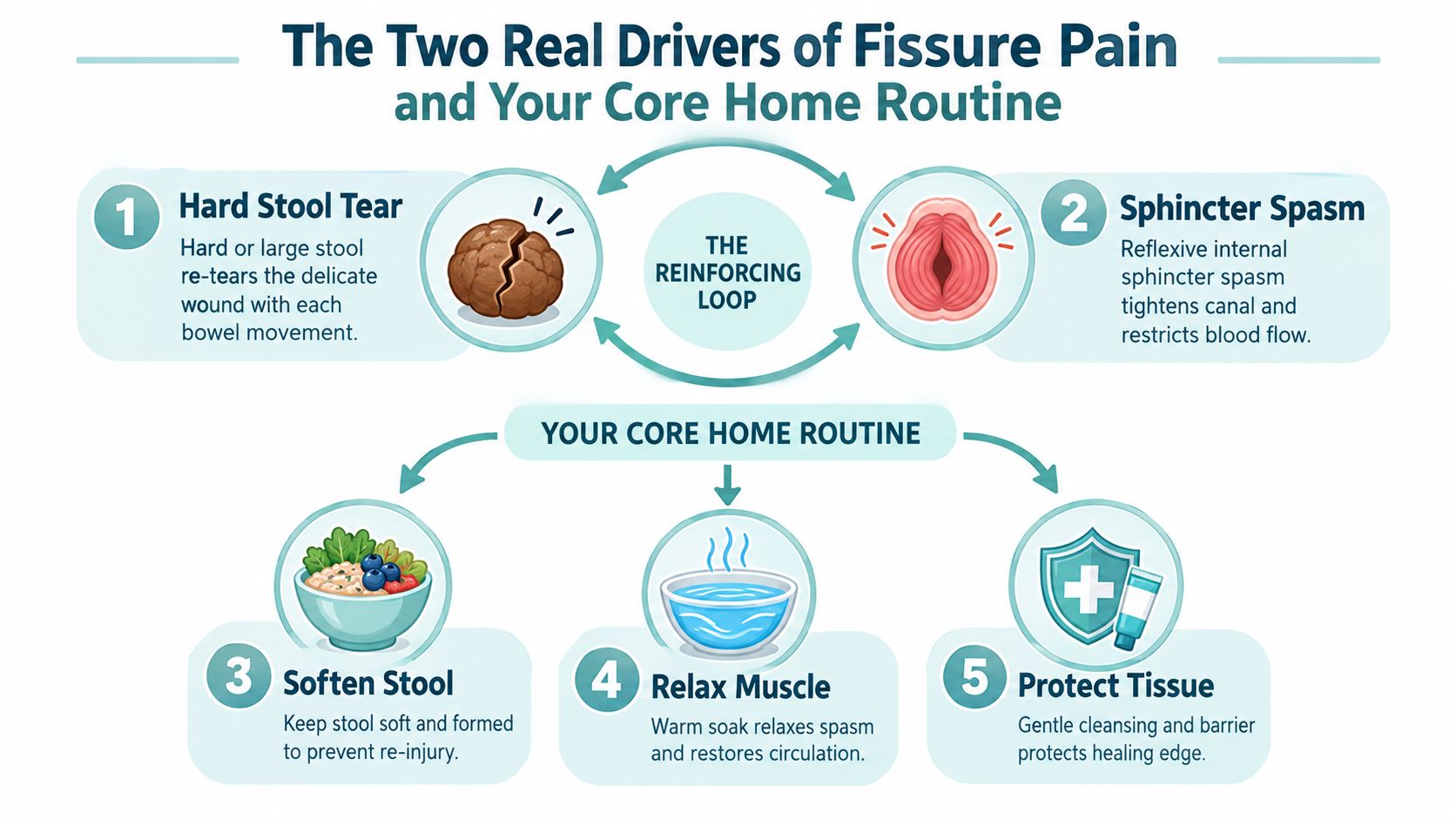
Treat both drivers at the same time
If you only numb the area but don't soften stool, the fissure keeps getting re-opened.
If you only take fiber but ignore spasm and pain, you may still tense up every time you use the bathroom.
Specialty guidance supports conservative care built around softening stool, warm sitz baths after bowel movements, and a short course of topical anesthetic if pain is stopping normal defecation. It also notes that nearly half of acute fissures resolve with these nonoperative measures, and one randomized trial found pain relief in 91% with sitz baths plus fiber compared with 60% with topical anesthetic and 68% with topical hydrocortisone in the ASCRS management guidance.
Your core daily routine
Use this order because each step supports the next one.
- Start with stool softening. Fiber or a bulking agent, enough fluid, and if needed a stool softener, are the foundation. This is what prevents the next re-tear.
- Use warm soaks after bowel movements. Warm water helps relax the muscle and makes the area feel less guarded.
- Add short-term pain control if needed. A topical anesthetic can help when pain is making you avoid bowel movements. Don't lean on numbing cream alone.
- Protect the skin afterward. A simple barrier can reduce friction and stool contact on irritated tissue.
- Keep moving and don't strain. Gentle walking often helps bowel regularity more than people expect.
A good routine done every day beats an impressive routine done once.
What a sample day looks like
Morning: Take fiber with water. Don't ignore the urge to go.
After a bowel movement: Gently clean, then soak in warm water, then pat dry, then use a thin layer of topical support if needed.
Evening: Repeat a warm soak if you're still tight or sore. Keep fluid intake steady through the day. If your clinician has suggested a stool softener, many people find nighttime use easiest to stick with.
For people who want one OTC option that combines a topical anesthetic with protectants, Revivol-XR® Advanced Hemorrhoid Cream - 5% Lidocaine + Phenylephrine (Vasoconstrictor) - Fast Relief of Burning, Itching, Discomfort includes 5% lidocaine for temporary pain, itching, burning, soreness, and discomfort relief, phenylephrine HCl 0.25% to help temporarily shrink swollen hemorrhoidal tissue, and glycerin plus petrolatum to help coat and protect irritated anorectal skin. Use only as directed on the Drug Facts label, and ask a doctor if symptoms worsen, don't improve within 7 days, or if bleeding occurs.
Sitz Baths, Cleansing, and Protective Topical Care Step by Step
Warm water helps, but only when you use it correctly. Too hot, too long, or followed by rough wiping can leave the area more irritated than before.
Major clinical sources recommend warm sitz baths for about 10 to 20 minutes several times a day, especially after bowel movements, and Cleveland Clinic specifies 10 to 15 minutes, 2 to 3 times daily in its anal fissure care guidance.
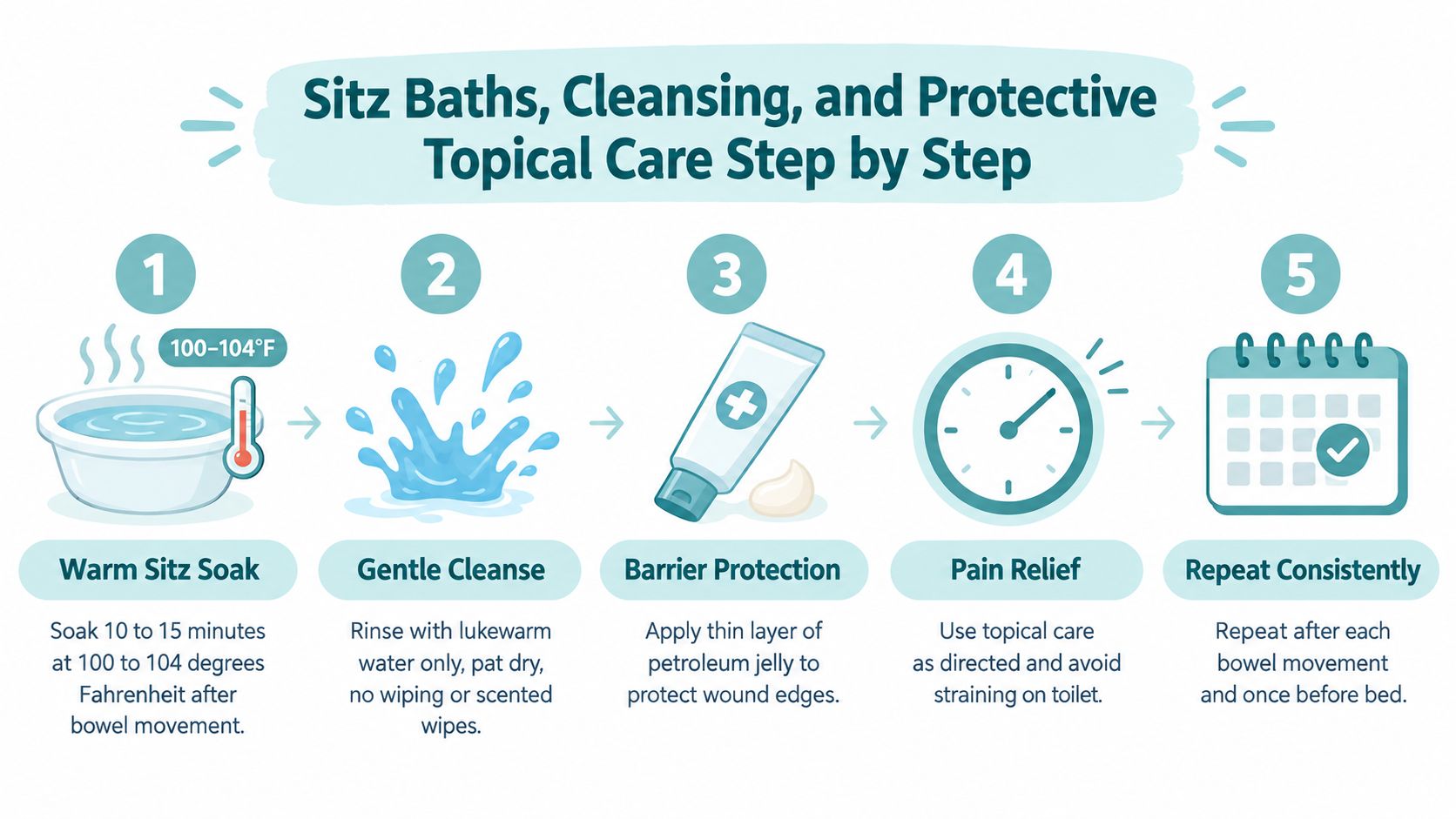
The right post-bowel-movement sequence
The order matters more than people realize.
- Clean first. Rinse with lukewarm water. Skip vigorous wiping.
- Soak second. Sit in comfortably warm water for about 10 to 15 minutes.
- Dry third. Pat dry with a soft cloth. Blot. Don't rub.
- Protect last. Apply a thin layer of a bland barrier such as petroleum jelly or zinc oxide ointment.
For a practical walkthrough, this guide on how to do a sitz bath at home is useful if you're unsure whether to use a tub or a basin.
Details that make a difference
Aim for warm, not hot, water. Roughly 100 to 104 degrees Fahrenheit is a reasonable comfort range for a typical individual. The goal is muscle relaxation, not heat therapy.
Avoid perfumed soaps, alcohol-based wipes, and scrubbing. Those are common reasons a fissure stays angry even when someone thinks they're "keeping it clean."
Later in the day, if you want to watch the process visually, this short video helps:
Some people like using a soak additive. Revivol-XR® Sitz Bath Soak Mix – Super Concentrated 20-in-1 Blend with Epsom Salt & Essential Oils – 15 Soaks – USP Grade is a bath water additive that includes Epsom salt along with other ingredients such as Dead Sea salt, baking soda, witch hazel, aloe vera, and calendula oil. Use it only as directed, start with a small amount to test sensitivity, and avoid it if you know you react to essential oils unless your clinician says it's appropriate.
Warmth should relax the area. If a product stings, perfumes the skin, or leaves you redder afterward, stop using it.
Save-this checklist
- After each bowel movement: Rinse, soak, pat dry, protect.
- Before bed: Repeat a warm soak if the area still feels tight.
- Always skip: Fragrance, alcohol wipes, harsh soap, and scrubbing.
Topical Pain Relief and Product Choices for At-Home Use
Topicals can help, but each type does a different job. The mistake I see most often is using one product for everything and expecting it to soften stool, relax spasm, protect skin, and numb pain all at once. No topical does all of that well.
Where each product type fits
Topical anesthetics are for short-term comfort. Protectants are for friction control. Astringents can calm irritated outer tissue. Steroid-type hemorrhoid creams may help itching, but they shouldn't become the center of a fissure plan.
Merck Manual and Healthline both note that lidocaine can be applied to the anus to ease discomfort, with warm soaking often paired after bowel movements in Healthline's overview of anal fissure care.
For readers comparing OTC numbing options, this article on how lidocaine cream works explains where it fits and where it doesn't.
At-Home Topical Products for Fissure Pain
| Product Type | Key Ingredients | Best Timing | Cautions |
|---|---|---|---|
| Topical anesthetic | Lidocaine, benzocaine, prilocaine | Right after a bowel movement or shortly before one if pain is intense | Use short-term. Too much or too often can irritate sensitive skin |
| Protectant ointment | Petroleum jelly, zinc oxide, glycerin-based protectants | After cleansing and drying | Apply a thin layer only. Heavy rubbing can hurt |
| Astringent outer-care product | Witch hazel | Between baths on irritated outer skin | Avoid if it stings or if added fragrance/alcohol causes irritation |
| Hemorrhoid cream with hydrocortisone | Hydrocortisone | Mainly when itching is the main issue | Don't let this replace stool-softening and warm soaking |
How to apply them without making things worse
- Use a small amount: A pea-sized amount is usually enough for external application.
- Dab, don't wipe: Put it on a clean finger or soft pad and press gently into place.
- Choose simple formulas: Fragrance and alcohol are common irritants around a fissure.
- Watch the timeline: If a numbing cream becomes your only strategy, you're probably missing the main driver.
Diet, Fiber, Hydration, and Movement to Prevent Re-Injury
This is the maintenance phase, but it isn't optional. A fissure can't settle down if every bowel movement keeps re-opening it.
Older but still important clinical evidence helped establish this. A randomized study cited in an NIH-linked review found that 10 g of unprocessed bran twice daily plus warm sitz baths for 15 minutes twice daily and after each bowel movement produced 88% healing at 3 weeks, while another study found 15 g/day of bran cut recurrence to 16% versus 68% with placebo. The same review also described a long-term observational study of 393 patients followed for about five years in which more than 44% were cured nonsurgically within 4 to 8 weeks in the review on anal fissure treatment history and outcomes.
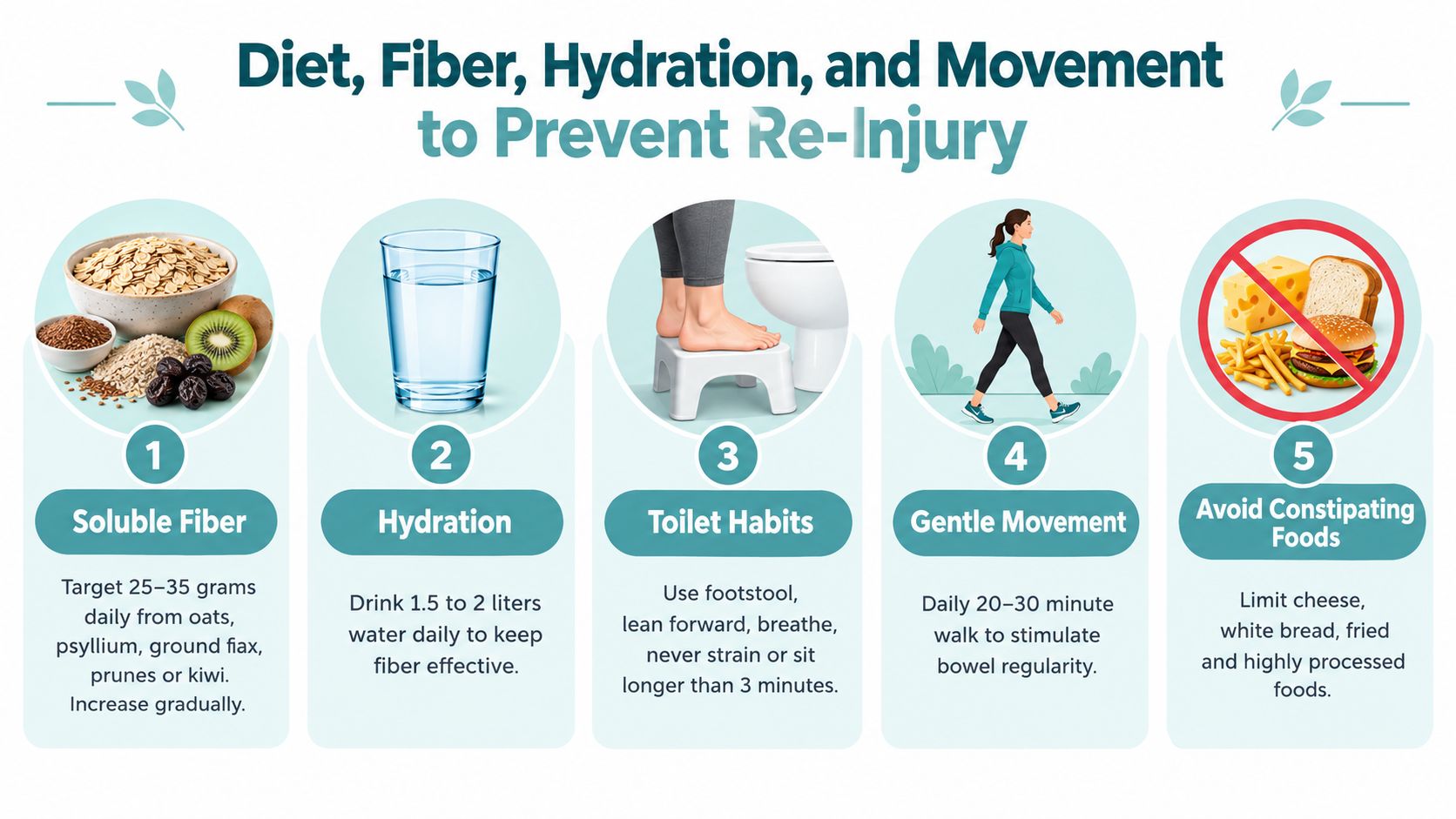
What to change this week
- Build fiber gradually: Aim for 25 to 35 grams daily from foods like oats, psyllium, ground flax, prunes, or kiwi. Go up slowly so you don't end up bloated and tighter.
- Pair it with fluid: Drink enough water through the day so fiber can do its job. Fiber without enough fluid can backfire.
- Trim constipating foods for now: Large amounts of cheese, white rice, and heavy red meat meals can make recovery harder for some people.
- Walk every day: 20 to 30 minutes of walking or gentle movement often helps bowel regularity.
- Fix toilet habits: Don't sit there scrolling. Don't hold your breath and push.
Soft, formed stool is the target. Loose stool can also irritate a fissure, so the goal isn't "more laxative." The goal is easier passage.
If psyllium is the easiest way for you to hit your target, this primer on psyllium husk for hemorrhoids covers practical ways people use it to support softer, more regular bowel movements.
When Home Care Is Not Enough and You Need a Clinician
Home care is the right first move for many new fissures. It isn't the right final move for every fissure.
A review of the literature notes that conservative care can lead to symptom resolution, but not universally. It also highlights that fiber reduced recurrence from 60% to 16% in a placebo-controlled maintenance study, and that sitz baths alone shouldn't be expected to heal the fissure because randomized evidence found no significant difference in healing or overall pain relief versus no sitz bath, even though patients liked them better, in the review on modern management of anal fissures.
Red flags that deserve prompt evaluation
Call a clinician sooner if any of these show up:
- Bleeding keeps happening: More than a light streak on the paper, or repeated bleeding that worries you.
- Pain is getting worse: Especially after a week of consistent home care.
- You notice pus, fever, or a lump: Those raise concern for something other than a simple fissure.
- The fissure lasts beyond 6 weeks: That's when chronic fissure becomes more likely.
What a clinician adds
A good exam can rule out other causes of pain and bleeding. If a fissure is lingering, clinicians often add prescription topical medicines that relax the internal sphincter, such as nifedipine, diltiazem, or nitroglycerin.
Mayo Clinic notes that topical nitroglycerin heals about 60% of fissures compared with about 40% with placebo at 8 weeks in its anal fissure diagnosis and treatment page. That's one reason I tell people not to stay stuck in endless self-treatment when the basics clearly aren't enough.
Escalating care isn't failure. It's often the smartest way to shorten the total time you're dealing with this. If symptoms are persistent, severe, or bleeding, talk with a healthcare provider.
Your Two-Week Fissure Recovery Plan and Common Questions
The first two weeks are about consistency, not perfection. If your routine is simple enough to repeat, you're much more likely to calm the cycle of re-tearing and spasm.
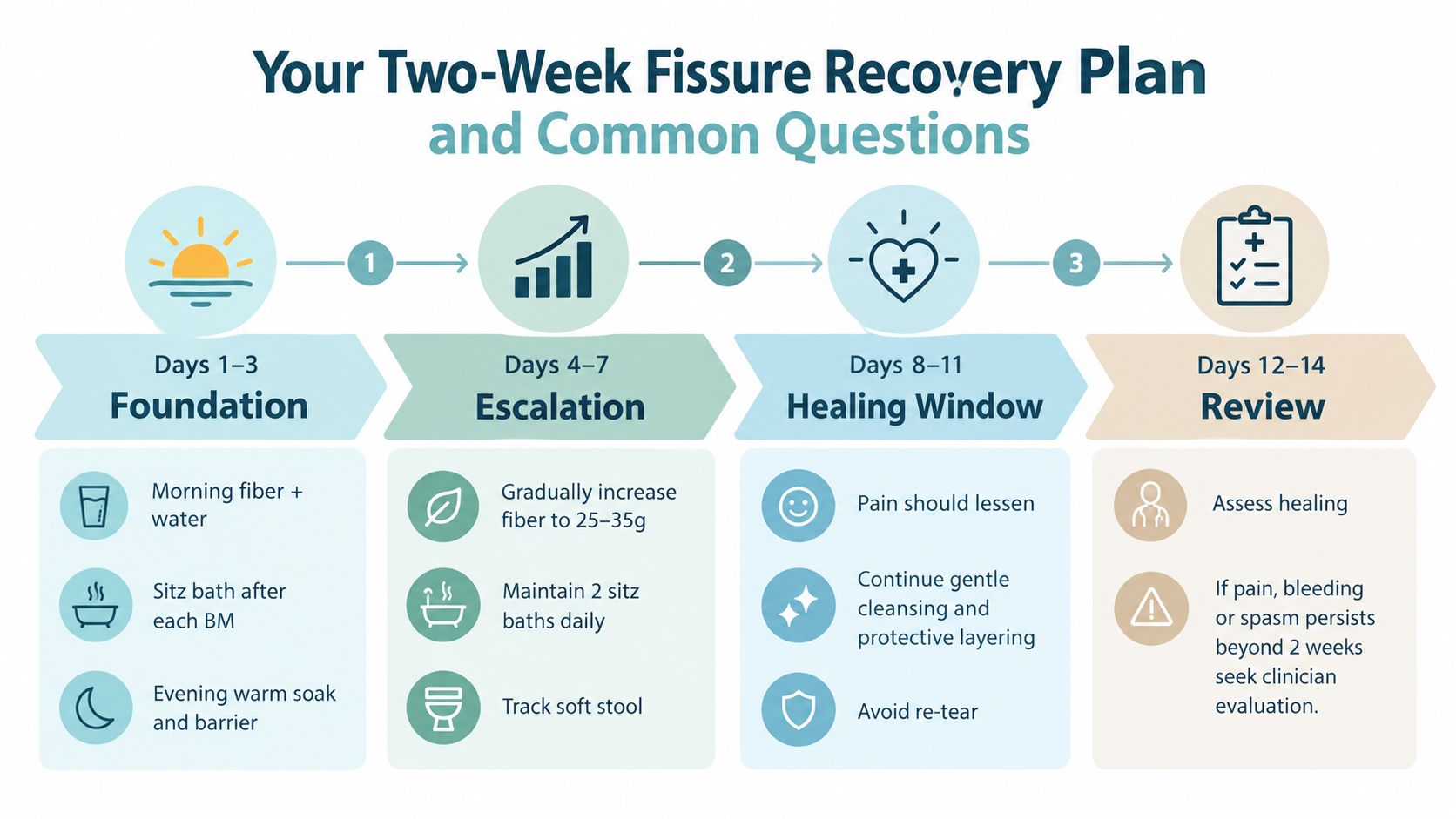
Days 1 through 3
Keep the goal narrow. Make bowel movements less traumatic.
- Morning: Start fiber and water.
- After each bowel movement: Clean gently, warm soak, pat dry, apply a protectant or short-term topical comfort measure if needed.
- Evening: Warm soak again if the area still feels tight or burning.
Days 4 through 7
Many people drift. Don't.
- Increase fiber gradually: Work toward your daily target without forcing it too fast.
- Stay active: A daily walk helps more than another internet remedy.
- Review your triggers: Long toilet sitting, skipped water, heavy constipating meals, and delayed bowel movements are common setbacks.
Days 8 through 14
By now, pain during and after bowel movements should be easier for many people if stool is soft and the area isn't being re-irritated.
Questions people usually ask:
Is a little bleeding normal?
A light streak can happen with a fresh tear, but repeated, heavy, or worsening bleeding needs medical review.
How long should pain last?
Some discomfort can linger after bowel movements early on, but the pattern should trend downward, not upward.
Can I exercise?
Usually, gentle walking is fine. Skip anything that increases pressure, friction, or straining until things settle.
Do fissures come back?
They can, especially if constipation or straining returns. That's why the fiber and bathroom-habit piece matters even after you feel better.
Quick FAQ
Can I combine warm soaks and lidocaine?
Yes, many people use a short-term topical anesthetic around bowel movements and still rely on warm soaks for comfort. Follow the product directions and stop if irritation develops.
Should I keep using numbing cream for weeks?
Usually not as your main strategy. Short-term use makes more sense while you fix stool consistency and reduce spasm.
What if my stools are already soft, especially postpartum?
Then don't keep pushing laxatives. Focus more on gentle cleansing, warm soaks, barrier protection, and avoiding irritation. Pregnancy and breastfeeding can also limit medication choices, so check with your healthcare provider if symptoms persist.
Where does a product like Revivol-XR fit?
It fits as symptom support, not as a substitute for stool-softening and bowel habit changes. If you're pregnant or breastfeeding, ask a health professional before use.
When should I skip self-care and get examined?
If pain is severe, bleeding keeps happening, symptoms worsen, or you're not clearly improving, get seen in person.
If you need extra comfort while you're working through anal fissure treatment at home, Revivol-XR offers OTC options for temporary soothing relief, including lidocaine-based topical support and sitz bath products that can fit into the kind of routine described here. For discreet fissure and hemorrhoid comfort products, visit Revivol-XR.