Witch Hazel Hemorrhoids Side Effects: A Safety Guide

Many people don't realize the “natural” hemorrhoid remedy they use for quick cooling relief can also create the dryness, burning, or rash they're trying to escape.
You're standing in a drugstore aisle after an uncomfortable bowel movement, comparing witch hazel pads, creams, and wipes. The label promises temporary relief, but your real question is more important: which witch hazel hemorrhoids side effects are minor, and which mean you should stop using the product?
Table of Contents
- Why People Reach for Witch Hazel for Hemorrhoids
- How Witch Hazel Works on Hemorrhoid-Prone Skin
- Common Witch Hazel Hemorrhoids Side Effects to Watch For
- Safe Concentrations, Frequency, and Product Label Rules
- When Witch Hazel Helps Itch but Misses the Underlying Problem
- Interactions With Other Topicals and Hemorrhoid Products
- Stop Use and Consult a Clinician
- Your Safe Use Checklist and Next Steps
Why People Reach for Witch Hazel for Hemorrhoids
A person with a sudden flare often makes the same practical choice. They walk into a pharmacy, see medicated witch hazel pads, and reach for the familiar container because it's available without a prescription and seems simple to use. The appeal usually comes from three places, easy access, a reputation for being natural, and the expectation of cooling comfort.
That choice makes sense when itching, mild swelling, or discomfort after a bowel movement has become distracting. Witch hazel products are commonly sold as wipes and pads for external use, and they're intended to temporarily relieve itching, burning, and irritation associated with hemorrhoids or bowel movements. Cleveland Clinic's guide to witch hazel wipes describes local irritation, redness, and dryness as the main concerns.
A product's popularity doesn't prove that it's suitable for every person or every type of hemorrhoid. Sensitive perianal skin may already be inflamed, rubbed by toilet paper, or exposed to repeated moisture. A product that feels cooling for one person can sting or dry the skin for another.
Relief can blur the safety question
Consumer discussions often treat “it helped” and “it was safe” as the same conclusion. They aren't. A pad may reduce surface itching while leaving deeper pain, swelling, or bleeding unchanged.
The guide to what witch hazel is good for can help explain its common uses, but the practical limit remains important: topical witch hazel is mainly a symptom-soothing option. Historical and clinical summaries describe temporary relief for mild anorectal symptoms, while the evidence base remains modest and focused on comfort rather than cure. Medical News Today's overview of witch hazel also notes mild irritation or dryness as possible adverse effects.
Practical rule: Widespread over-the-counter use doesn't make prolonged application, internal use, or worsening symptoms automatically safe.
How Witch Hazel Works on Hemorrhoid-Prone Skin
Witch hazel, commonly derived from Hamamelis virginiana, is an astringent. Its tannins can interact with superficial proteins and create a temporary tightening sensation on the skin. That surface effect may reduce wetness and make external itching feel less noticeable.
The same drying action explains the main trade-off. Inflamed tissue may feel less damp, but repeated exposure can remove some of the skin's natural oils and worsen barrier disruption. When the barrier becomes irritated, the area may burn, crack, or itch more after wiping.
The formula matters as much as the plant
Not every witch hazel product has the same vehicle. Water-based or alcohol-free formulas may feel gentler than products that use alcohol as a carrier, especially when the skin is already raw. Fragrance, preservatives, and other inactive ingredients can also contribute to irritation or allergic contact dermatitis.
The Revivol-XR Hygienic Cleansing Lotion contains aloe, mineral oil, lanolin oil, vitamin E, chamomile, and witch hazel extract, and is intended for external cleansing. Its product information says to apply a dime-sized amount to toilet paper, while also warning that it's for external use only and should be kept away from the eyes.
Surface comfort isn't deeper treatment
Witch hazel can make external tissue feel cleaner and less irritated after a bowel movement. It doesn't establish why the symptoms are occurring, and it doesn't replace evaluation when bleeding, severe pain, or persistent swelling continues.
The technical issue is simple. A soothing surface response can coexist with an unresolved hemorrhoid, fissure, or another source of rectal symptoms. If the product feels increasingly harsh, stop rather than applying more often.
Common Witch Hazel Hemorrhoids Side Effects to Watch For
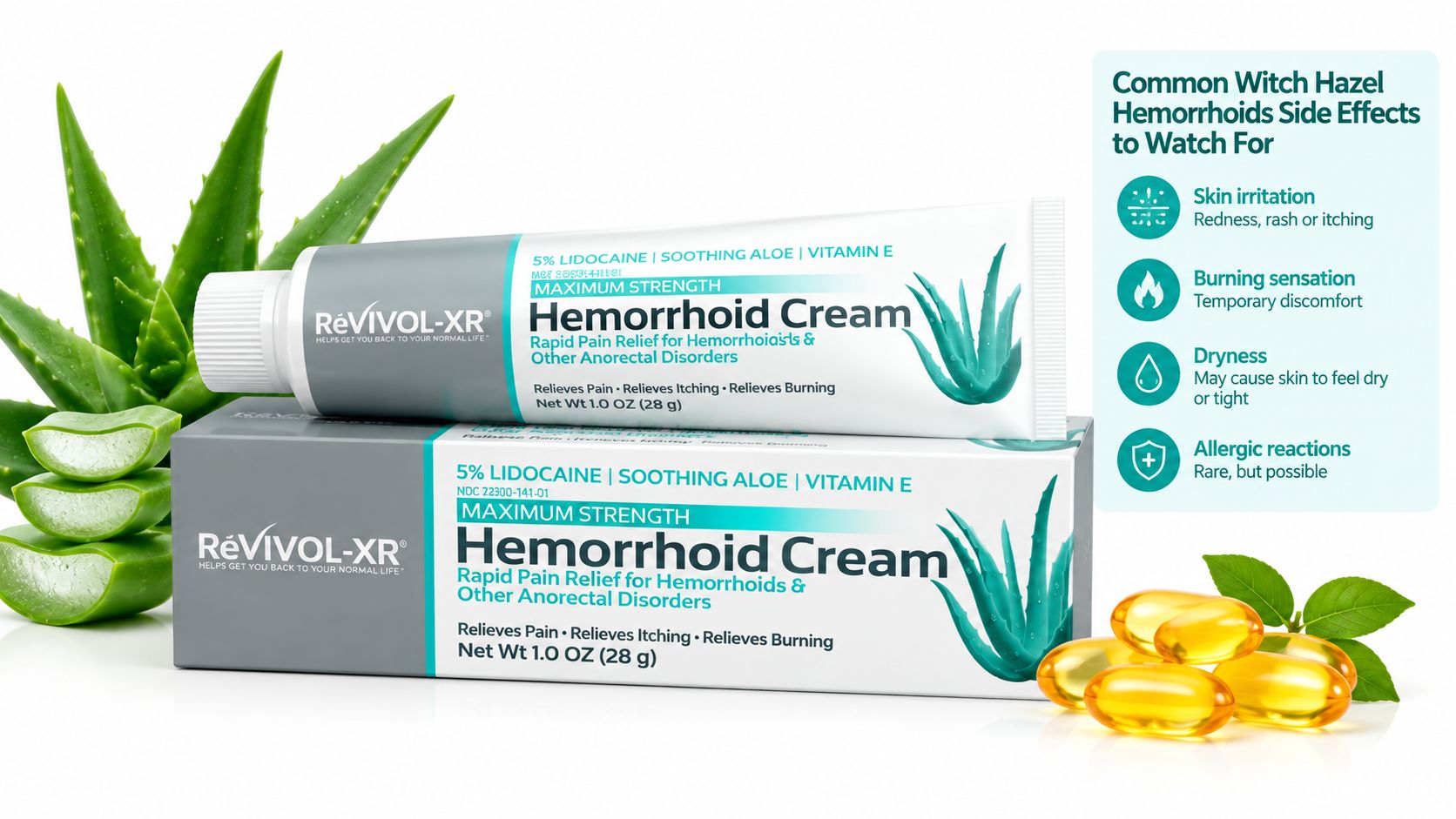
The most common witch hazel hemorrhoids side effects are local. References describe dryness, mild stinging, redness, burning, and irritation at the application site, with allergic contact dermatitis occurring less often. WebMD's safety information on witch hazel distinguishes these topical effects from problems linked to oral use.
A brief tingle can occur when an astringent touches irritated skin. Burning that persists, spreads, or becomes stronger after each application deserves a different response. Alcohol-based products may dry the area more aggressively, while fragrances or preservatives can trigger a rash beyond the exact area touched by the pad.
Signs versus expected sensations
| Reaction | Expected / Minor | Stop Use / See Clinician |
|---|---|---|
| Tingling | Brief, mild sensation that settles quickly | Burning that persists or worsens |
| Dryness | Mild tightness after occasional external use | Cracking, painful wiping, or increasing itch |
| Redness | Limited redness that fades | Spreading redness, raised bumps, or welts |
| Itching | Temporary improvement in surface itch | Itch that intensifies after application |
| Swelling | No new swelling | Facial, lip, tongue, or throat swelling |
Stop using the product if a rash or hives develops. Seek urgent medical help for trouble breathing or swelling of the face, lips, tongue, or throat. The Revivol-XR Advanced Hemorrhoid Cream uses lidocaine, phenylephrine, glycerin, and petrolatum for temporary symptom relief, but its label information also directs users to stop and ask a doctor if bleeding occurs, symptoms worsen, or symptoms don't improve within 7 days.
Safe Concentrations, Frequency, and Product Label Rules
Labels matter more than a general belief that witch hazel is gentle. Read the active ingredient, inactive ingredients, route of application, and maximum daily use before applying anything to irritated tissue.
Products differ in concentration and carrier. Some drugstore formulations use alcohol, while others use water, glycerin, or another base. A lower-alcohol or alcohol-free option may be more comfortable for someone whose skin becomes dry or irritated easily, but “alcohol-free” doesn't guarantee that every ingredient will suit you.
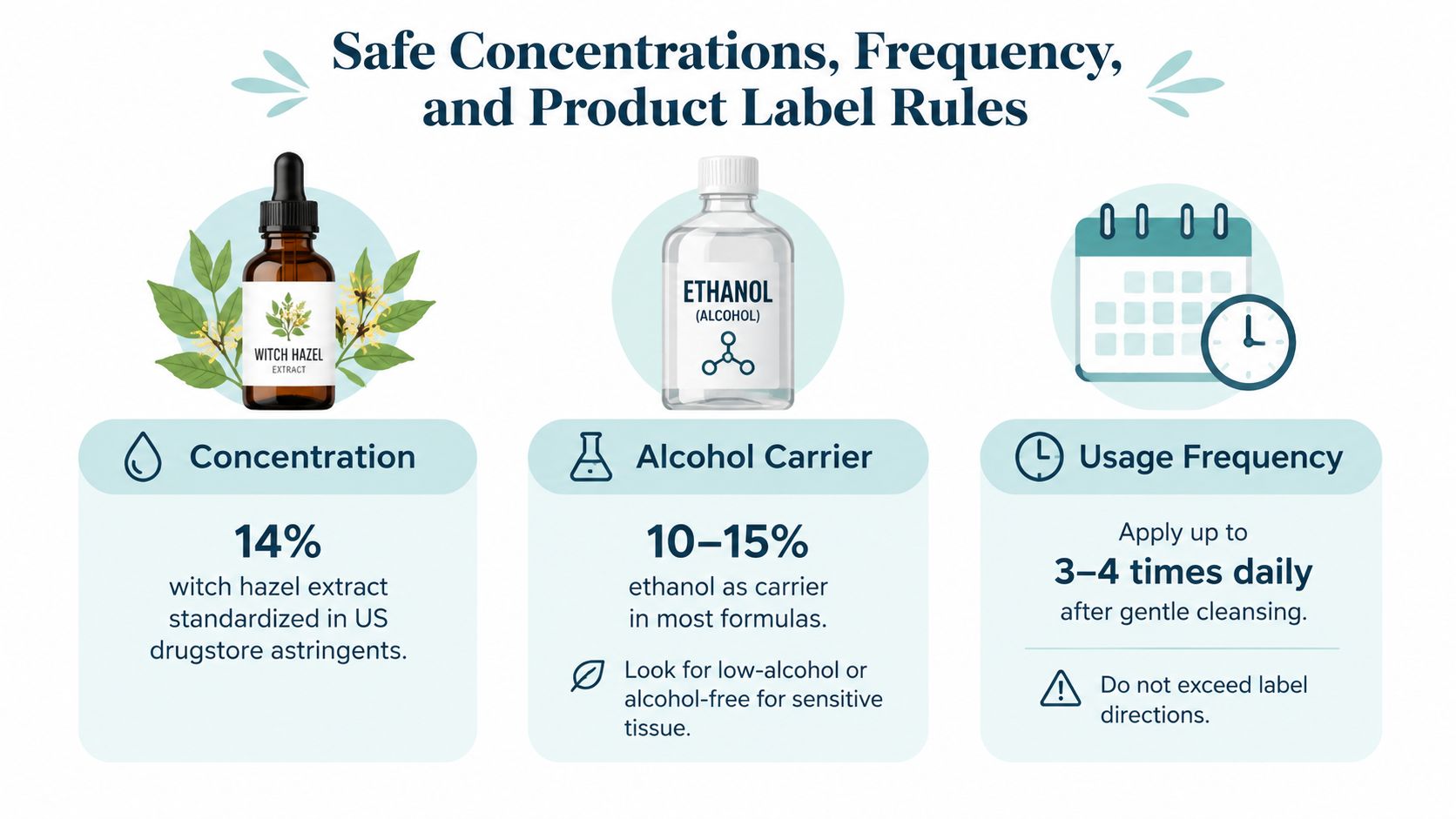
A safer application routine
- Confirm the route. The FDA DailyMed label for a witch hazel hemorrhoid wipe states that it's for external use only and shouldn't be inserted into the rectum or vagina. Read the DailyMed hemorrhoid wipe label before use.
- Clean gently. Rinse or dab rather than scrub. Pat the area dry, then apply the pad externally according to the label.
- Follow the stated frequency. Don't keep using a product throughout the day for weeks just because it provides short-term comfort. Hemorrhoid-specific labeling advises stopping and seeking medical advice if bleeding occurs or symptoms don't improve within 7 days. WebMD's witch hazel reference also advises stopping if irritation persists.
- Don't insert a pad. Internal rectal tissue may react differently from external skin, and aggressive application can worsen irritation.
The European Medicines Agency assessment describes short irritation and slight burning as possible effects of topical Hamamelis virginiana, and says allergic contact dermatitis can occur in sensitive individuals. Its guidance supports the same practical conclusion: use the label, watch the tissue, and consult a healthcare professional if the reaction continues. The EMA assessment information is summarized in this clinical drug reference.
For a broader discussion of formulations, see this guide to witch hazel creams for hemorrhoids.
When Witch Hazel Helps Itch but Misses the Underlying Problem
If itching eases after applying witch hazel but pain or swelling remains, match the reaction to the symptom before continuing. Temporary cooling can reduce mild external discomfort without showing that the hemorrhoid itself has settled.
The 2025 NIH review of witch hazel and hemorrhoid symptoms describes evidence for relief in mild external or Grade I–II internal hemorrhoids. It does not establish the same benefit for severe or persistent symptoms. Continued pain, swelling, or bleeding after the itch improves is a reason to reassess the product rather than apply it more often.
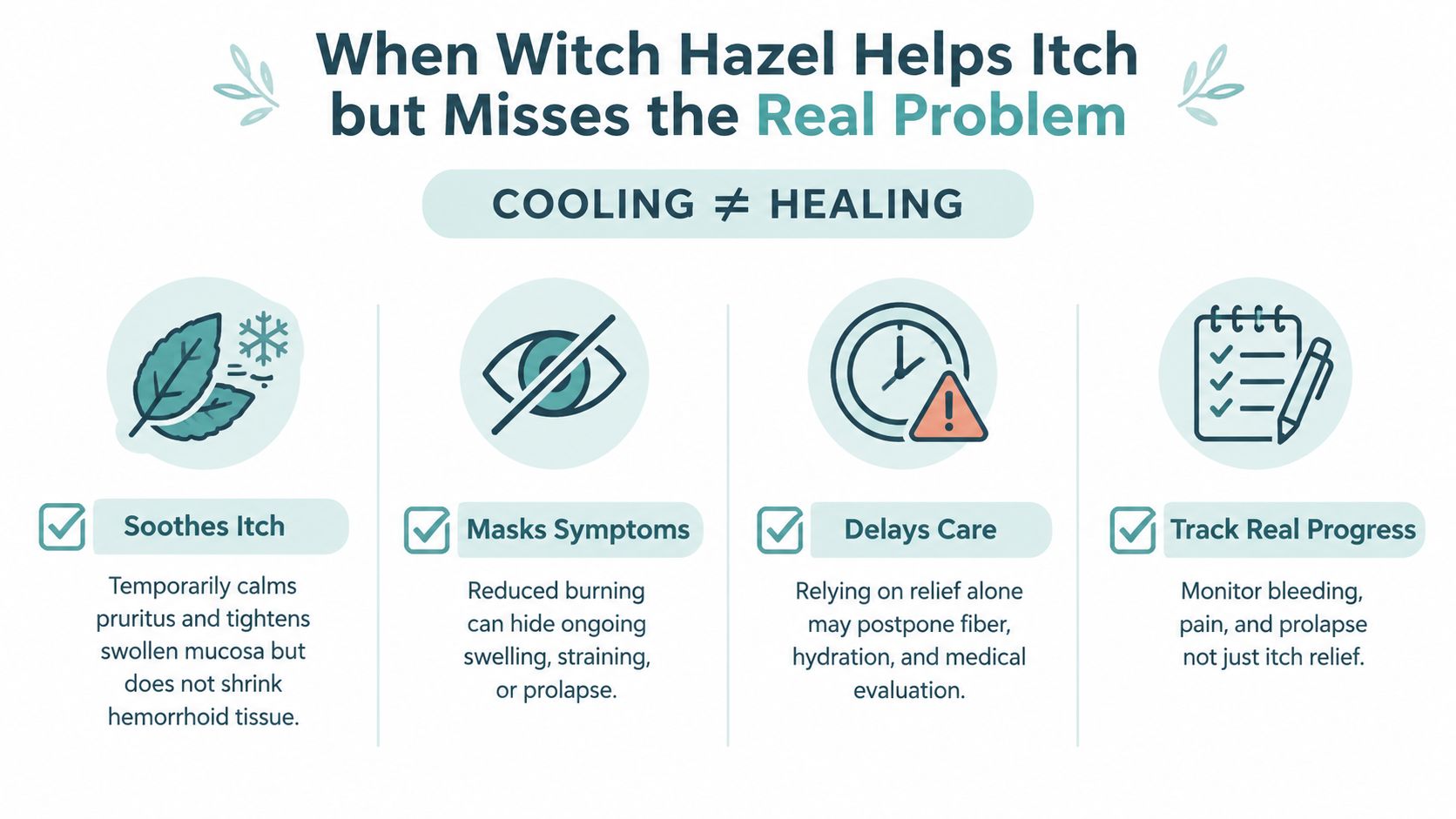
Match the reaction to the next step
Keep a brief phone note to separate useful symptom relief from signs that it is time to stop, seek care, or switch to a multi-ingredient OTC product:
- Itch or surface burning improves: the product may be providing temporary relief.
- Burning increases, or new irritation appears: stop using it.
- Pain becomes sharp or throbbing: do not treat the change as ordinary itching.
- Bleeding continues or increases: arrange medical evaluation.
- A lump grows, stays tender, or remains prolapsed: seek clinical advice.
Constipation and straining can continue to drive symptoms even when the skin feels calmer. Relief that lasts only until the next bowel movement is useful information, not proof that the underlying cause has improved.
Interactions With Other Topicals and Hemorrhoid Products
Layering products can make it difficult to identify what's helping and what's irritating the skin. A witch hazel pad, lidocaine cream, phenylephrine product, steroid cream, and medicated wipe may each have a different purpose, but combining them without checking labels can increase exposure and mask changes.
Use this comparison as a conversation starter with a pharmacist or clinician, not as permission to combine products:
| Combination | Likely Effect | Caution Level |
|---|---|---|
| Witch hazel and lidocaine | May combine surface soothing with temporary numbing | High if numbness hides worsening pain |
| Witch hazel and phenylephrine | Adds two products aimed at swelling relief | High if the labels overlap or symptoms persist |
| Witch hazel and hydrocortisone | May increase irritation when the skin is already fragile | High without professional guidance |
| Witch hazel wipes and another medicated wipe | Adds repeated exposure to preservatives, fragrance, or alcohol | Moderate to high |
| Witch hazel and suppositories | External cleansing does not replace internal product directions | Check each label carefully |
Map the entire routine
Write down every product used near the anus, including soaps, wipes, creams, suppositories, and prescription medicines. Note the active ingredients, because two different brand names may contain the same ingredient.
The witch hazel and aloe care guide may help you compare soothing ingredients, but it shouldn't override the Drug Facts label or advice from a healthcare professional. Don't apply witch hazel before a prescription product unless the prescriber or pharmacist confirms that the routine is appropriate.
If you're using lidocaine, don't use more frequently or over a larger area than directed. Numbing can make a serious change feel less obvious, which is one reason persistent or increasing pain should be assessed rather than repeatedly covered.
Stop Use and Consult a Clinician
Some reactions are annoying. Others are warnings. Stop witch hazel and seek medical advice if bleeding occurs, symptoms worsen, or the condition doesn't improve within 7 days, as stated on the FDA DailyMed product label.
Heavy bleeding, sudden severe pain, dizziness, faintness, or marked weakness calls for prompt medical attention. Don't assume that visible blood is just another hemorrhoid symptom, especially if it's persistent or increasing.
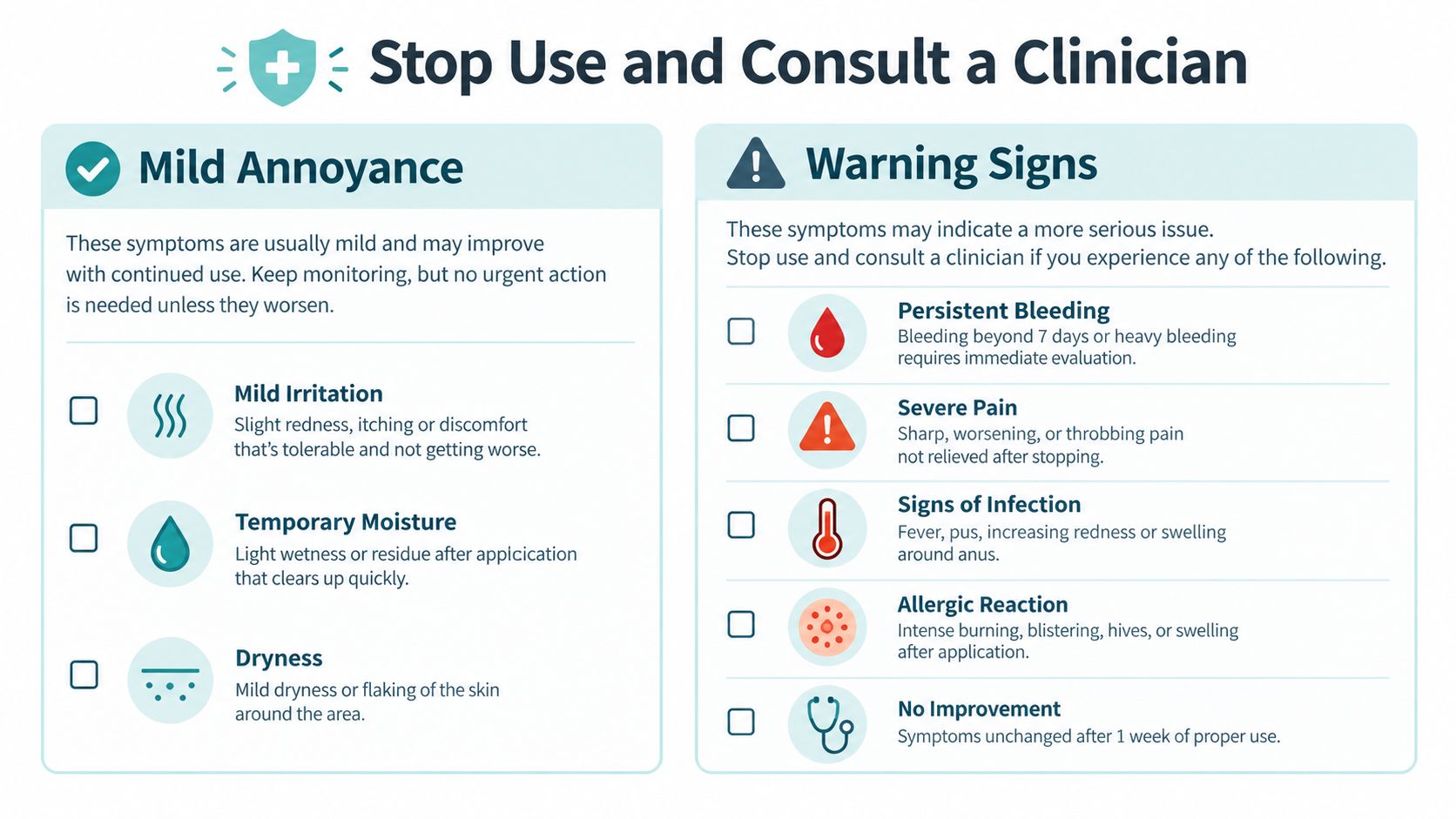
Sort the urgency
- Call a pharmacist: Mild dryness or brief stinging that stops after application, provided there's no bleeding, rash, swelling, or worsening pain. Ask the pharmacist to review the full ingredient list and your other topical products.
- Contact a primary care clinician: Symptoms remain unchanged, bleeding continues, or discomfort keeps returning despite careful external use. Bring the product container or a photo of the label.
- Seek same-day urgent care: Pain becomes severe or throbbing, swelling increases, a hard lump appears, or you develop fever or foul-smelling discharge. These symptoms can reflect a problem that witch hazel can't evaluate or manage.
- Seek emergency help: Hives with facial or throat swelling, difficulty breathing, faintness, or heavy bleeding.
Before the visit, prepare the product name, active and inactive ingredients, how often you used it, when you started, and the order in which symptoms appeared. That timeline helps a clinician distinguish a product reaction from the original anorectal problem.
A clinical overview from Cleveland Clinic also identifies rash, hives, and swelling as allergic reaction signs. Don't continue testing a product on yourself after those symptoms appear.
Your Safe Use Checklist and Next Steps
Use this checklist before starting or continuing witch hazel. The goal isn't to make a product seem risk-free. It's to make your routine controlled enough that you can recognize a problem early.
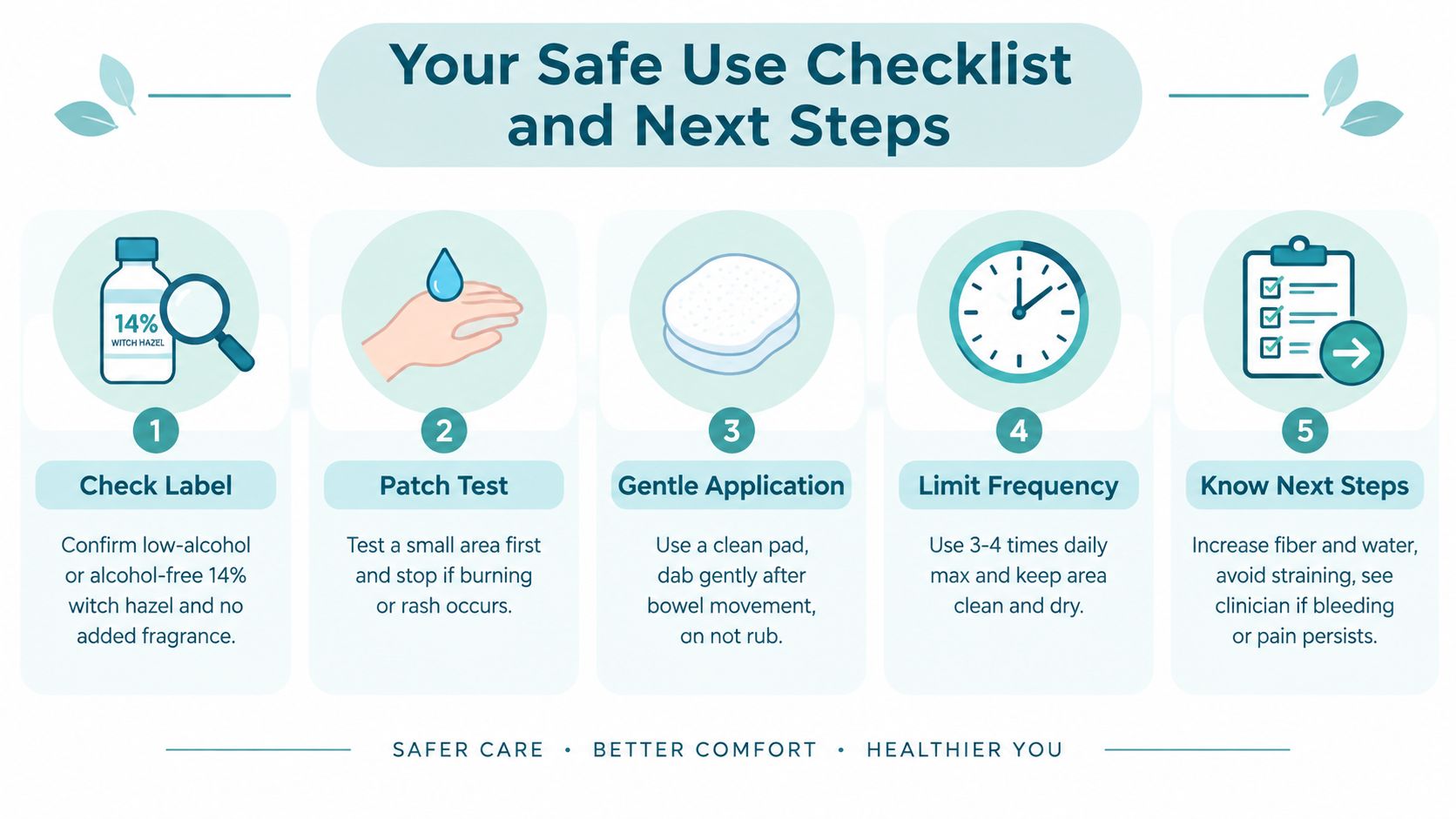
Five practical checks
- Read the whole label. Confirm that the product is intended for external use and check whether it contains alcohol, fragrance, or other ingredients you've reacted to before.
- Start cautiously. If you're prone to sensitive skin, test a small amount on another small area of skin first and watch for burning, rash, or swelling before applying it near the anus. A patch test doesn't guarantee that the product will be comfortable on hemorrhoid-prone tissue.
- Dab, don't rub. Apply a clean pad gently after cleansing. Scrubbing can add mechanical irritation to already tender skin.
- Limit use to the label. Don't leave pads in place overnight unless the product label specifically says that's appropriate. Stop if dryness, burning, rash, or worsening itch develops.
- Address the wider routine. Support comfortable bowel movements with adequate fiber and fluids, avoid straining, and ask a healthcare provider or pharmacist about sitz baths, stool softeners, or other options suited to your situation.
Pregnancy and postpartum recovery deserve extra care. The American College of Obstetricians and Gynecologists lists witch hazel pads as an option for relieving pain and reducing swelling during pregnancy, alongside ice packs and warm, not hot, sitz-style baths. The ACOG guidance is available through this DailyMed document. Even then, persistent bleeding or severe symptoms should be discussed with an obstetric clinician.
Witch hazel can be a reasonable adjunct for mild external discomfort when you follow the label and stop at the first sign of a worsening reaction. It isn't a substitute for evaluation when pain, bleeding, swelling, or symptoms lasting beyond a week continue.
Revivol-XR offers external cleansing with aloe, chamomile, and witch hazel, along with an advanced hemorrhoid cream that provides temporary symptom relief with lidocaine, phenylephrine, glycerin, and petrolatum. Review the ingredients and directions, then visit Revivol-XR to compare options and choose the product that matches your symptoms.