Tea Tree Oil for Hemorrhoids: Safe or Risky?

Tea tree oil for hemorrhoids isn't a proven treatment, and undiluted oil can irritate the sensitive skin around the anus. The often-cited trial tested a gel with three ingredients, not tea tree oil alone, so it's worth checking both the evidence and the safety limits before trying this home remedy.
The remedy a friend swears by could leave you more sore, not more comfortable. You don't need to feel embarrassed about looking for relief, but you deserve a clearer answer than “it's natural, so try it.”
Table of Contents
- Is Tea Tree Oil Proven for Hemorrhoids
- Antimicrobial Oil and Swollen Veins
- Where Tea Tree Oil Is Off Limits
- Tea Tree Oil Next to Common OTC Actives
- Choose Proven Comfort Instead
- Quick Answers to Common Searches
Is Tea Tree Oil Proven for Hemorrhoids
Tea tree oil has not been shown to relieve hemorrhoids on its own. The available clinical evidence comes from a gel that combined the oil with two other ingredients, so it cannot identify tea tree oil as the cause of any improvement.
What the combination-gel trial found
A double-blind, placebo-controlled clinical trial published in 2013 evaluated a gel containing tea tree oil, hyaluronic acid, and methylsulfonylmethane, also called MSM, in 36 patients with grade 1 to 3 hemorrhoids. The patients were divided into equal groups of 18 and treated for 14 days.
Patients and investigators rated anal pain, pain during bowel movements, visible bleeding, itching, irritation, and inflammation. All measured symptoms improved significantly more with the active gel than with placebo, and the investigators described the formulation as well tolerated during the treatment period.
The result applies to the complete gel, not to tea tree oil by itself.
Tea tree oil claims versus what was studied
| Claim | What was studied | What it means |
|---|---|---|
| Symptom relief in 14 days | 36 patients used a gel with tea tree oil, hyaluronic acid, and MSM, not oil alone | The trial found improvement with the full formula. A household bottle of tea tree oil is not the product tested. |
| Antimicrobial power | Laboratory studies of Melaleuca alternifolia oil | Laboratory activity does not show that hemorrhoids will shrink or bleed less. |
| Low allergy risk | Patch-test positivity of about 1.8% to 3.5% reported in general testing, not specifically in hemorrhoid patients | Undiluted or oxidized oil can irritate or sensitize skin. |
| Severe or prolapsed hemorrhoids | Effectiveness wasn't established by this evidence | Clots, significant bleeding, or tissue that stays outside need clinical assessment. |
The HerbalGram evidence summary describes laboratory antimicrobial findings and reports patch-test positivity of approximately 1.8% to 3.5% in general testing. Those figures do not predict an individual's risk, and the summary emphasizes that clinical evidence specific to hemorrhoids remains limited.
What symptom improvement can tell you
If someone uses a combination gel and feels less itchy, that improvement is real. It still doesn't show which ingredient helped or whether a different tea tree product would have the same effect.
A short study's tolerability findings also leave questions about repeated use on damaged skin and use by people with severe symptoms. The evidence doesn't establish that tea tree oil resolves a clot, corrects prolapse, or makes enlarged hemorrhoidal tissue disappear.
Bleeding, fever, or pain that interferes with daily life calls for medical assessment rather than more experimentation. You don't need to exhaust home remedies before asking for help.
Antimicrobial Oil and Swollen Veins
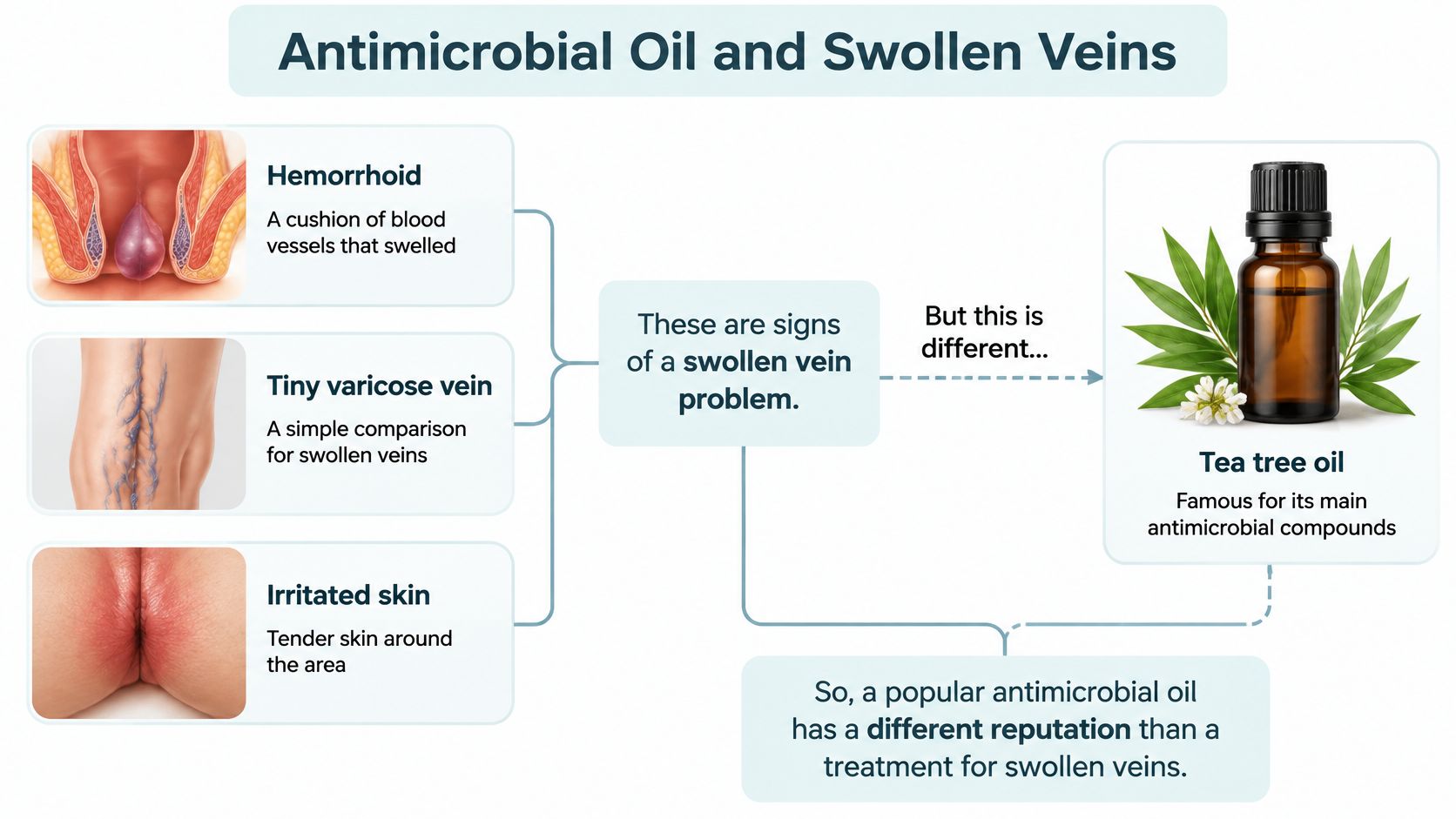
Hemorrhoidal cushions are enlarged blood-vessel tissue, much like varicose veins. Nearby skin can become irritated, but the swollen vessels and any surface irritation are different problems.
What laboratory activity can tell you
Tea tree oil's principal constituent, terpinen-4-ol, has antimicrobial and anti-inflammatory activity in dermatology literature, including effects involving tumor necrosis factor, interleukins, and prostaglandin E2, according to a review in the International Journal of Dermatology.
Those biological signals cannot show whether hemorrhoids shrink, bleed less, or heal faster. A germ-fighting effect and a change in swollen veins are separate outcomes.
Match the solution to the symptom
Germ control does not reposition prolapsed tissue or address constipation and straining, which put repeated pressure on the area. The Drugs.com clinical overview of tea tree oil notes that hemorrhoid use isn't supported by sound research. A report of personal comfort may be sincere, but it cannot establish a reliable treatment effect.
Match the approach to the problem:
- For pain or burning: Look for an anorectal product with a labeled symptom-relief purpose.
- For surface irritation: Choose gentle cleansing and an appropriate soothing or protective product.
- For difficult bowel movements: Address stool consistency and bathroom habits rather than adding another skin ingredient.
- For persistent swelling or protruding tissue: Ask a clinician what may be causing it and which options fit.
The useful question is what a product can do for the specific symptom, and whether it may add irritation.
Where Tea Tree Oil Is Off Limits
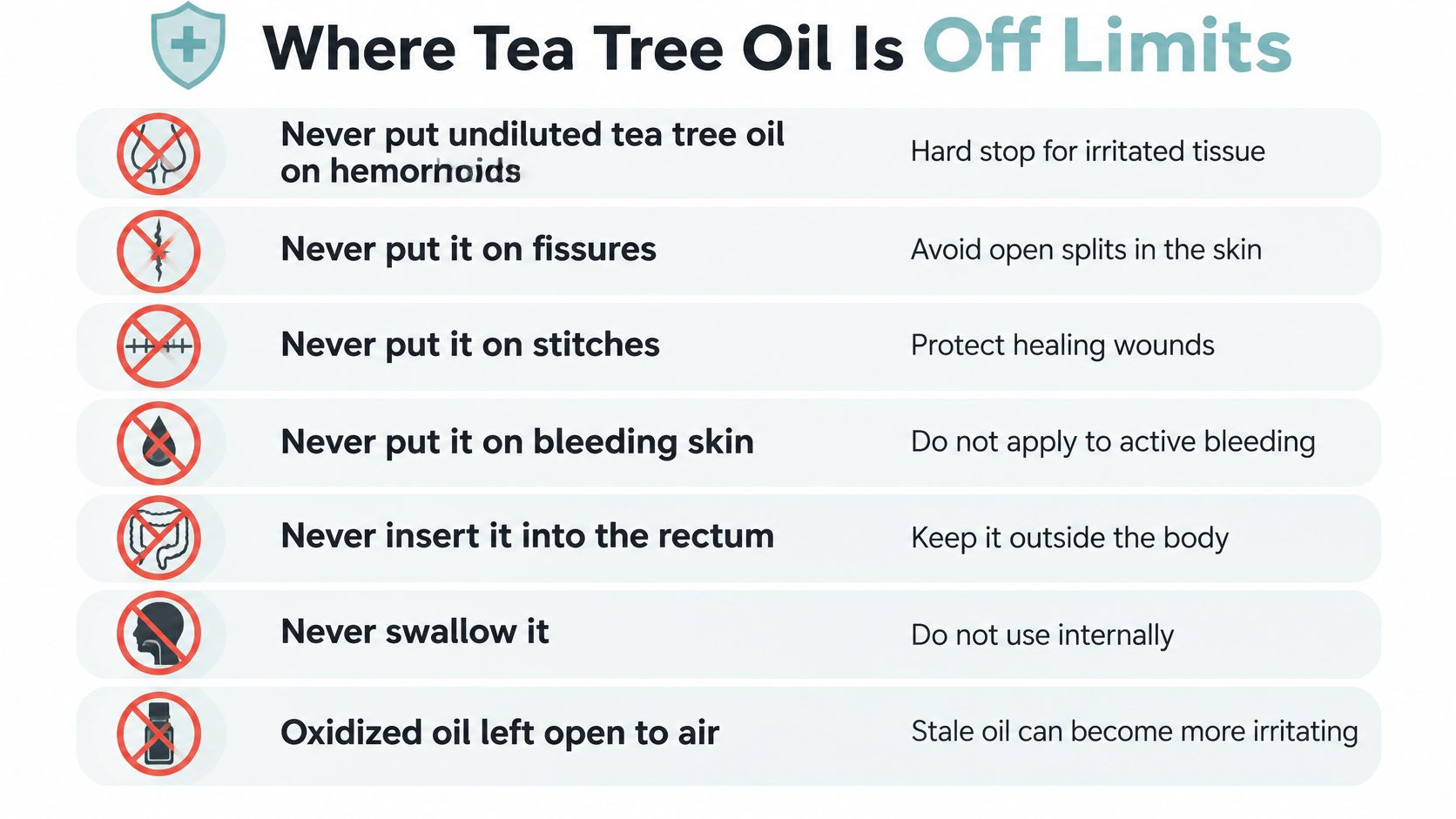
Never apply undiluted tea tree oil to hemorrhoids, fissures, stitches, or bleeding skin. Never insert essential oil into the rectum, and never swallow it.
These boundaries matter more than a dilution recipe. The skin around the anus, also called perianal skin, may already be inflamed, scratched, or split, and nearby tissue may be mucosal rather than ordinary outer skin.
A systematic review of randomized trials reports topical reactions including itching, burning, and scaling, along with irritation and allergic sensitization. It also identifies inadequate safety information or reasons for avoidance in pregnancy, lactation, attempted conception, hypersensitivity, and children under 12.
Keep these route-specific stops in mind before considering any finished product.
External doesn't mean safe on every surface
An external-use label doesn't automatically mean a product belongs on a fissure, healing childbirth injury, or bleeding hemorrhoid. Intact outer skin and an open wound aren't interchangeable application sites.
Oxidation is another concern. Exposure to air and light can create compounds with stronger irritating and sensitizing potential, so an old or poorly stored bottle isn't a harmless substitute for a controlled formulation.
There's no validated home drop recipe established here for sensitive anorectal tissue. Adding a carrier oil doesn't prove that the resulting mixture is suitable for that location.
Where tea tree oil does and does not belong
| Situation | Tea tree oil | Safer move |
|---|---|---|
| Intact outer skin, finished low-strength product, patch tested | Maybe, only if intended for that site. Stop at any sting | Keep any trial brief and external |
| Fissure, stitches, or bleeding skin | No | Skip the oil and ask a clinician |
| Inside the rectum | No | Never insert essential oil |
| Undiluted or oxidized bottle | No | Don't dab pure or stale oil |
| Pregnancy, lactation, or trying to conceive | Only with clinician agreement | Check every product first |
| Child under 12 | No self-directed trial | Get pediatric advice instead |
The same location-specific caution applies to other household remedies. Our guide to Vicks VapoRub for hemorrhoids addresses another common temptation to use a familiar product on tissue it wasn't meant for.
A cautious sequence for a finished external product
This sequence applies only to a finished product intended for the relevant external area, not pure oil or a homemade blend. A pharmacist can help check whether the label supports the use you have in mind.
- Confirm the intended site. Check that the directions permit external use on the area you want to soothe. A general skin-care label isn't enough.
- Check sensitivity away from the sore area. Follow the product's patch-testing instructions on intact forearm skin. Use the labeled amount and observation period rather than inventing a test.
- Keep application limited. If the label permits it and the test causes no reaction, use only a small amount on intact outer skin. A calm forearm test doesn't guarantee perianal tolerance.
- Stop at the first reaction. Burning, new itching, redness, scaling, swelling, or worsening pain are reasons to discontinue use, not signs that the product is working.
- Set a stopping point. If symptoms aren't improving after a brief trial, ask a healthcare provider rather than increasing the amount. Bleeding calls for medical advice.
Don't test several new products together. If a reaction occurs, you'll have a harder time identifying what caused it.
Pregnancy and postpartum recovery need a separate decision
The National Center for Complementary and Integrative Health says topical tea tree products may be safe during pregnancy and breastfeeding, while other evidence reviews emphasize insufficient safety information. Neither position establishes safety on a fresh tear, stitches, or internal tissue.
Ask your OB, midwife, or pharmacist before using a botanical soak or topical product during pregnancy or postpartum recovery. Bring the full ingredient list, not just the name of the ingredient you're interested in.
A practical question is: “I have soreness near a tear or hemorrhoid. Is this exact product suitable for that tissue, and should I use plain water instead?”
Don't add pure oil to maternity pads, wipes, or a sitz bath. Repeated contact doesn't become safer because a pad or water carries the ingredient.
Postpartum rule: A product that feels gentle on your arm may still be wrong for healing tissue.
If you develop severe or worsening pain, fever, persistent bleeding, or a new painful lump, seek medical assessment rather than trying another preparation. If tea tree oil is swallowed, get urgent poison-control or medical advice.
Tea Tree Oil Next to Common OTC Actives
Adding tea tree oil to a drugstore cream doesn't make the cream more effective. It creates an untested mixture, with no clear directions for the combined exposure.
Labeled actives and botanical additives have different jobs. Compare the intended purpose before deciding what to put on sensitive skin.
OTC actives and tea tree oil together
| Active | Usual job | Combine with tea tree oil |
|---|---|---|
| Lidocaine 5 percent | Temporary relief of pain, soreness, burning, and itching | Don't improvise a stack. Numbing may make irritation harder to notice |
| Phenylephrine | Temporary swelling comfort in some OTC products | No established combination here. Don't invent one |
| Witch hazel or protectants | Soothing care or, for protectants, a barrier on irritated skin | Prefer a suitable finished product over adding dripped oil |
| Trace tea tree in a sitz soak | Bath-water additive only | Not a second layer to apply over medicated cream |
Read the Drug Facts before choosing a schedule
A U.S. DailyMed label for a 5% lidocaine anorectal product describes temporary relief of local pain, soreness, burning, itching, and discomfort, with external application up to six times daily under that product's directions and medical advice if bleeding occurs or symptoms don't improve within seven days.
That's a product-specific boundary, not permission to apply every lidocaine cream on the same schedule. Don't exceed your package directions, and ask a health professional before use during pregnancy or breastfeeding.
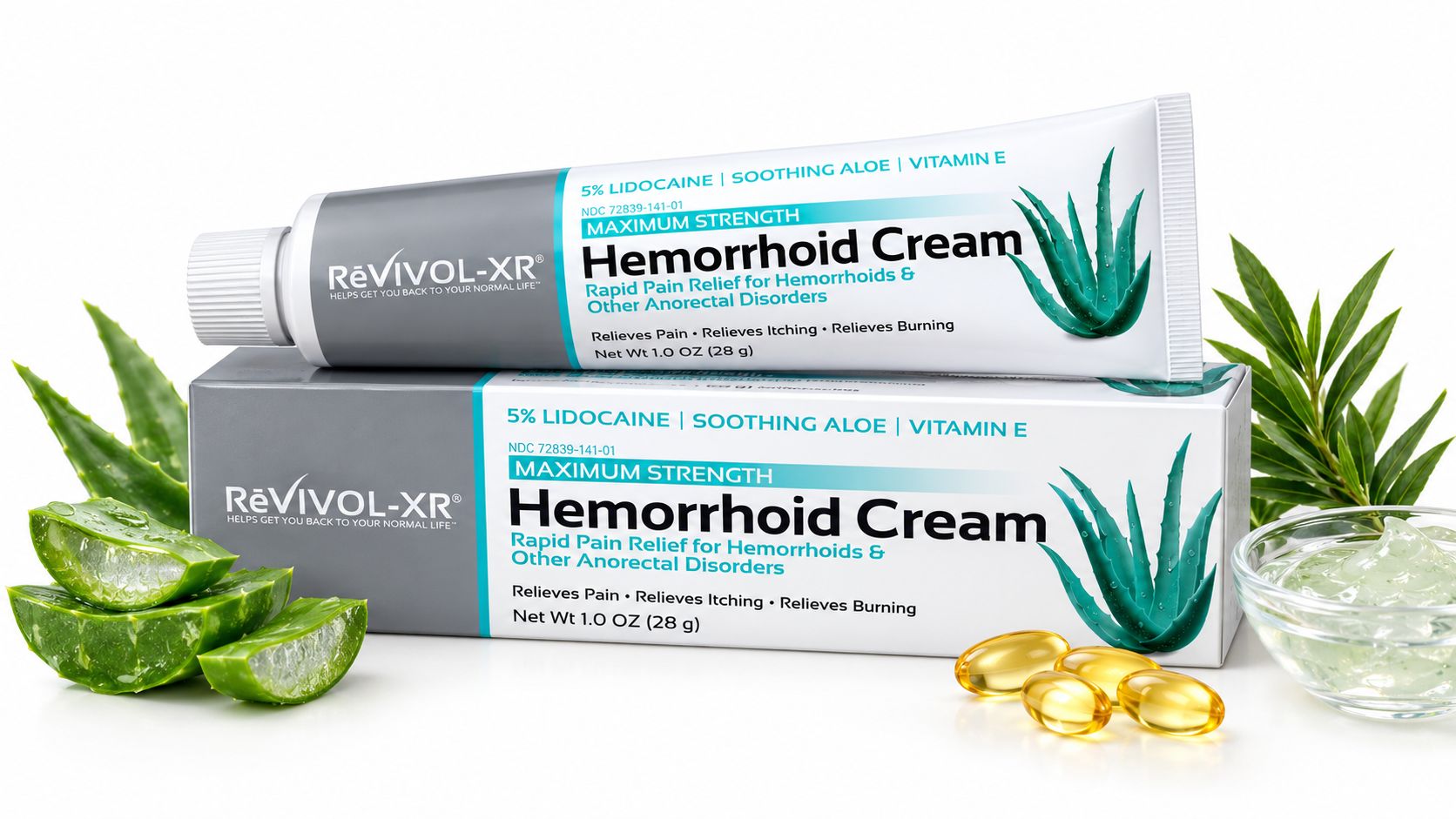
One external option is Revivol-XR 5% Lidocaine Numbing Cream, which includes aloe and vitamin E as inactive ingredients for a soothing feel. It's intended for temporary comfort, not to cure an underlying condition, and shouldn't be inserted into the rectum.
The pictured cream is an example of a finished, labeled external product rather than a home mixture.
Keep one clear external plan
Don't put undiluted oil under or over a numbing cream. Reduced sensation could make it harder to recognize an irritating exposure promptly.
Also, witch hazel and protectants aren't identical. A protectant coats skin, while a witch-hazel product's purpose and tolerability depend on its complete formulation.
Practical rule: Choose a labeled plan, not a homemade combination.
If you're comparing options, our guide to choosing a stronger hemorrhoid cream can help you focus on active ingredients and intended symptoms rather than adding more products.
Choose Proven Comfort Instead
For mild external soreness or itching, start with a routine that reduces friction and makes bowel movements easier. It's a more useful first move than experimenting with an essential oil.
The American Society of Colon and Rectal Surgeons' 2023 guideline for anal fissures supports nonoperative care for acute fissures, including sitz baths, fiber or bulking agents, and topical anesthetics when appropriate. That's fissure guidance, not proof that every anal symptom has the same cause.
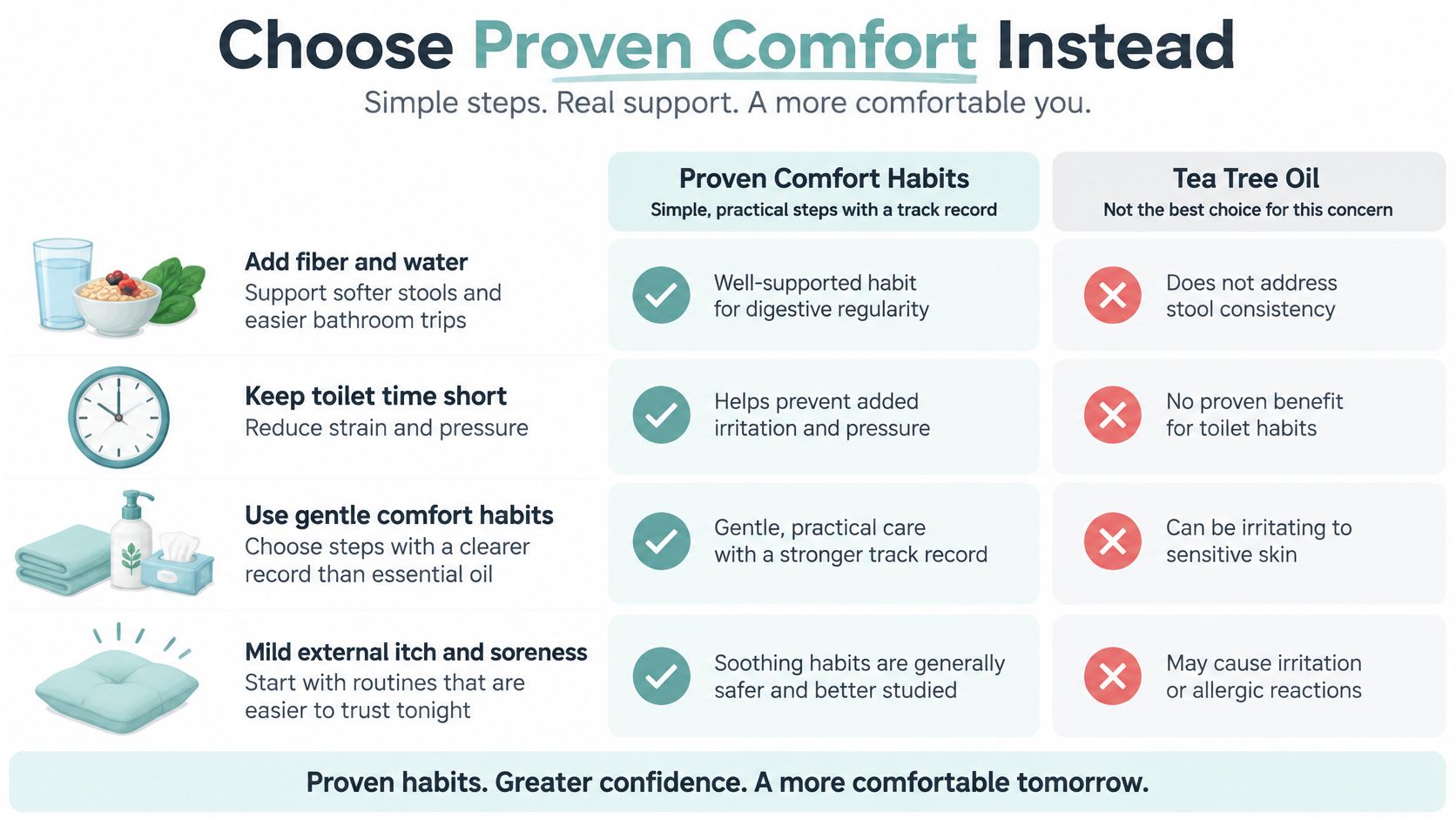
These comfort habits keep the focus on easier bathroom trips and gentler care.
A simple routine for tonight
- Support softer stools. Add fiber gradually and drink water regularly, unless your clinician has given you fluid restrictions.
- Keep toilet visits brief. Don't sit scrolling or push repeatedly when nothing is happening.
- Use comfortably warm water. A plain sitz soak avoids introducing another ingredient to already tender skin.
- Clean without scrubbing. Use water and a soft, damp cloth, then pat dry instead of rubbing with dry paper.
Our sitz bath comfort guide explains how to make soaking part of a gentle routine.
A bath additive is optional
Plain water remains a reasonable choice. A botanical soak isn't necessary, especially when skin is broken or you're unsure what's causing the pain.
If you consider a finished soak, inspect every ingredient, follow its sensitivity-testing instructions, and use it only as a bath-water additive. Essential oils in a packaged blend still require caution, particularly during pregnancy, postpartum healing, or with known allergies.
This video offers another way to follow the comfort discussion.
Comfort measures shouldn't become a reason to postpone an exam. Persistent symptoms, bleeding, fever, or pain that disrupts daily life deserve a healthcare provider's attention.
Quick Answers to Common Searches
Does tea tree oil shrink hemorrhoids?
Evidence from a combination gel cannot show whether tea tree oil alone reduces hemorrhoid size. A reduction in itching also doesn't tell you whether a lump is enlarged or protruding tissue. If it persists, becomes painful, or remains outside, a clinician can examine its location and feel, and check for other possible causes.
Can I use tea tree oil wipes or face products on my bottom?
A wipe is not a controlled treatment dose, and a facial product may contain ingredients unsuitable for irritated perianal skin. Choose a product labeled for the intended external area, or cleanse with water. Stop using anything that causes stinging, redness, or increased soreness.
Is lidocaine safe to use with tea tree oil?
A lidocaine label doesn't establish the safety of adding tea tree oil before or after it. Use each product according to its own directions rather than layering them. If you've already used several products and the area feels worse, bring their packages or ingredient lists to a pharmacist or healthcare provider.
When should I see a doctor?
Contact a healthcare provider about bleeding, persistent symptoms, severe or worsening pain, fever, or a new hard or painful lump. Heavy bleeding, faintness, or feeling seriously unwell warrants urgent care.
Be ready to describe where it hurts, whether there's blood, what changed, and what you've applied.
Revivol-XR offers external comfort options, including labeled numbing cream and gentle-care products. Visit Revivol-XR to compare directions and ingredients. If you're pregnant, recovering from childbirth, or experiencing persistent, severe, or bleeding symptoms, ask your healthcare provider before choosing a product.