Postpartum Recovery Products: A Safe Relief Guide

Most new mothers don't realize that hemorrhoids affect up to 85% of postpartum patients... and the right product depends on whether the problem is external pain, internal pressure, itching, or tearing. The most useful postpartum recovery products match the symptom to the format, while keeping wound care, breastfeeding, delivery type, and warning signs in view.
You may be sitting on a folded towel, dreading the next bowel movement, while a peri bottle, cold pack, witch hazel pad, cream, and sitz bath compete for space in the bathroom. After a vaginal birth, soreness from stitches or a tear can overlap with hemorrhoids and an anal fissure. After a C-section, you may be dealing with incision discomfort, constipation, and pressure from sitting, even when the perineum wasn't injured.
Postpartum discomfort is common, but you don't have to treat every symptom with the same product.
Table of Contents
- Why Postpartum Recovery Products Matter More Than You Think
- Understanding Postpartum Recovery Product Categories
- What the Evidence Says About Cooling and Sitz Baths
- Cream vs. Suppository vs. Spray, Matching Products to Symptoms
- Safety Guidance for Breastfeeding and C-Section Recovery
- Building Your Postpartum Recovery Kit, Practical Next Steps
Why Postpartum Recovery Products Matter More Than You Think
A new mother may describe the problem as “just soreness,” but the details matter. Burning on the outside points toward irritated skin or external hemorrhoids. Deep pressure can suggest internal swelling. Sharp pain during or after a bowel movement may fit fissure-type discomfort. Those experiences can occur together, yet a product designed for one area may do little for another.
The scale of the problem is easy to underestimate. A clinical review reports that hemorrhoids affect up to 85% of postpartum patients (clinical review of postpartum hemorrhoids and anorectal conditions). A separate review found hemorrhoids and anal fissure were the most common perianal conditions in pregnancy and after childbirth, with a combined frequency of 43.9% (NIH/PMC review on perianal diseases).
Many women still assume they should tolerate the discomfort. That can lead to avoiding bowel movements, straining when they finally go, or wiping aggressively because they want to feel clean. Each habit can make already-irritated tissue feel worse.
A growing category with a practical problem
The postpartum products market has expanded from roughly USD 2.22 billion in 2021 to an estimated USD 2.51 billion in 2023, with a projection of USD 3.90 billion by 2030 at a 6.5% CAGR from 2024 to 2030 (Grand View Research postpartum products market report). Breastfeeding accessories are identified as the largest segment, while the U.S. postpartum products market is estimated at USD 704.7 million in 2024 in the same report.
That growth gives shoppers more choices, but not necessarily better guidance. A larger shelf of products doesn't answer the question that matters at 2 a.m.: do you need a cooling product, a topical cream, a cleansing lotion, a suppository, or warm water?
Practical rule: Choose by symptom location first, then check ingredients, directions, and whether the product is suitable for your current stage of recovery.
Understanding Postpartum Recovery Product Categories
Postpartum recovery products work best when each one has a defined job. A peri bottle supports gentle cleansing. A cold pack may numb and calm early perineal discomfort. A hemorrhoid cream may address external itching or burning. A sitz bath offers warm-water comfort without requiring repeated wiping.
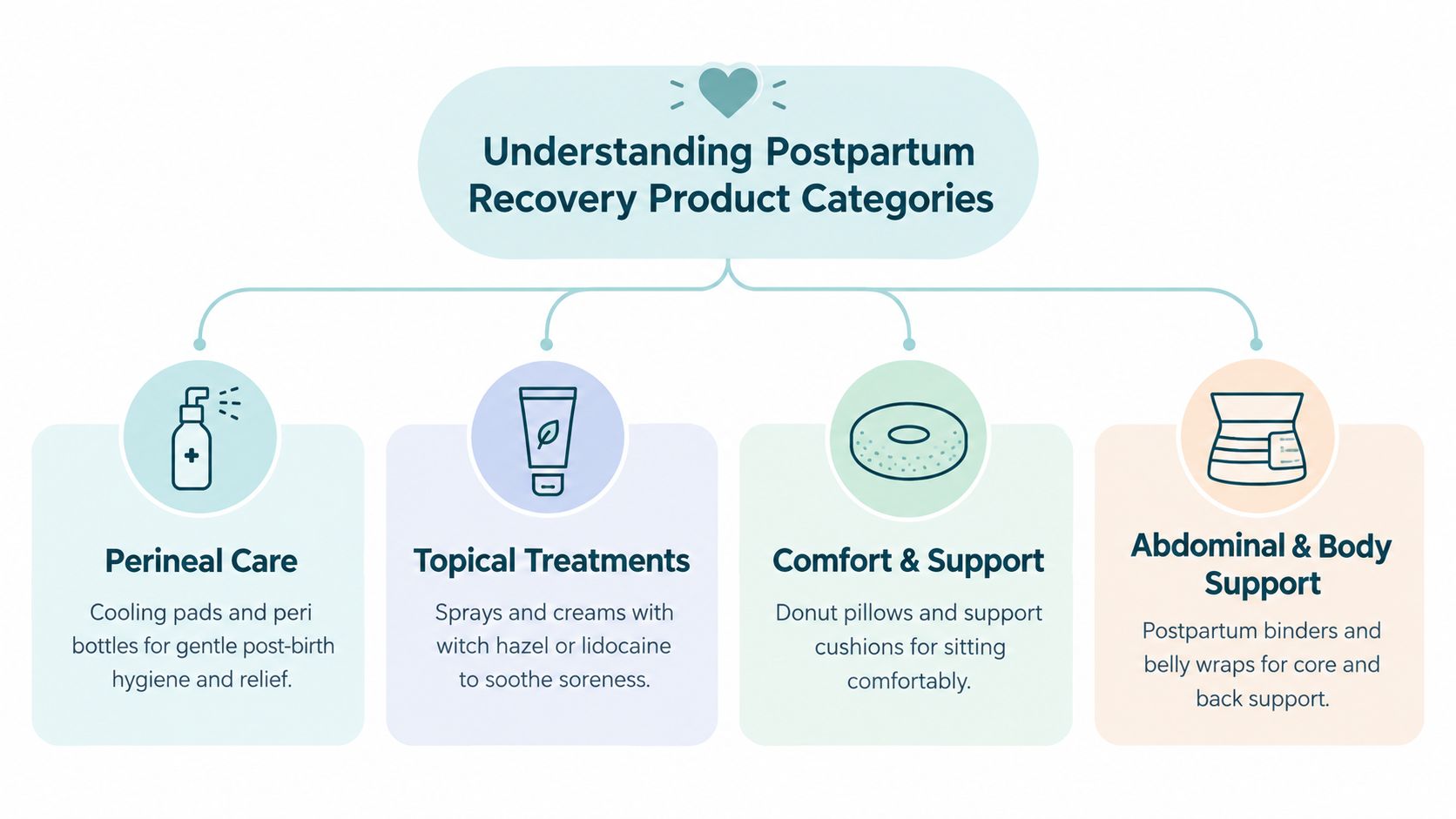
Perineal care
Peri bottles and cooling pads are most useful when the vulvar or perineal area feels tender after vaginal birth. Use water or a product specifically intended for the area, and avoid scrubbing. Cooling pads should be used in short cycles with a barrier between very cold material and skin.
For cleansing after a bowel movement, Revivol-XR® Hygienic Cleansing Lotion, Gentle Relief + Soothing Aloe & Witch Hazel for “Down-There” Sensitive Areas is described as an external-use lotion that can be applied in a dime-sized amount to toilet paper. Its listed ingredients include aloe, witch hazel, chamomile, mineral oil, and vitamin E. Stop if it stings or irritates, and don't apply it to internal tissue or an open wound.
Topical treatments
Creams and sprays are easier to match to external pain, itching, burning, and soreness. Look for clearly listed active ingredients and follow the Drug Facts label. Witch hazel may feel cooling or tightening for some people, while lidocaine can provide temporary numbing relief. Neither removes the need to address constipation, straining, or medical evaluation when symptoms persist.
Suppositories
Suppositories are intended for internal use and may suit internal pressure or swelling, but they aren't automatically appropriate after childbirth. Avoid inserting anything if you have been told to avoid vaginal or rectal products, or if insertion is painful. Ask your healthcare provider or pharmacist about timing, especially after a tear, repair, or significant bleeding.
Sitz baths and support
A sitz bath uses warm water to soothe the perineal or anal area. Comfort cushions can reduce pressure while sitting, but a donut cushion isn't right for everyone. Abdominal support products belong to a separate need, particularly after a C-section, and shouldn't press on an incision or replace medical guidance.
What the Evidence Says About Cooling and Sitz Baths
Cooling has the clearest, though still limited, evidence among non-drug perineal comfort options. A Cochrane review of perineal pain treatments after childbirth found very low-certainty evidence that cooling reduced self-reported pain by about 4.46 points on a 10-point scale within 4 to 6 hours and lowered the chance of pain at 24 to 48 hours, with a risk ratio of 0.73.
That doesn't mean an ice pack will make recovery painless. A more recent expert review discussed in the same evidence context found that 4 of 7 randomized trials showed significant pain reduction during the first 24 to 48 hours, while two found no significant benefit. No cold-related injuries were reported in those trials, but safe application still matters.
Use cold strategically
A gel pad or wrapped ice pack should make contact with the area without freezing the skin. Short applications are more sensible than leaving a cold product in place for a long period. Cooling tends to make the most practical sense early after vaginal delivery or perineal trauma, including a tear or episiotomy.
Warm-water care is different. ACOG's postpartum pain guidance says evidence for topical agents and cooling therapies is inconclusive, and the evidence supporting ice packs is low quality. Clinical guidance still commonly uses sitz baths for symptom relief, hygiene, and comfort.
For a practical method, this sitz bath guide can help you set up a warm soak without adding unnecessary ingredients. Cleveland Clinic describes using enough warm water to cover the perineum, typically 3 to 4 inches, soaking for 15 to 20 minutes, and patting dry afterward (Cleveland Clinic sitz bath guidance).
Cream vs. Suppository vs. Spray, Matching Products to Symptoms
Product format should follow the symptom, not the popularity of the product. External discomfort is easier to reach with a cream or spray. Internal pressure may call for a different discussion with a clinician or pharmacist. A sitz bath is broader comfort care, not a substitute for targeted treatment when symptoms are severe.
| Primary Symptom | Best Product Format | Key Ingredients to Look For |
|---|---|---|
| External itching, burning, or irritated skin | Cream or gentle cleansing lotion | Witch hazel, aloe, skin protectants, or lidocaine where appropriate |
| External pain that makes touching difficult | Touch-free spray or carefully applied cream | Lidocaine for temporary numbing, soothing ingredients, clear external-use directions |
| Internal pressure or swelling | Suppository only when appropriate for you | Clearly labeled active ingredients and postpartum-use guidance |
| General perineal soreness and swelling | Sitz bath or wrapped cooling pad | Plain warm water for comfort, or a purpose-made cold product |
| Pain linked to bowel movements and tearing | Comfort care plus healthcare guidance | Avoid straining; ask about fissure-specific care |
Creams give you control over the amount and can coat irritated external skin. Sprays reduce touching, which can be helpful when the area is too tender to handle. Suppositories reach internal tissue, but insertion can be uncomfortable and isn't suitable for every postpartum situation.
A product containing lidocaine may temporarily numb discomfort, while witch hazel may provide a cooling sensation. Read the label carefully, especially if you're breastfeeding, have allergies, or are using another topical product. For additional technique guidance, see how to use a suppository for hemorrhoids, but confirm that internal use is appropriate after your delivery.
Safety Guidance for Breastfeeding and C-Section Recovery
Breastfeeding changes how carefully you should choose any medication or topical product. A product applied to external anorectal skin may have different considerations from one inserted internally, but “topical” doesn't automatically mean risk-free. Check the active ingredients and ask your healthcare provider or pharmacist before using lidocaine, phenylephrine, hydrocortisone, or a combination product while breastfeeding.
Lochia also changes the routine. Use clean, breathable menstrual pads as directed by your maternity team, and avoid putting a hemorrhoid product on vaginal tissue unless the label specifically says it's intended for that use. Keep anal and vaginal products separate, and wash your hands before and after application.
C-section considerations
A C-section doesn't prevent hemorrhoids. Reduced movement, constipation, and discomfort sitting can still make bowel symptoms difficult. At the same time, a peri bottle or hemorrhoid cream won't treat an abdominal incision, and a belly binder shouldn't rub, trap moisture against, or compress the surgical site without guidance.
Safety boundary: Stop a product if it causes increasing burning, rash, swelling, or pain. Persistent, severe, or bleeding symptoms need assessment rather than another over-the-counter experiment.
The postpartum pain relief guide may help you organize general comfort measures, but it doesn't replace individualized discharge instructions. Seek prompt medical care for heavy bleeding, fever, severe pain, wound concerns, or symptoms that are worsening instead of settling.
Building Your Postpartum Recovery Kit, Practical Next Steps
A useful kit doesn't need every product on the shelf. Start with the delivery-related needs, then add one item for the symptom causing the most trouble.
For vaginal recovery, a simple setup may include:
- Gentle cleansing: A peri bottle and a soft method for drying without rubbing.
- Early swelling comfort: A wrapped cooling pad used for short applications.
- Warm-water option: A basin or sitz bath setup for soreness and anal comfort.
- External symptom relief: One appropriately labeled cream or spray, not several overlapping products.
- Bowel support: Fluids, fiber-rich foods, and a plan from your healthcare team if constipation is a concern.
After a C-section, prioritize supplies that make bathroom trips and sitting easier without touching the incision. A supportive pillow, loose clothing, and healthcare-provider-approved abdominal support may matter more than a perineal kit. Hemorrhoid care can still be added if pressure, itching, or painful bowel movements appear.
A simple decision check
Before buying or applying anything, ask:
- Where is the symptom? External skin, internal pressure, perineum, or incision?
- What does it feel like? Itching, burning, swelling, soreness, or sharp tearing?
- Is the skin intact? Don't apply a product to broken skin unless its instructions allow it.
- Could breastfeeding or another medicine change the choice? Ask a pharmacist or healthcare provider.
- Is there bleeding, severe pain, fever, or worsening swelling? Get medical advice instead of self-treating.
Postpartum recovery isn't a test of endurance. The right postpartum recovery products can make basic tasks more manageable, but persistent hemorrhoid, fissure, itching, or pain deserves professional attention.
Revivol-XR offers an external cleansing lotion with aloe, witch hazel, chamomile, and vitamin E for gentle hygiene, plus other OTC comfort formats described on its site. Visit Revivol-XR to review the options and choose a product that fits your symptoms, delivery recovery, and label directions.