Lidocaine Based Numbing Cream: Relief Guide

Many people don't realize how quickly a hemorrhoid flare, anal fissure, or postpartum soreness can turn an ordinary evening into a search for anything that might stop the burning.
You may be comparing creams, wondering whether lidocaine based numbing cream is safe for sensitive skin, or trying to understand whether 5% is better. This guide explains how lidocaine works, where it fits into hemorrhoid and fissure care, how pregnancy changes the conversation, and which label details deserve your attention.
Table of Contents
- When Numbing Cream Becomes the Only Thing on Your Mind
- What Lidocaine Actually Does on the Skin
- Why 5% Lidocaine Is the OTC Sweet Spot
- Where a Lidocaine Based Numbing Cream Fits in Real Relief
- Safety Rules, OTC Status, and Special Situations
- Choosing the Right Product and What to Do Next
When Numbing Cream Becomes the Only Thing on Your Mind
You finish using the bathroom, clean as gently as possible, and still feel a sharp sting that doesn't settle. Sitting becomes uncomfortable. Walking, changing clothes, or trying to sleep keeps reminding you of the irritated area.
That experience is common, even if people rarely discuss it openly. Hemorrhoids, anal fissures, itching from irritated skin, and soreness after childbirth can all make basic hygiene and daily movement feel difficult. During pregnancy and after delivery, perianal problems are especially frequent. One study found that 43.9% of women developed hemorrhoids or anal fissures during pregnancy or after delivery, with 61% of cases occurring in the third trimester and 34.1% after delivery (study of pregnancy-related hemorrhoids and fissures). A separate study of 1,422 pregnant women found anal pathologies in 38.4%, including hemorrhoidal disease in 13% and anal fissure in 10.5% (2024 pregnancy study).
The important question isn't only whether a cream numbs. You also need to know what tissue it reaches, how much to apply, whether the product is external-use only, and when symptoms need medical attention.
Practical rule: Temporary comfort is useful, but it shouldn't hide bleeding, worsening pain, fever, or symptoms that keep returning.
The sections ahead focus on the decisions that matter most: how lidocaine interrupts pain signals, why 5% is a familiar OTC benchmark, how to use it cautiously on delicate skin, and what to consider during pregnancy or postpartum recovery.
What Lidocaine Actually Does on the Skin
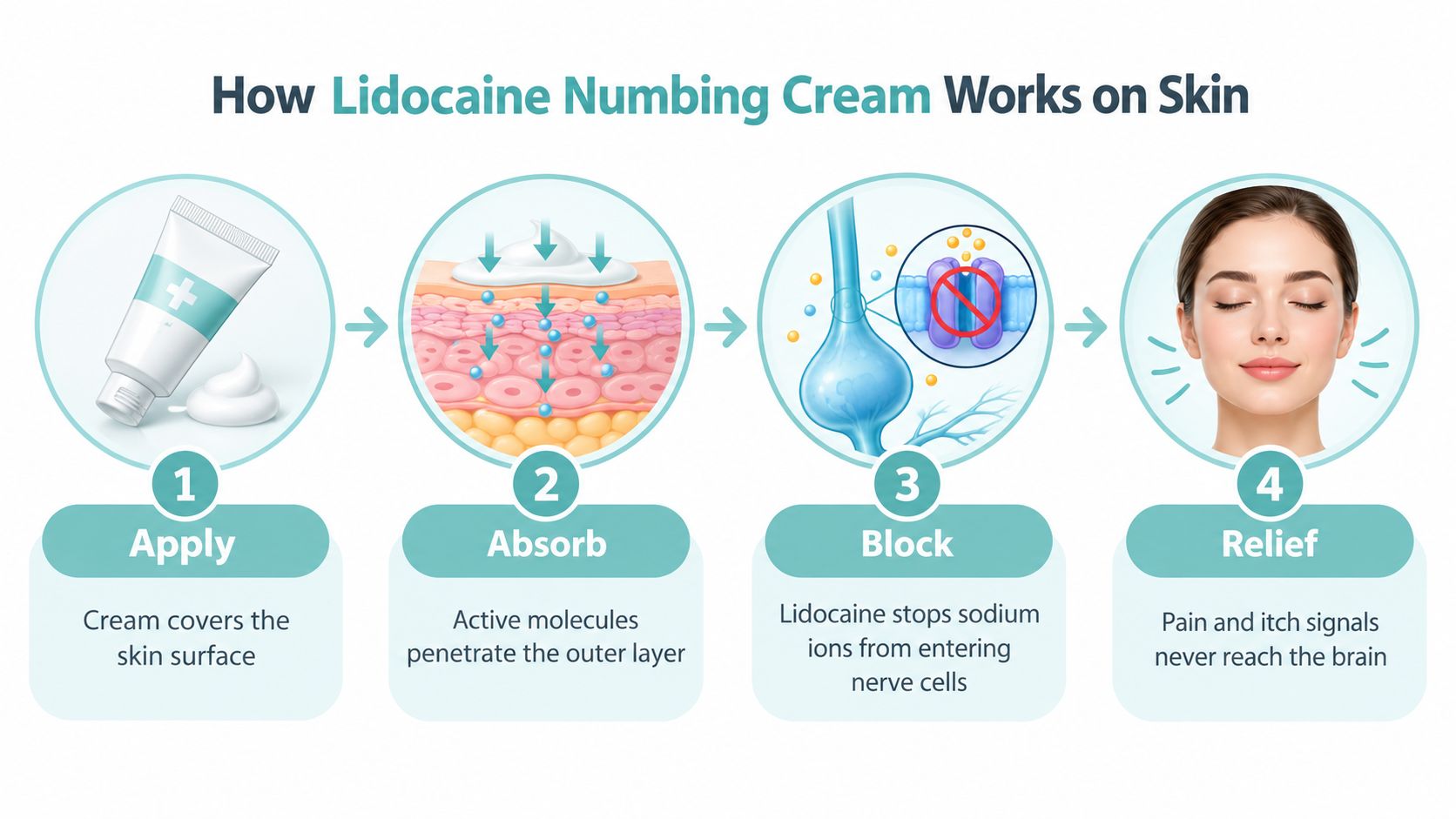
Lidocaine is an amide local anesthetic. Applied to the skin, it reduces the ability of nearby nerve endings to send pain and itch signals. In simple terms, it turns down communication between the irritated surface and the brain. It doesn't repair a fissure, remove a hemorrhoid, or resolve the cause of inflammation.
Topical penetration is mainly superficial. One expert review reports a maximal penetration depth of about 8 to 10 mm for topical lidocaine (clinical review of topical lidocaine). That helps explain why it can be useful for localized surface pain, burning, and itching, while offering less benefit for deeper inflammatory pain.
How quickly and strongly it works depends on more than the percentage printed on the tube. Skin condition, formulation, application area, contact time, and whether the area is covered can all affect absorption. Broken or inflamed skin may behave differently from intact skin, so using extra cream isn't a reliable shortcut to better relief.
A product such as Revivol-XR 5% Lidocaine Numbing Cream is labeled for temporary external relief of localized hemorrhoid discomfort, burning, and itching. Its listed formula includes lidocaine with aloe and vitamin E, and the product directions emphasize a thin external application and following the label.
The key distinction is simple: numbing is symptom relief, not a cure. You still need gentle cleansing, comfortable bowel habits, and medical advice when symptoms persist or become concerning.
Why 5% Lidocaine Is the OTC Sweet Spot
A 5% lidocaine cream contains 5 grams of lidocaine in every 100 grams of product, commonly expressed as 50 mg per gram. That concentration is familiar because FDA external analgesic materials identify lidocaine in the 0.5% to 4% range for topical external analgesic use, while specific OTC 5% anorectal products are marketed under their labeling and monograph framework (FDA external analgesic monograph material).
A lower-strength product may be enough for mild surface itching or occasional irritation. A 5% formula is often selected when localized burning or pain is more intrusive. Higher concentration doesn't automatically mean better care, though. The formulation, amount applied, surface area, and exposure time can matter as much as the number on the label.
| Concentration | Typical strength | Common uses | OTC status |
|---|---|---|---|
| 0.5% to 2.5% | Lower | Mild localized discomfort and itching | OTC products may be available |
| 4% | Higher topical strength | Localized external discomfort | Included in FDA external analgesic framework |
| 5% | Maximum-strength OTC category for some anorectal products | Temporary hemorrhoid pain, burning, itching, and soreness | Available in labeled OTC products |
The DailyMed label for a 5% anorectal lidocaine cream describes temporary relief of pain, itching, burning, soreness, and discomfort associated with hemorrhoids and other anorectal disorders, and states that it's for external use only (DailyMed lidocaine 5% anorectal label).
Before buying, compare the active ingredient panel rather than relying only on phrases such as “maximum strength.” This guide to anorectal cream with lidocaine can help you understand how lidocaine products differ from creams that mainly moisturize, protect, or address swelling.
Where a Lidocaine Based Numbing Cream Fits in Real Relief
Consider the person who feels a knife-like sting during a bowel movement and then dreads wiping. An anal fissure can make cleaning feel harsh, so a thin layer of an appropriately labeled external product may make the surrounding skin more comfortable. It won't close the fissure or replace measures that keep stool softer and bowel movements easier.
Someone with a painful hemorrhoid may notice a different pattern: pressure while sitting, surface burning, or itching that becomes worse after repeated wiping. In that situation, lidocaine can fit alongside warm sitz baths, adequate fluids, fiber, stool-softening strategies, and a protective ointment when appropriate.
Postpartum recovery deserves its own caution. Perineal soreness, swelling, stitches, hemorrhoids, and fissures can overlap, and the safest product choice depends on where the discomfort is located and whether tissue is intact. A healthcare provider can help distinguish ordinary recovery discomfort from a problem that needs evaluation.
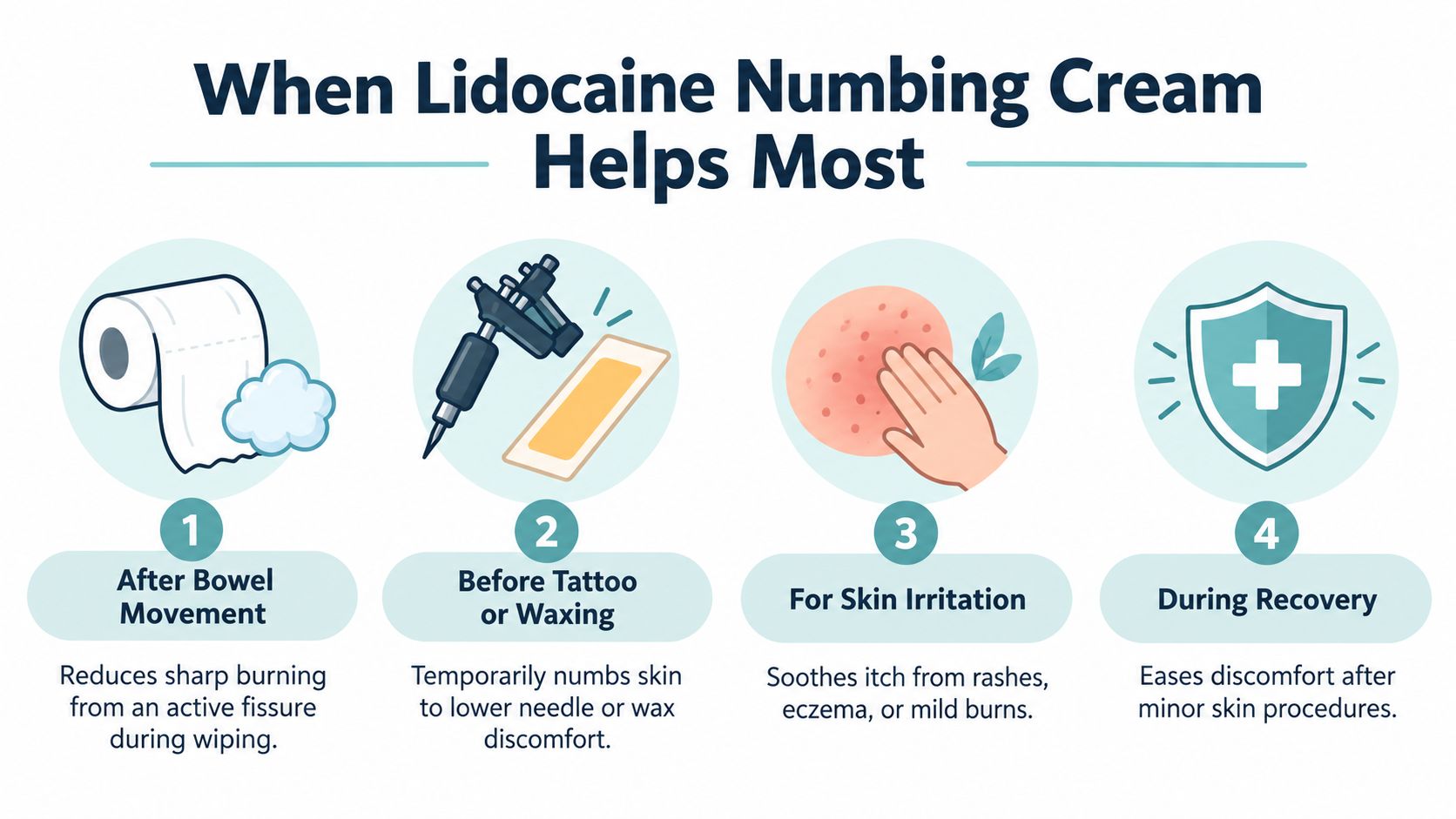
Lidocaine may be useful for:
- Sharp fissure-related burning: It can temporarily reduce surface discomfort around hygiene and bowel movements.
- Hemorrhoid irritation: It may quiet localized pain, itching, and burning while other care addresses stool strain and skin friction.
- Postpartum soreness: Use only according to the product label and with provider guidance when pregnant or breastfeeding.
- Itch and scratch cycles: Less itching can make it easier to stop scratching, but the irritant still needs to be identified and avoided.
Lidocaine isn't the right answer for every symptom. It doesn't treat infection, explain unexplained bleeding, or remove a deeper source of pain. Internal symptoms also require careful attention to the label, because many 5% products are explicitly intended for external use only.
Safety Rules, OTC Status, and Special Situations
The most important safety principle is exposure control. FDA labeling states that systemic absorption rises with both application duration and surface area. For one lidocaine topical system, only about 3 ± 2% of the applied dose is expected to be absorbed when used as directed. An EMLA label reports mean lidocaine absorption of 0.045 ± 0.016 mg/cm²/hr, with peak plasma timing for lidocaine ranging from 21 to 125 minutes under topical use (FDA lidocaine and EMLA labeling).
That's why large-area application, prolonged wear, occlusion, and damaged skin deserve caution. Serious adverse events have been reported after misuse of topical anesthetics, including a 2024 TGA report involving two serious neonatal cases with EMLA cream (published safety report).
| Situation | Safe to use? | Notes |
|---|---|---|
| Small amount on intact external skin | Usually, when label directions are followed | Use the smallest effective amount |
| Large area or prolonged contact | Avoid unless a healthcare provider directs it | Absorption can increase with area and time |
| Broken, raw, bleeding, or infected tissue | Don't self-treat with lidocaine | Seek medical guidance |
| Pregnancy or breastfeeding | Ask a healthcare professional first | Pregnancy outcome data remain limited |
| Children under the labeled age | Don't use without medical advice | Follow the exact product label |
A 5% product label may direct adults and children 12 years and older to cleanse the area gently, then apply externally up to 6 times daily. It may also state that you shouldn't use finger cots or mechanical devices to insert the product into the rectum, and that you should consult a doctor if symptoms don't improve within 7 days or if bleeding occurs (DailyMed OTC directions).
Pregnancy requires balanced advice. Medical references generally consider topical lidocaine usable during pregnancy when needed, but recommend medical supervision because information about outcomes such as preterm delivery and low birth weight is limited (pregnancy and lactation lidocaine reference). For gentle cleansing after bowel movements, Revivol-XR Hygienic Cleansing Lotion is described as an external-use lotion containing aloe, chamomile, witch hazel, and vitamin E. It isn't a substitute for lidocaine, and its label still matters.
Read more about lidocaine cream side effects, especially if you have heart rhythm concerns, seizure medication, significant medical conditions, or symptoms that are worsening. Stop and seek care for bleeding, fever, severe swelling, allergic symptoms, or pain that doesn't settle.
Choosing the Right Product and What to Do Next
Start with the Drug Facts label, not the front-of-package promise. Check the exact lidocaine percentage, whether the product is for external use only, and whether it contains other active ingredients such as phenylephrine or pramoxine.
A plain lidocaine cream may suit someone who wants temporary numbing for a small area of external discomfort. A hemorrhoid-specific formula may combine an anesthetic with skin protectants or a vasoconstrictor, but those added ingredients can create additional warnings for people with certain health conditions.
Compare the base and the packaging
Creams usually spread easily and may feel lighter. Ointments can leave a thicker protective layer, which may help reduce friction, but they can also feel messier. Petrolatum and zinc oxide are examples of skin-protective ingredients often chosen for barrier support, while fragrance and alcohol may be unwelcome on irritated perianal skin.
A tube can help limit repeated contact with the product. A pump or hygienic applicator may make controlled external application easier. Whatever the package, don't use more because the area still feels uncomfortable.
Use a short, careful trial
- Clean gently: Use mild soap and warm water if appropriate, rinse well, and pat dry.
- Apply a thin layer: Stay within the product's directions and keep the application external if the label says external use only.
- Watch the response: Stop if redness, swelling, irritation, or worsening pain develops.
- Track the pattern: Note bowel movements, itching, bleeding, and how long relief lasts.
- Escalate when needed: Persistent, severe, or bleeding symptoms call for a healthcare provider, not repeated increases in cream.
This guide to the best hemorrhoid cream with lidocaine can help you compare product types while keeping the focus on active ingredients and label directions.
Revivol-XR offers a 5% lidocaine cream for temporary external relief of hemorrhoid-related pain, burning, itching, and discomfort, with aloe and vitamin E in the listed formula. Visit Revivol-XR to review the product details, follow the label, and choose a discreet next step for comfort.