5 Ways to Stop Straining During Bowel Movements (That Actually Work)

Most people don’t realize that straining on the toilet for just five minutes can be the start of years of hemorrhoid pain. So, how do you stop?
I remember sitting in a doctor’s office, embarrassed and in pain, after a particularly bad bout of constipation. I had tried everything I could think of... drinking more water, eating more salads... but nothing seemed to work. The doctor listened patiently and then said something that completely changed how I thought about this problem. He explained that it wasn't about one big change, but a series of small, connected habits.
He told me about a patient who thought his problem was just "bad luck." For months, this man would spend 20 minutes on the toilet every morning, phone in hand, pushing and straining. He developed painful hemorrhoids that bled and made it hard to sit. He was convinced he needed surgery. The doctor simply gave him a small footstool and told him to leave his phone outside the bathroom. A week later, the man came back, amazed. His straining had stopped, and his symptoms were already getting better.
It wasn't a miracle cure... it was just understanding how the body is supposed to work.
Your toilet posture is often more important than the fiber you eat.
Learning how to avoid straining during bowel movements boils down to a few powerful habits: adding the right kind of fiber, staying properly hydrated, fixing your posture on the toilet, and listening to your body’s cues. This combination is the key to softening stool so it can pass easily, which prevents the pressure that causes so much discomfort. Making these small adjustments can be the difference between daily pain and effortless relief.
At Revivol-XR, we've seen firsthand how these simple strategies, combined with soothing care, can transform people's lives. It’s not just about temporary fixes... it’s about creating a sustainable routine for long-term comfort.
To take action, focus on these steps:
- Add one high-fiber food like pears, berries, or beans to your next meal.
- Place a small stool under your feet the next time you use the toilet to lift your knees.
- Drink a full glass of water right now and keep a water bottle with you all day.
- When you feel the urge to go, don't wait... head to the bathroom within a few minutes.
That doctor's appointment wasn't just about getting a diagnosis... it was about realizing that I had more control than I thought. The straining, the pain, the worry... it was all connected to simple, daily habits I could change.
Why Straining Happens And How To Stop It Now
Having to strain on the toilet isn't just a minor annoyance... it's your body waving a big red flag. When you feel the need to push, bear down, or hold your breath, it’s a clear sign that your stool is too hard or your body isn't in the right position for a smooth bowel movement.
This extra effort dramatically increases pressure on the delicate veins around your rectum, a direct cause of painful hemorrhoids and anal fissures.
This problem is incredibly widespread, often fueled by modern lifestyles. In fact, research points to straining from constipation as a leading trigger for hemorrhoids. The issue is especially common among pregnant women, with up to 40% developing hemorrhoids, and people with sedentary jobs whose lack of movement slows down digestion. You can find a detailed analysis of these risk factors and their impact on treatment trends.
The Four Pillars Of Effortless Bowel Movements
The good news is that you don't need a complete life overhaul. The solution lies in making small, consistent adjustments to your daily routine. Just think of it as a simple framework built on four essential pillars.
- Your Diet: What you eat has a direct impact on your stool. A diet low in fiber is a common culprit behind hard, dry stools that are tough to pass.
- Your Hydration: Water is fiber's essential partner. Without enough of it, even a high-fiber diet can backfire and make constipation worse.
- Your Toilet Posture: The typical seated position on a modern toilet actually creates a kink in your colon, forcing you to push much harder than you should.
- Your Habits: Ignoring the urge to go or spending too much time on the toilet can throw off your body's natural rhythm and create new problems.
By focusing on these four areas, you can transform your bathroom experience from a daily struggle into a smooth, natural process. It's all about working with your body, not against it.
In the sections that follow, we’ll take a closer look at each of these pillars. But first, here is a quick-start guide to give you an immediate action plan.
Quick Guide to Stop Straining
This table breaks down the most effective strategies you can use to reduce straining right away, with a simple, actionable step for each one.
| Strategy | Why It Works | Simple Action Step |
|---|---|---|
| Increase Fiber | Fiber adds bulk and softness to your stool, making it easier to pass. | Add one high-fiber food to your next meal, like a pear, a handful of berries, or a scoop of beans. |
| Boost Hydration | Water helps fiber do its job and prevents stool from becoming hard and dry. | Drink a full glass of water right now, and keep a water bottle with you for the rest of the day. |
| Fix Your Posture | Elevating your feet unkinks your colon and mimics a natural squatting position. | Place a small stool or stack of books under your feet the next time you use the toilet. |
| Heed The Urge | Waiting too long allows your colon to absorb more water from the stool, making it harder. | When you feel the first urge to go, head to the bathroom within a few minutes instead of holding it. |
Mastering these simple habits is the key to knowing how to avoid straining during bowel movements for good.
Free tools: Not sure if your stool is too hard? Check it against our Bristol Stool Chart checker. Then find your daily fiber target with our fiber calculator.
Adjusting Your Diet For Smoother Bowel Movements
When you’re trying to figure out how to avoid straining during bowel movements, what’s on your plate is often the best place to start. The old advice to "eat more fiber" is spot on, but it doesn't mean much without a game plan. Making a few smart food choices is the foundation for creating stool that is soft, bulky, and easy to pass.
This isn’t about a complete diet overhaul overnight. The real goal is to gradually build sustainable eating habits that support your digestive system for the long haul.
Understanding The Two Types Of Fiber
Fiber isn’t a one-size-fits-all deal. There are two main types, and your body needs a healthy balance of both to keep things moving smoothly. Think of them as a team.
Soluble Fiber: This type dissolves in water and creates a gel-like substance in your gut. It's the "softener" in your diet. Its main job for bowel health is making your stool softer and much easier to manage.
Insoluble Fiber: This is the "bulking agent." It doesn’t dissolve. Instead, it adds weight and substance to your stool, which helps it move more quickly and efficiently through your system.
A common mistake is loading up on one type of fiber and ignoring the other. For smooth, effortless bowel movements, you absolutely need both the softening power of soluble fiber and the bulking action of insoluble fiber.
Easy Ways To Add More Fiber To Your Meals
Boosting your fiber intake is probably simpler than you think. You don’t need to hunt down specialty foods; many common, delicious options are already packed with what you need.
Start by adding one or two of these to your daily routine:
- For Breakfast: Kick off your day with oatmeal or a high-fiber cereal. A great trick is to top it with berries like raspberries or blackberries, which are fiber powerhouses.
- For Lunch: Try adding a cup of lentil soup on the side or sprinkling a half-cup of black beans into your salad. And always choose whole-wheat bread over white for sandwiches.
- For Dinner: Swap out white rice for brown rice or quinoa. A good rule of thumb is to make sure at least half of your plate is filled with vegetables, especially leafy greens like spinach or broccoli.
- For Snacks: Instead of chips, reach for an apple or a pear (keep the skin on!), a handful of almonds, or some chia seed pudding.
Remember to take it slow. A sudden, massive jump in fiber can lead to uncomfortable gas and bloating. Give your digestive system time to adjust by adding just one new high-fiber food every few days. This gradual approach is key to learning how to prevent hemorrhoids through diet, not just treating the symptoms of straining.
The Critical Role Of Hydration
Fiber can't do its job alone. Its most important partner is water. Without enough fluids, a high-fiber diet can actually backfire and make constipation even worse.
Think of fiber as a dry sponge. It needs water to expand, soften up, and work its magic.
When you eat fiber, it pulls water into your colon. This process is exactly what creates a soft, bulky stool that's easy to pass. If you're dehydrated, there just isn't enough water available for the fiber to absorb, leaving you with a hard, dense stool that’s difficult to move.
Aim to drink at least 8-10 glasses of water throughout the day. If you're actively increasing your fiber, you might need even more. Herbal tea and other fluids can help, but plain water is always your best bet.
Foods That Can Make Straining Worse
Just as some foods help, others can really hinder your progress. You don’t have to cut them out completely, but being mindful of how often you eat them can make a huge difference.
The usual culprits include:
- Highly Processed Foods: Things like white bread, pastries, fast food, and most frozen dinners are low in fiber and high in fat and sugar, all of which can slow down digestion.
- Excessive Dairy: For many people, large amounts of cheese and milk can be constipating. Just pay attention to how your body reacts after you have them.
- Red Meat: Because it has no fiber, red meat can take longer for your body to digest, potentially contributing to slower bowel transit times.
The key here is balance. It’s not about restriction, but about prioritizing whole, fiber-rich foods that naturally support your body's digestive rhythm.
Your Posture and Habits on the Toilet
What you do in the bathroom is just as important as what you eat and drink. The way you sit, how long you stay there, and even the way you breathe can make the difference between an easy, comfortable bowel movement and a painful, straining one.
Believe it or not, modern toilets work against our natural anatomy. Sitting upright creates a kink in the colon that acts like a brake, forcing you to push and strain unnecessarily. But there's a surprisingly easy fix.
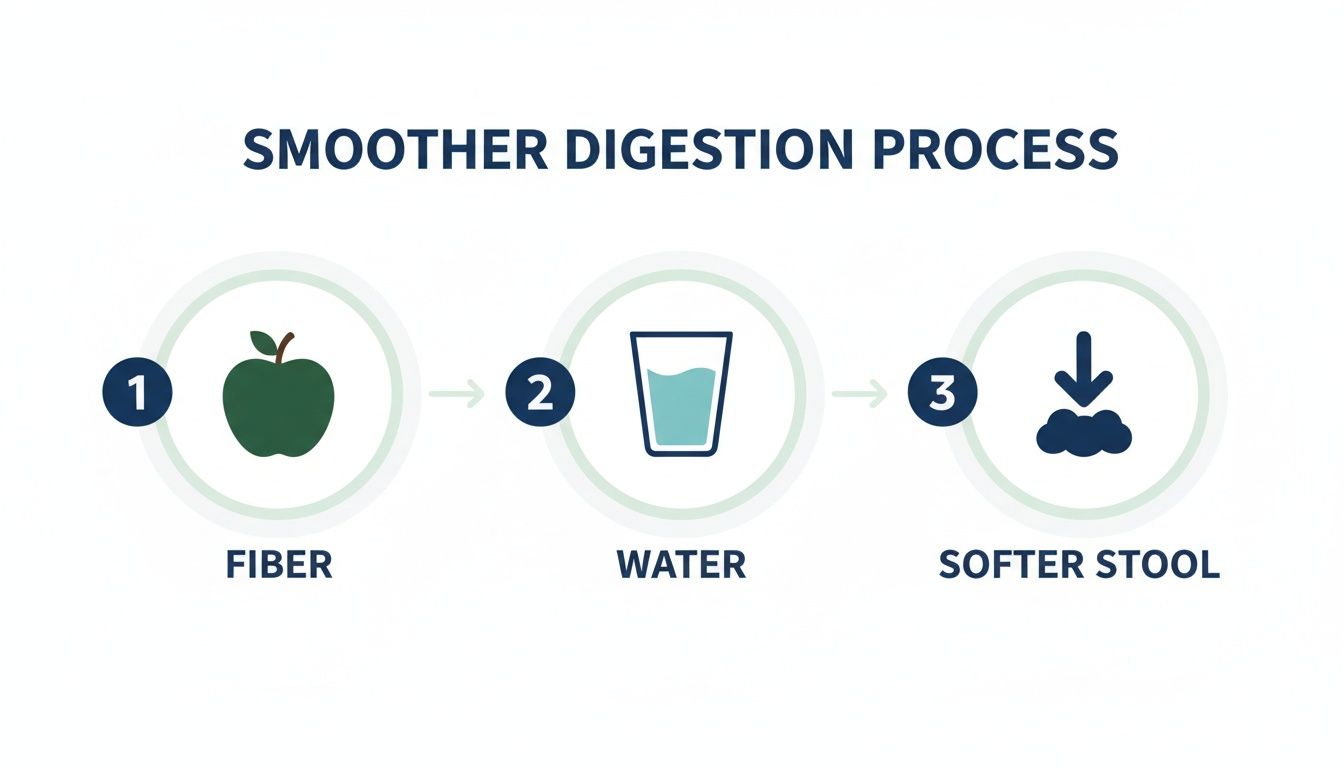
This simple flow shows how getting enough fiber and water is the foundation... it sets the stage for everything else to work properly.
The Power of Proper Toilet Posture
The single best change you can make in the bathroom is to get your feet up. Pop your feet on a small stool, a yoga block, or even a stack of old books to lift your knees higher than your hips.
This simple move mimics a natural squat.
Why does it work? This posture straightens out the anorectal angle... that kink at the end of your colon. It creates a straight shot for stool to pass through without any roadblocks. The result is a faster, more complete, and much less forceful bowel movement. In fact, studies show that using a footstool can slash straining effort by as much as 35%.
Build Better Bathroom Habits
Good posture is a huge piece of the puzzle, but your habits matter, too. Some common behaviors can completely undo your best efforts.
- Go When You Get the Urge: When your body gives you the signal, listen to it. Try to head to the bathroom within a few minutes. If you hold it, your colon just keeps absorbing water from the stool, making it drier and harder to pass.
- Ditch the Distractions: Your phone is your worst enemy in the bathroom. Mindless scrolling keeps you on the toilet for way too long, putting constant pressure on the delicate veins in your rectum... even if you aren't actively pushing.
- Keep it Brief: Aim for no more than 5 to 10 minutes on the toilet. If nothing is happening, get up and walk away. You can always try again later when the urge feels stronger.
The toilet is not your office, your library, or your social media hub. The goal is to get in, get the job done, and get out. This one mental shift can save you from years of discomfort.
These small adjustments can have a massive impact. Straining from constipation is a leading cause of hemorrhoids, a condition affecting anywhere from 4% to 39% of people globally. This is especially true for pregnant and postpartum women, who face hemorrhoid rates up to 40%, often triggered by the strain of childbirth. As lifestyles change, this issue is becoming more common, fueling a growing $1.32 billion U.S. hemorrhoid treatment market.
Use Your Breath to Relax and Release
The natural instinct when you feel like you need to push is to hold your breath and bear down hard. This is called the Valsalva maneuver, and it's the exact opposite of what you want to do. It skyrockets internal pressure, straining your pelvic floor and rectal veins.
Instead, try this breathing technique. It feels a little strange at first, but it works.
- Breathe into Your Belly: Take a slow, deep breath, letting your abdomen expand like a balloon.
- Exhale with a Sound: As you slowly breathe out, make a soft "moo" or "hissing" sound. This automatically engages your diaphragm to create a gentle, downward pressure without straining.
- Let Your Belly Bulge: While you're exhaling, consciously bulge your stomach forward. This action helps your pelvic floor muscles relax, opening the exit path for stool.
This method works with your body, using its own mechanics to ease the stool out instead of forcing it. It lets your muscles relax so gravity can do the heavy lifting. Mastering this is a total game-changer for anyone who strains.
Lifestyle Changes That Support Bowel Health
Your daily habits outside of the bathroom play a massive role in what happens inside it. Small, consistent changes to your routine can have a profound impact on your digestive regularity, making it much easier to avoid the discomfort of straining.
It's not just about what you eat or drink. It’s about the bigger picture... how you move, manage stress, and use over-the-counter aids wisely. The key is to build a whole-body strategy for sustainable, long-term bowel health.
Get Moving to Get Things Moving
Physical activity is one of the most effective, yet often forgotten, tools for preventing constipation. When you move your body, you stimulate the muscles in your intestines, encouraging them to contract and push stool along.
You don't need to run a marathon to see the benefits. Something as simple as a brisk 20 to 30 minute walk each day can be enough to kickstart your digestive system. Regular movement helps decrease the time it takes for food to move through the large intestine, which limits the amount of water your body absorbs from the stool.
This is a powerful way to learn how to avoid straining during bowel movements. Softer, better-hydrated stool is just plain easier to pass. You can learn more about how exercise can help with hemorrhoids and overall rectal health in our detailed guide.
Manage Stress to Settle Your System
The connection between your brain and your gut is incredibly strong. When you’re stressed, your body releases hormones that can throw your entire digestive system out of whack.
For some people, stress speeds things up. For many others, it brings everything to a grinding halt, leading directly to constipation and straining.
Finding healthy ways to manage that stress is crucial for keeping your bowels regular.
- Mindful Breathing: Just a few minutes of deep belly breathing can calm your nervous system and help relax your abdominal muscles.
- Gentle Yoga: Poses that involve gentle twisting are fantastic for stimulating the digestive tract.
- Time in Nature: Even a short walk outdoors can significantly lower stress levels and improve your mood.
Your gut is highly sensitive to your emotional state. Prioritizing your mental well-being is a direct investment in your physical comfort and digestive health.
Using Over-the-Counter Aids Smartly
Sometimes, even with the best habits, you might need a little extra help. But it’s vital to understand the difference between the available options and use them correctly.
A common mistake is reaching for a powerful laxative when a gentle stool softener is all that's really needed.
Stool Softeners For Prevention
Think of stool softeners (like docusate sodium) as a preventive tool. They don’t force a bowel movement. Instead, they work by drawing more water into your stool, making it softer and much easier to pass without any straining.
They are an excellent choice if you know you’re entering a period that might cause constipation... like after surgery or when starting certain medications. Stool softeners are gentle and typically take 1 to 3 days to start working. Their job is to prevent the problem, not provide instant relief.
Stimulant Laxatives For Occasional Relief
Stimulant laxatives (like bisacodyl or senna) are a different beast entirely. They work much faster, usually within 6 to 12 hours, by directly triggering the muscles in your intestines to contract forcefully.
These are intended for short-term, occasional use after you're already constipated. Using them too often can cause your bowels to become dependent on them, creating a long-term problem. Think of them as a temporary bridge to get you back on track, not a daily solution. Always check with your doctor before starting any new medication to make sure it’s the right choice for your situation.
How To Find Soothing Relief After Straining
Even when you're doing everything right, straining can still happen sometimes. The aftermath often leaves you feeling sore, irritated, and frankly, a bit worried. Your immediate priority should be gentle, soothing care to calm the inflammation and get some comfort.
This isn't about ignoring what caused the strain in the first place... that's a long-term fix. Right now, it's about managing the immediate discomfort so your body has a chance to heal. Think of these as your first-response steps for post-strain soreness.
Soothe Inflammation With a Sitz Bath
One of the simplest and most effective tools in your relief toolkit is a sitz bath. It's essentially just a shallow, warm-water soak that targets the perineal area. The warmth is incredibly therapeutic... it boosts blood flow, which helps relax the anal sphincter, reduce swelling, and speed up healing.
To get even more out of your soak, adding specialized salts can make a huge difference. The Revivol-XR® Sitz Bath Soak Mix, for instance, is a 20-ingredient blend of Epsom salt, Dead Sea salt, witch hazel and essential oils for a soothing, comforting soak.
Just a 15-minute soak two or three times a day, especially right after a bowel movement, can bring incredible relief. If you want to learn more, we have a complete guide on how to get the most from a sitz bath for hemorrhoids.
Apply Targeted Topical Relief
After a warm soak, following up with a topical treatment directly on the affected area can provide more lasting comfort. A multi-symptom cream is your best bet here, as it can tackle the pain, swelling, and skin irritation all at once.
The idea is to numb the immediate pain while also protecting the sensitive tissue from any further friction. Look for a product that combines a numbing agent with ingredients that shrink swollen tissue and create a protective barrier.
When you're in pain, you need more than just one-dimensional relief. A formula that numbs, shrinks, and protects gives you a comprehensive solution for temporary relief of discomfort.
The Revivol-XR Advanced Hemorrhoid & Fissure Cream is designed for exactly this situation. It contains 5% lidocaine for maximum-strength pain relief, phenylephrine to temporarily shrink swollen tissue, and a protective base to shield the area.
Rethink Your Wiping Routine
The absolute last thing irritated skin needs is the friction from dry, scratchy toilet paper. Wiping can easily aggravate swollen hemorrhoids or tiny fissures, turning a minor problem into a major source of pain and even bleeding. Being gentle here is non-negotiable.
Switching to a different cleansing method is a game-changer. While many people reach for pre-moistened wipes, they often contain fragrances and preservatives that can sting and make irritation worse.
A toilet paper lotion is a much better alternative. With the Revivol-XR® Hygienic Cleansing Lotion, you just put a small amount on your regular toilet paper, transforming it into a soft, soothing cleanser. It's formulated with aloe and witch hazel to clean effectively without stripping away natural moisture, turning your cleanup into a moment of relief, not dread. This simple swap is a key part of learning how to avoid straining during bowel movements and dealing with the consequences when it happens.
FAQs: Your Questions on Straining, Answered
We’ve gone over the fundamentals of how to stop straining, but you probably still have a few specific questions. Let's dig into some of the most common ones that come up.
How Long Is Too Long To Sit On The Toilet?
You really want to keep your time on the toilet short and sweet... think 5-10 minutes, max. If nothing happens in that window, it’s best to get up, walk around a bit, and wait for a stronger urge to return.
Lingering on the toilet, even without actively pushing, puts a ton of sustained pressure on the veins around your rectum. It’s a habit that, over time, can be a direct cause of hemorrhoids.
Will Coffee Help Me Go Without Straining?
For a lot of us, that morning cup of coffee is a reliable way to get things moving. The caffeine is a natural stimulant that wakes up your digestive tract muscles, often triggering the urge for a bowel movement.
Making a warm cup of coffee part of your morning ritual can be a great way to establish a predictable bathroom routine. Just remember, coffee is also a diuretic, so it makes you pee more. Be sure to drink plenty of water throughout the day to stay hydrated and keep your stool soft.
Is It Okay To Strain Just A Little Bit?
A bit of gentle effort is completely normal... your body has to do some work, after all. The real problem is forceful straining. You should never have to hold your breath, bear down hard, or feel like you’re in a wrestling match just to have a bowel movement.
Your body should be doing most of the work on its own. If you find yourself consistently needing to push hard, that's a sign that something in your routine... like your diet, hydration, or toilet habits... needs a tweak.
What's The Difference Between A Stool Softener And A Laxative?
This is a really important distinction. A stool softener (like docusate sodium) works by helping the stool absorb more water from your intestines. This makes it softer and bulkier, so it can pass easily without force. They’re gentle, best for prevention, and usually take a day or two to kick in.
A stimulant laxative (like senna or bisacodyl) is a different beast entirely. It’s much more powerful because it directly stimulates the intestinal muscles to contract and push the stool out. Laxatives are meant for short-term relief from constipation, not as a daily solution, because your bowels can become dependent on them.
At Revivol-XR, we know that good bowel health comes from a combination of smart habits and effective relief. Our products, from our soothing Sitz Bath Soak Mix to our fast-acting Advanced Hemorrhoid & Fissure Cream, are designed to give you comfort when and where you need it most. Check out our full line of solutions at https://hemorrhoid.com.