Epsom Salt Bath: Recipes, Temperatures and Safe Soak Times

You're standing beside the tub with an aching bottom and a bag of Epsom salt, wondering whether a stronger soak will bring faster relief. An Epsom salt bath can be a comforting part of your routine, but more salt and hotter water aren't a shortcut to feeling better. The useful starting point is choosing the right soak, keeping it gentle, and knowing when symptoms need medical attention.
Table of Contents
- Epsom Salt Bath Recipes at a Glance
- What an Epsom Salt Bath Does and Does Not Do
- How to Take a Sitz Bath Step by Step
- Who Should Skip or Adjust an Epsom Salt Soak
- Using Soaks for Fissures and Hemorrhoids
- Fix Common Soak Problems Fast
- Epsom Salt Bath Questions Readers Ask Most
- Pick Your Soak and Confirm Your Next Step
Epsom Salt Bath Recipes at a Glance
| Soak type | Water depth and temperature | Epsom salt | Soak time | How often |
|---|---|---|---|---|
| Full body soak for sore muscles | Warm running water, comfortable bathtub level | About 2 cups, per U.S. drug label directions | About 20 minutes | As needed, within label directions |
| Sitz bath for hemorrhoids | 3 to 4 inches, about 104°F (40°C), only if comfortable | Optional. Use the product's sitz-bath amount, not a full-tub amount | 15 to 20 minutes | Once or twice daily; after bowel movements if your care plan calls for it |
| Anal fissure comfort | Shallow water covering the affected area, as warm as tolerated, never scalding | Plain warm water, or an additive your clinician approves | About 15 minutes | Several times daily or whenever needed, according to clinical guidance |
| Postpartum perineal comfort | 2 to 3 inches of comfortably warm water | Plain water is sufficient; ask your care team before adding salts | 10 to 20 minutes | Once or twice daily, or as your care team directs |
The full-body recipe of about 2 cups for about 20 minutes comes from U.S. Epsom salt drug labeling. That's a bathtub recipe, not a concentration to copy into a small toilet-mounted basin.
For a sitz bath, PIH Health's patient guidance describes 3 to 4 inches of water at about 104°F (40°C), with 15 to 20 minutes of soaking. The accompanying postpartum guidance uses 2 to 3 inches for 10 to 20 minutes once or twice daily. Treat temperature as a comfort check, not a target you must tolerate.
For fissures, Cambridge University Hospitals recommends sitting in water as warm as tolerated for 15 minutes, several times daily or whenever needed. Warm should never mean painful, stinging, or scalding.
Choose the recipe for the area you're soothing
A full bath immerses much of your body. A sitz bath focuses on the perineum, the area around the anus and external genitals. You don't need deep water to reach that area.
Warm water alone is enough for a sitz bath. There's no universal salt dose for every basin, and adding extra crystals doesn't establish extra benefit.
Practical rule: If the package gives only full-bathtub directions, don't guess a smaller-basin dose. Use plain water or ask a pharmacist about that specific product.
Before your first soak, measure the water depth with a ruler. That makes the recipe meaningful in your own tub or basin rather than relying on how full it looks.
What an Epsom Salt Bath Does and Does Not Do
An Epsom salt bath isn't a proven way to raise your magnesium levels. Epsom salt is magnesium sulfate, which dissolves easily in water. Dissolving in bathwater, however, isn't the same as passing through intact skin in a useful dose.
The NIH-indexed review of transdermal magnesium examines a frequently cited experiment involving 19 volunteers who took daily baths over seven days. Although investigators reported increased serum magnesium, the experiment lacked rigorous controls and wasn't a definitive clinical trial.
The same review describes unusually demanding conditions: water around 50 to 55°C and roughly 500 to 600 grams of magnesium sulfate per bath. Those conditions aren't a safe home recipe to reproduce.
What the evidence leaves unanswered
A convincing test would need to establish more than whether someone feels relaxed afterward. Important unanswered questions include:
- Magnesium delivery: Does an ordinary bath reliably produce validated, clinically meaningful changes in magnesium levels?
- Added comfort: Does Epsom salt improve symptoms more than the same bath with plain warm water?
- Condition-specific results: Does adding salt improve outcomes for hemorrhoids or anal fissures?
Warm water can provide warmth, gentle cleansing, relaxation, and temporary comfort. That experience can be worthwhile without proving that minerals entered your bloodstream or that the soak changed an underlying condition.
A soothing bath and a magnesium supplement serve different purposes. Feeling better after a soak doesn't prove you absorbed magnesium.
If you suspect low magnesium, ask a healthcare provider whether testing or dietary assessment makes sense. Don't replace prescribed supplementation with bathing, and be cautious about claims that a soak detoxifies your body or corrects an electrolyte problem.
The fair takeaway is simple: use the bath for comfort, not as a measured mineral dose.
How to Take a Sitz Bath Step by Step
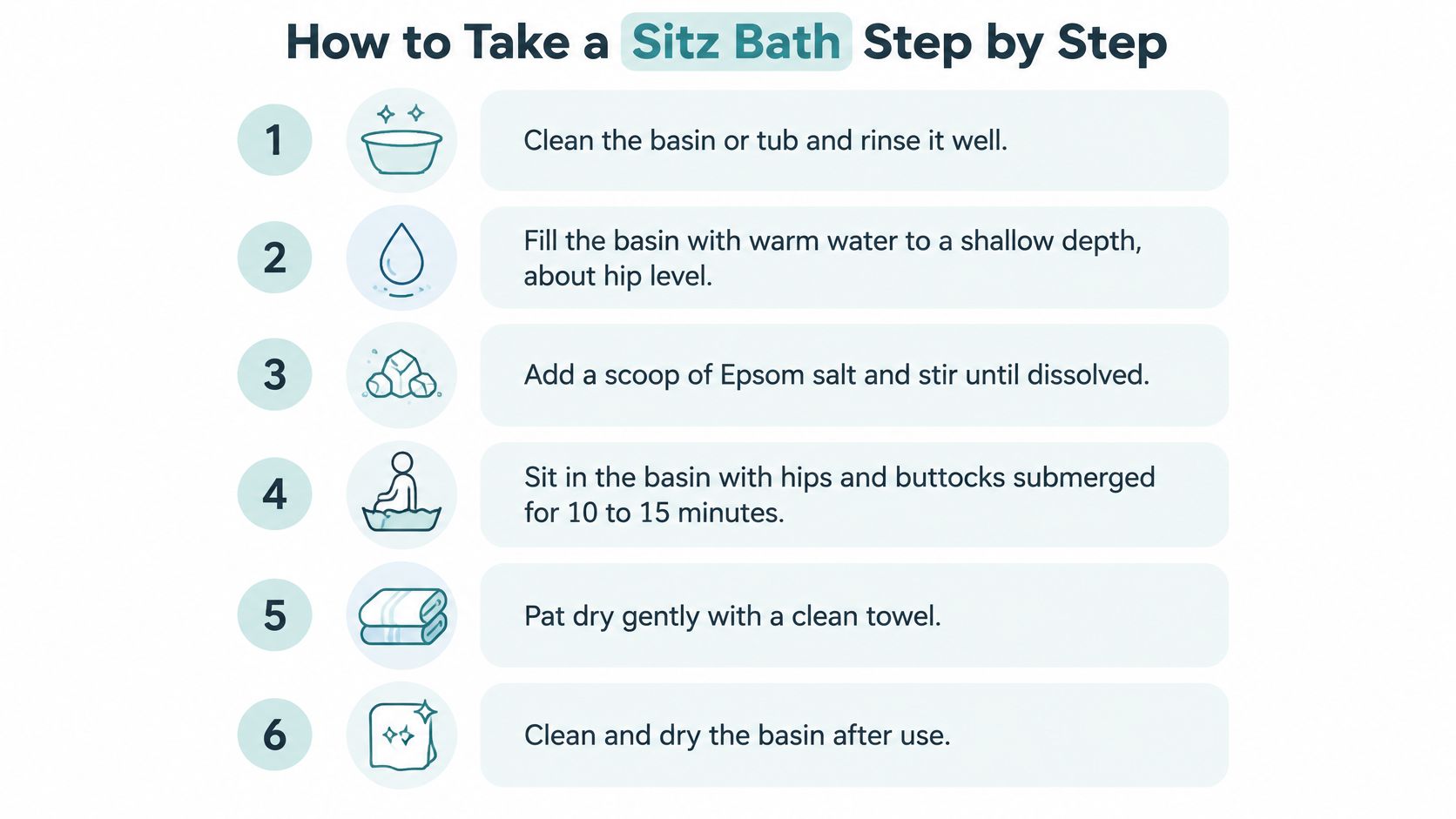
A sitz bath lets you soak your hips and buttocks without immersing your whole body. University Hospitals Plymouth's anal fissure guidance describes a toilet-mounted basin and a 15-minute warm bath as an option for soothing discomfort.
Use this graphic as a setup reminder. Its scoop illustration isn't a universal salt measurement; your product's directions and your clinician's advice take priority.
Prepare, soak, and dry gently
- Clean the basin or tub and rinse it well. Remove residue before filling, including cleaning products or soap left from an earlier bath. A basin that looks clean may still need rinsing.
- Check the setup before sitting. Fit a toilet-mounted basin securely according to its instructions, or use shallow water in a clean bathtub. Don't balance a loose bowl over the toilet or use a basin that shifts under your weight.
- Test the water before lowering yourself in. A bath thermometer gives a clearer reading than guessing; your wrist can help check whether it feels comfortably warm. Don't add hot water while your skin is in its path.
- Dissolve any approved additive completely, then start your timer. Use the soak time for your situation rather than staying until the water turns cold. Sitting on undissolved crystals or adding another scoop midway can make a gentle routine irritating.
- Rise slowly and use a stable support. Hold a grab bar or ask someone to stay nearby if getting out feels difficult, especially after childbirth. Don't rush to stand if you feel lightheaded.
- Pat dry with a clean, soft towel, then clean the basin. Press gently rather than wiping back and forth over tender skin. Let the equipment dry before storing it so it's ready for the next use.
If sitting puts pressure on the sore area, adjust your support rather than forcing yourself to remain uncomfortable. Our guide to finding a comfortable sitz bath position explains positioning options.
This video provides another view of the setup.
Relief should feel gentle, during the soak and shortly afterward. Burning that builds, worsening pressure, or feeling faint isn't something to push through to finish the timer.
Who Should Skip or Adjust an Epsom Salt Soak
Use lukewarm rather than hot water, keep bath salts out of children's reach, and never swallow a soaking product. External comfort care still needs precautions, particularly when skin is injured or you're recovering from delivery.
| Situation | Soak guidance | Check with |
|---|---|---|
| Pregnant | Lukewarm water; fragrance-free salt only if approved | Obstetric clinician before regular use |
| Postpartum, after delivery or tear | Follow your care team's timing and water depth | Care team; stop if dizzy or bleeding heavily |
| Diabetes | Avoid hot or warm soaks unless your physician advises them | Physician |
| Open wound, burn, or broken skin | Skip the salt and avoid soaking unless specifically directed | Clinician |
| Skin infection or fever | Don't soak | Seek care promptly |
| Ongoing or worsening symptoms | Stop soaking and follow your care plan | Healthcare provider |
Cleveland Clinic's pregnancy bathing guidance notes that fragrance-free Epsom salts generally aren't irritating for most pregnant people, while emphasizing the need to avoid overheating. Pregnancy doesn't make every bath additive appropriate, so ask your obstetric clinician before making it a regular routine.
For diabetes, the Epsom salt drug label available through the FDA specifically warns against hot or warm soaks unless advised by a physician. Don't treat that warning as applying only to very hot water.
When a soak isn't the next step
Fever, spreading redness, pus, severe pain, or heavy bleeding need medical attention, not another recipe adjustment. If you're immunocompromised, ask your clinician before soaking an irritated area.
Postpartum stitches and tears need individualized instructions. A clinician-directed plain-water bath isn't permission to add salts or botanical oils over healing tissue.
A soak can't diagnose or resolve unexplained bleeding, a clotted hemorrhoid, an abscess, or a fissure that needs medical treatment. If you're unsure whom to call, this guide to healthcare professionals who treat hemorrhoids can help you choose.
When in doubt, ask first. You don't need to know the diagnosis before requesting help.
Using Soaks for Fissures and Hemorrhoids
NHS Scotland's anal fissure guidance reports that 50% of anal fissures resolve completely with a combination of constipation management, sitz baths, and dietary-fibre supplementation. That finding describes combined care, not an Epsom salt success rate.
The distinction matters. Softer stools and less straining reduce repeated trauma, while the warm bath helps soothe the area. A soak won't make up for repeatedly passing hard stools.
Build a routine around easier bowel movements
- Address constipation: Drink enough fluids, include high-fiber foods, and discuss fiber supplementation or other stool-softening measures with your clinician.
- Make bathroom visits unhurried, not prolonged: Avoid pushing hard or staying on the toilet scrolling after you're finished.
- Use the soak when it's useful: Fit it around bowel movements or discomfort according to your care plan, rather than adding sessions automatically.
- Apply topical care afterward: Pat dry first, then use any appropriate cream on clean, dry skin according to its label.
For new parents, NHS postpartum guidance also emphasizes fluids, high-fiber foods, and avoiding straining for piles after birth. It recommends speaking with a midwife or pharmacist when discomfort is significant.
Say your bottom feels calmer after bathing, but every bowel movement brings the pain back. That's a reason to review stool consistency and your treatment plan, not make the bath stronger.
Our guide to nonsurgical fissure care explains how supportive habits fit with other options.
Comfort measures help you manage the day. Persistent pain, recurring symptoms, or bleeding still deserve a healthcare provider's assessment.
Fix Common Soak Problems Fast
Dryness, stinging, and dizziness are reasons to change or stop the routine, not signs that the salts are working. Cleveland Clinic's Epsom salt guidance warns that frequent use can dry or irritate skin and advises avoiding salt baths with open wounds, severe burns, skin infection, or severe inflammation.
| Symptom | Possible cause | Fix |
|---|---|---|
| Dry, tight, or itchy skin afterward | Too much soaking or overly hot water | Reduce or pause sessions and switch to lukewarm water |
| Stinging or burning during the soak | Salt contacting raw skin or sensitivity to an additive | Stop, rinse with plain water, and check with a clinician |
| Redness or irritation that lingers | Excess salt, soap residue, or prolonged exposure | Stop until settled; reassess ingredients, amount, and duration |
| Dizziness when standing | Heat, rising quickly, or postpartum changes | Sit safely, rise slowly, and use stable support |
| Pain, swelling, or redness that spreads | Possible infection or another condition needing care | Stop soaking and contact a healthcare provider |
| Bleeding that continues or grows | A problem needing direct evaluation | Seek medical care promptly |
Don't troubleshoot worsening symptoms indefinitely
Change the suspected irritant rather than adding another product to counteract it. You don't need to retry salt to prove it caused the problem.
Persistent irritation needs advice, even if it seems mild. For spreading symptoms, fever, or bleeding, follow the medical-care guidance rather than experimenting with another soak.
Epsom Salt Bath Questions Readers Ask Most
How long should I sit in an Epsom salt bath?
Use the recipe that matches your situation and any shorter time specified by your product or clinician. Set a timer before sitting down, and stop early if you develop burning, lightheadedness, or increasing pain.
A full-body soak and a targeted perineal soak aren't interchangeable. Check the recipe table for the appropriate setup.
Can I use an Epsom salt bath every day?
Daily sitz bathing may fit some care plans, but it isn't a requirement for everyone. Your skin's response matters more than completing a schedule.
If your skin becomes tight, itchy, or irritated, reduce or pause soaking and ask whether plain water would be more appropriate. Don't keep increasing frequency because relief is brief.
Will an Epsom salt bath cure hemorrhoids?
No. A warm soak may ease discomfort, but it isn't a cure for hemorrhoids. Feeling calmer afterward doesn't tell you what caused a lump, itching, or bleeding.
Get a healthcare provider's assessment for symptoms that persist, become severe, bleed, or keep returning. Don't assume every anal symptom is a hemorrhoid.
Is Epsom salt safe during pregnancy?
Pregnancy calls for avoiding overheating and checking the suitability of any additive with your obstetric clinician. Fragrance-free doesn't mean every product is right for every person.
If you're also recovering from delivery, use the specific instructions your maternity team gives you. Healing tears, stitches, and changes in bleeding can affect what's appropriate.
Pick Your Soak and Confirm Your Next Step
Plain warm water is the simplest starting point, especially when the area is already sensitive. If you want an additive, compare the full ingredient list and the mixing directions, not just the word natural on the front.
| Option | Ingredients and convenience | Fit for sensitive skin |
|---|---|---|
| Plain Epsom salt | A single additive you measure yourself | Easier to identify what you're using, but salt can still irritate |
| Botanical additions | Aloe vera, witch hazel, or oils add ingredients to the routine | More ingredients mean more potential sensitivities |
| Ready-made blend | Combines ingredients with product-specific measuring directions | Check every ingredient and patch test as directed |
Botanicals may add a soothing feel, but they don't turn a bath into treatment for an underlying condition. Avoid improvising with concentrated essential oils on tender perineal skin.
Our Revivol-XR® Sitz Bath Soak Mix is designed for soothing comfort care. Epsom salt is one of its 20 all-natural and organic ingredients, alongside Dead Sea salt, organic coconut oil, baking soda, witch hazel, aloe vera, calendula oil, and botanical oils. The mix is LegitScript Certified; that credential isn't evidence that bathing treats a condition.
The packaged blend is shown below.
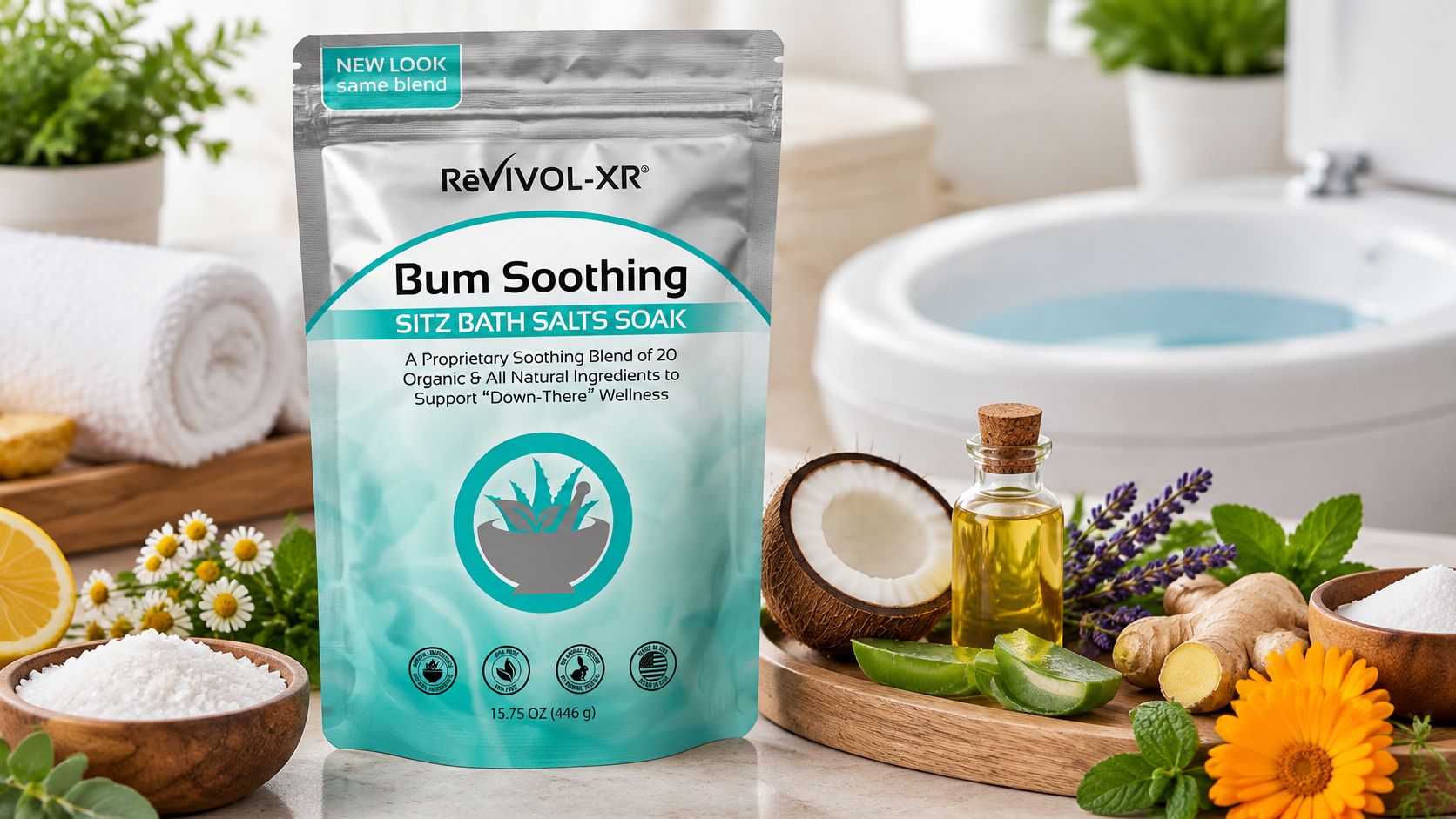
Check the packaging for the complete ingredient list. Follow its small-amount patch-test directions before first use, and consult your physician first if you have sensitive skin, essential oil allergies, or ongoing irritation.
- Choose your soak: Plain water is a valid choice.
- Set your timer: Follow the appropriate recipe and product directions.
- Watch your skin: Stop if irritation develops.
- Arrange care: Contact a healthcare provider for persistent or bleeding symptoms, severe pain, or fever.
Revivol-XR offers a sitz soak blend for soothing comfort as part of a gentle external-care routine. Visit Revivol-XR to review the ingredients and directions, and choose an option that fits your skin's needs and your healthcare provider's advice.