Sitz Bath Position: How to Sit for Relief at Home

Sitting in a sitz bath the wrong way can press on the exact spot you're trying to soothe. You're sore, the basin feels wobbly, and you're not even sure the water is reaching the right place. A good sitz bath position solves all three problems. It covers your hips, buttocks, and perineal area, supports your weight, and lets you stand up without a struggle.
Table of Contents
- Sitz Bath Positions for Each Setup
- How to Get Into a Sitz Bath Safely
- Postpartum Positioning for Tender Recovery
- Positions and Soak Times for Hemorrhoids and Fissures
- Fixing Common Positioning Problems
- Frequently Asked Questions
- Choose Your Setup and Start Tonight
Sitz Bath Positions for Each Setup
You don't need a deep, full-body bath. A sitz bath is a shallow seated soak, and the right position depends mostly on what you already own.
| Setup | Body position | Water coverage | Best for |
|---|---|---|---|
| Toilet-seat sitz basin | Sit upright, feet flat on the floor, knees bent | Hips and buttocks covered, upper body dry | Hemorrhoids, fissures and everyday use |
| Bathtub | Sit upright, knees bent or raised, feet on the tub floor | Hips and buttocks covered, chest above the water | Longer soaks at home |
| Portable sitz basin on the floor | Sit upright on a stable seat, feet flat, low enough to rise easily | Hips and buttocks covered, upper body dry | Travel, postpartum and limited space |
| Assisted seat with grab rail | Sit upright with a helper or rail for support, feet flat | Hips and buttocks covered, weight held by the rail | Older adults and limited mobility |
The one principle behind every setup
Every row follows the same rule. Your hips and perineum sit under the water, your torso stays above it, and you sit securely enough that you aren't bracing against a slip. Cleveland Clinic's sitz bath guide describes this as a seated, partially immersed posture where water reaches the hips, buttocks, and perineal region rather than the entire body, with knees bent or raised when that improves water contact.
That focus is the point. The warm water touches the lower pelvic area where hemorrhoid, fissure, postpartum, and post-procedure soreness tends to sit, while the rest of you stays dry and warm.
Simple test: If your chest is in the water, it's too deep. If the sore area is dry, bend your knees or add a little more water.
If you have limited mobility, choose support first and water depth second. A raised seat, a grab rail, or a helper in the room matters more than squeezing into a small basin on the floor. Pick the setup above that matches your bathroom, then use the same safe routine below for all of them.
How to Get Into a Sitz Bath Safely
The awkward part is rarely the soak itself. It's lowering yourself down without slipping, then getting back up when your legs feel warm and wobbly. These seven steps keep both ends of the session steady.
This visual sums up the setup before you start.
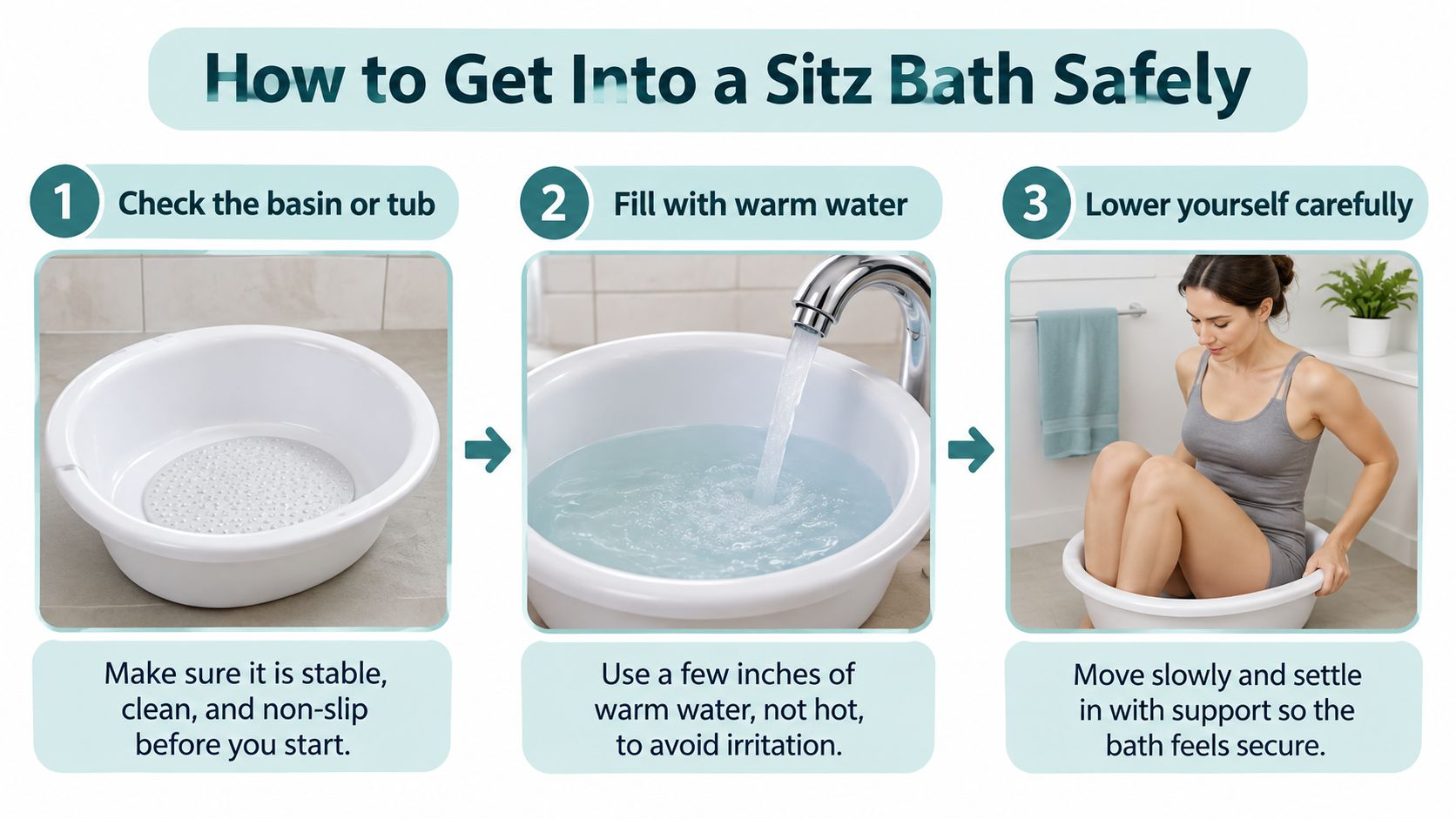
- Check stability first. Make sure the basin or tub is stable, clean, and non-slip. A wobbling basin is the most common reason people tense up and press down harder than they mean to.
- Fill with warm water. Use a few inches of warm, not hot, water. Hot water can sting sore tissue and make lightheadedness more likely.
- Test with your wrist or elbow. Your hand tolerates heat that tender skin won't. If it feels hot on your inner wrist, add cool water and test again.
- Lower yourself slowly. Hold a grab rail, the tub edge, or a helper's arm. Don't drop the last few inches, since that's when a smooth basin can slide forward.
- Settle and bend your knees. Sit back with feet flat where possible. Bent knees help the water reach the sore area without you leaning far back.
- Sit still for your soak. Shifting and pressing can irritate the area. Let the water do the work while you keep your weight even.
- Rise slowly and pat dry. Pause at the edge until you feel steady, then stand. Pat with a clean towel instead of rubbing.
Support during that transfer isn't a modern extra. At Malvern's water-cure facilities in 1842, patients were lowered into water to waist height for 10 to 15 minutes, according to the BBC A History of the World object record. Today's version is gentler and warmer, but the lesson holds. Slow entry, steady support, and a careful exit protect your balance.
If you'd like to see the basin setup in motion before your first try, this short video helps.
A good session feels boring in the best way. You feel gentle warmth on the target area, no pulling, no sharp pressure, and no dizziness when you stand. If you're gripping the sides the whole time, the setup needs adjusting.
One caution on anything you add to the water. Salts, oils, or botanical mixes are for external use only as a bath water additive, and you should patch test a small amount on your skin before a first full soak. If stinging starts, get out, rinse with plain water, and don't push through it.
Postpartum Positioning for Tender Recovery
After childbirth, sitting straight down can feel like the hardest part of the day. Soreness may come from a vaginal delivery, a perineal tear, or an episiotomy, and hemorrhoids often join in at the same time. You're tired, you're healing, and you don't need a deep tub to get relief.

The American College of Obstetricians and Gynecologists page on hemorrhoids in pregnancy defines a sitz bath as sitting in warm water shallow enough to cover the buttocks and hips. That shallow depth lets you soak the sore area without climbing into a full bathtub.
A gentler way to sit down
Lower yourself onto a stable basin or tub and keep much of your weight on your arms or the tub edge at first. Ease down a little at a time. Never force a posture that pulls or sharply hurts.
If sitting upright presses on a tender spot, try a light side-lean. Shift a small amount of weight to one side while keeping your perineum under the water. You'll likely need to bend your knees slightly so coverage doesn't change as you lean.
For the first few soaks, keep a partner or helper nearby. Warm water plus a long recovery day can leave you dizzy when you stand, so rise slowly and sit back down if the room tilts. Our guide to perineal pain after childbirth covers what soreness can feel like during those first weeks.
A sitz bath is one comfort option among several, alongside cold witch hazel compresses and topical products. It's normal for hemorrhoids to feel worse right after delivery and then improve gradually, but some signs shouldn't wait. Call a healthcare provider for heavy bleeding, fever, spreading redness, foul discharge, or pain that keeps getting worse.
Positions and Soak Times for Hemorrhoids and Fissures
Hemorrhoids and fissures both respond best to a relaxed seat, but the details differ a little. The goal in both cases is the same. Keep the sore area covered, keep pressure off it, and don't treat hotter or longer as better.
Hemorrhoids
Sit in a relaxed upright position in shallow warm water, with your hips and buttocks covered. Avoid bearing down or pressing into the seat, since that squeezes the spot you're trying to calm. Soaking after bowel movements is often the most useful timing, when irritation tends to flare.
Anal fissures
For a fissure, keep the same relaxed seated posture with the fissure area fully immersed. The Plymouth Hospitals NHS anal fissure leaflet points to Cambridge University Hospitals guidance for a 15 minute bath in water as warm as the person can tolerate, repeated several times daily or as needed. That means sitting, not standing, crouching, or aiming a forceful stream of water at the anus.
Warmth you can relax into is the target. If you're bracing against the heat, the water is too hot for you.
One caution belongs before the table. Hot or warm baths should not be used by persons with diabetes unless advised by their physician. Older adults and anyone with limited mobility can use the same positions with a raised seat, a rail, or a helper nearby.
| Condition | Position | Session length | How often |
|---|---|---|---|
| Hemorrhoid flare-up | Relaxed upright seat, hips and buttocks covered, no pressing on the sore spot | 10 to 15 minutes | After bowel movements, two or three times daily |
| Anal fissure | Relaxed seated posture, fissure area fully immersed, no crouching or standing | Up to 15 minutes | Several times daily or as needed |
| Postpartum tenderness | Shallow water, gentle seat with weight on arms or tub edge, side-lean if upright hurts | As comfortable, confirm with your provider | As directed by your provider |
| Limited mobility or older adult | Assisted seat with grab rail, stable basin, helper nearby | 10 to 15 minutes | As advised by your provider |
Screenshot the table or keep it open on your phone for your first few soaks. Remember what it is and isn't. The position supports comfort, not a cure, and our overview of fissure treatment without surgery explains the wider options if soaks alone aren't enough. Persistent, severe, or bleeding symptoms need a healthcare provider, not more baths.
Fixing Common Positioning Problems
A seat can feel uncomfortable even when the water is warm. Use the symptom to find what may need adjusting, then change one thing at a time.
| Symptom | Likely cause | Fix |
|---|---|---|
| Water does not reach the sore area | Sitting too high or legs stretched out | Bend your knees or slide slightly forward. Add enough warm water to cover the area. |
| Pain rises during the soak | Pressure on the sore spot, or irritation from an additive | Shift your weight so the sore area is not pressed against the seat. Switch to plain warm water if an additive stings. |
| Water cools before the soak ends | The water loses warmth during the session | Keep the soak to 10 to 15 minutes. If you add warm water, do so carefully and check its temperature before sitting back down. |
| Lightheadedness continues after standing | Your body may need more time to adjust after the soak | Sit down until you feel steady. Tell a healthcare provider if this keeps happening. |
| Stinging or burning | An additive may be irritating sensitive skin | Stop using it and rinse with plain water. Patch test a product before first use. |
When a sitz bath may be the wrong tool
A sitz bath may ease discomfort for a while, but it does not remove hemorrhoids or explain rectal bleeding. The Acibadem Health Point patient guide on sitz baths reports that a systematic review found no strong evidence that sitz baths reliably reduce pain or speed fissure or wound healing.
Focus on position before adding heat or time. Choose a neutral seat that does not press on the sore area, and use plain warm water if additives sting.
Stop soaking and seek medical care for fever, spreading redness, discharge, worsening pain, or persistent bleeding. A soak should not delay a visit you already know you need.
Frequently Asked Questions
How long should I sit in a sitz bath?
A short, comfortable soak is enough. Stop if your pain increases or you feel dizzy.
How often can I use one?
You can soak after a bowel movement if that feels soothing. If symptoms persist, contact a healthcare provider. The guide to which healthcare professionals treat hemorrhoids can help you decide whom to contact.
Can I use a sitz bath if I see blood?
A sitz bath may ease discomfort, but it cannot explain the cause of bleeding. Contact a healthcare provider to have bleeding checked.
Is a toilet-seat basin enough?
Yes, if it sits securely and the water reaches the area you want to soak. Keep your upper body dry and make sure you can sit and stand without slipping.
Choose Your Setup and Start Tonight
A small bathroom may favor a toilet-seat or portable basin; a bathtub gives you more room. If standing up is difficult, choose a raised seat or ask someone to help. The right setup is the one that lets water reach the area comfortably and gives you steady support when you get out.
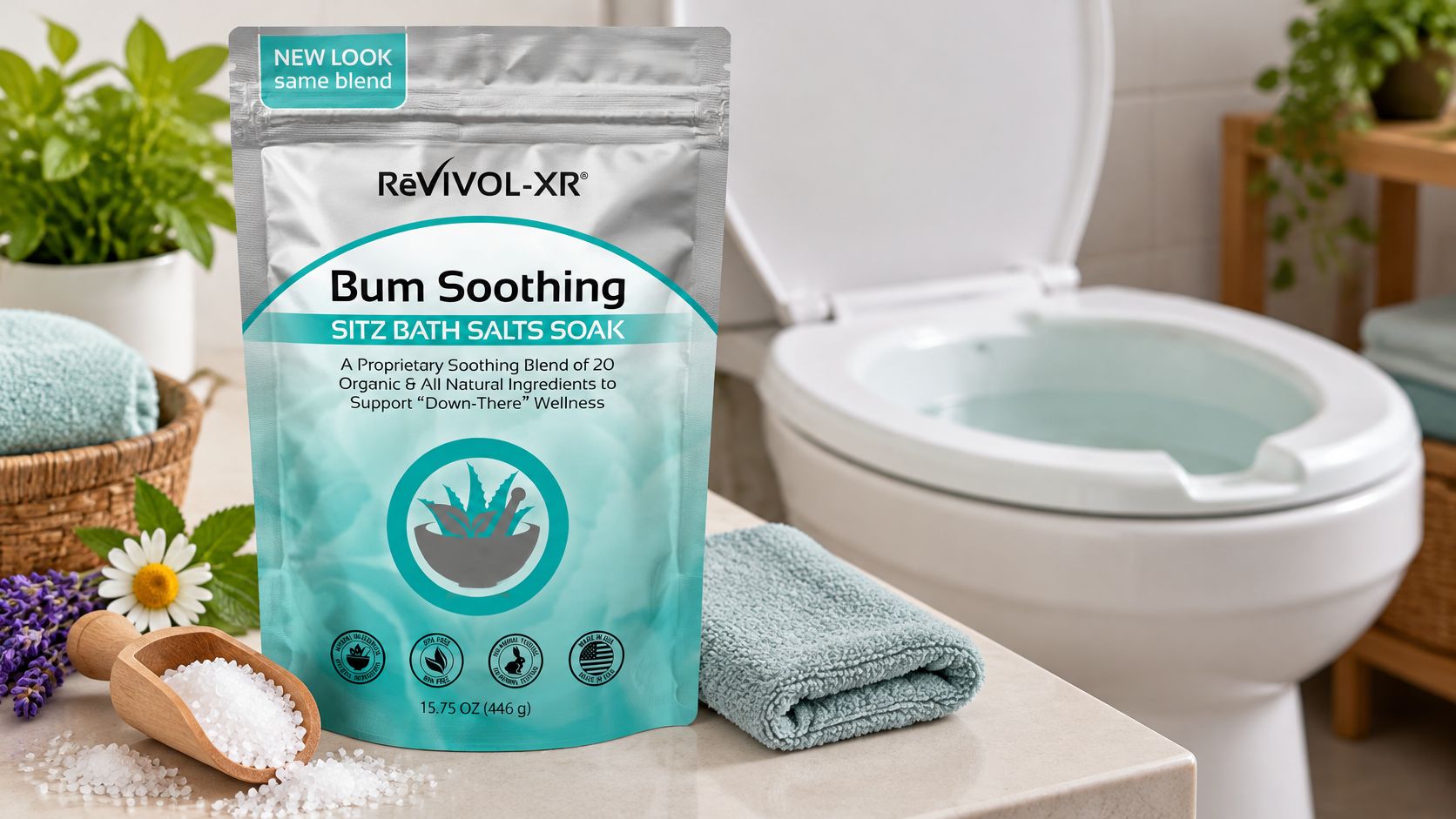
Plain water may be all you need. For an optional add-on, the Revivol-XR® Sitz Bath Soak Mix is a concentrated soak for the end of the day or when applying a cream feels uncomfortable. It is a 20-in-1 blend with Epsom salt and botanicals, ready to use in 1 to 2 minutes. Patch test before first use.
Persistent, worsening, or bleeding symptoms are a signal to contact a healthcare provider. When your setup feels steady and the water reaches the area you want to soothe, you're ready to begin.
For a calmer routine at home, Revivol-XR offers sitz bath and other personal-care products. Choose the setup that feels manageable and make room for a quiet pause in your day.