Aloe Vera for Skin Irritation: What the Evidence Shows

The advice to put aloe on any irritated skin can backfire, especially when the skin around your anus is already sore. Aloe vera for skin irritation may offer soothing comfort, but burn research doesn't prove that it heals hemorrhoids, closes an anal fissure, or makes every rash better. Before you apply it, it helps to separate promising evidence from practical safety limits.
Table of Contents
- What the Studies Show About Aloe Vera and Irritated Skin
- How Aloe Vera Soothes Irritated Skin
- Who Should Avoid Aloe Gel
- Choosing an Aloe Product for Sensitive Skin
- How to Apply Aloe Vera Safely to Irritated Skin
- Telling a Normal Sting From a Reaction
- Pairing Aloe With Other Care for Hemorrhoid and Fissure Pain
- Next Steps and Common Questions
What the Studies Show About Aloe Vera and Irritated Skin
Aloe has some research support for soothing irritated skin and supporting healing in selected cases. The important limits are the condition being studied and the exact preparation used. A cream tested in a burn clinic isn't interchangeable with a store-bought gel or gel scooped from a leaf.
A systematic review describes a randomized burn comparison in which each participant received different treatments on separate body areas. That design helps compare treatments within the same person, but it still answers a burn-care question, not a hemorrhoid or fissure question.
Aloe vera results in irritation and wound studies
| Study | Who was studied | Aloe result | Comparison result | What it means |
|---|---|---|---|---|
| Burn trial, 2009, summarized in a systematic review of aloe and wound healing | 30 people, each with burns on two body areas; 0.5% aloe cream on one area and 1% silver sulfadiazine on the other | 100% healed by day 19; mean recovery 15.9 days | 80% healed by day 19; mean recovery 18.73 days with silver sulfadiazine | Promising burn findings, not proof for all irritation |
| Complete healing comparison in a Cochrane wound review | 20 participants receiving aloe and 18 receiving silver sulfadiazine | 11 of 20 fully healed | 7 of 18 fully healed; the difference wasn't statistically significant | Results don't consistently establish an advantage |
| Itching or irritation in the same Cochrane comparison | Same comparison groups | 8 of 20, or 40% | 8 of 18, or 44% | Irritation remains possible with aloe |
The burn results are encouraging, but the smaller wound comparison didn't establish a reliable difference between treatments. Not statistically significant means the comparison didn't provide convincing evidence of a difference. It doesn't prove that the treatments work equally well.
Likewise, itching during wound care doesn't automatically mean someone was allergic to aloe. Injured skin, dressings, other ingredients, and the wound itself can contribute to discomfort.
The practical takeaways are straightforward:
- Condition matters. Burn healing can't establish effectiveness for unexplained anal itching or fissure pain.
- Results are inconsistent. A favorable trial doesn't settle every skin-care question.
- Tolerance isn't guaranteed. An ingredient can feel soothing to one person and irritate another.
Aloe's possible value is best understood as supportive skin care, not a substitute for identifying why the skin hurts.
How Aloe Vera Soothes Irritated Skin
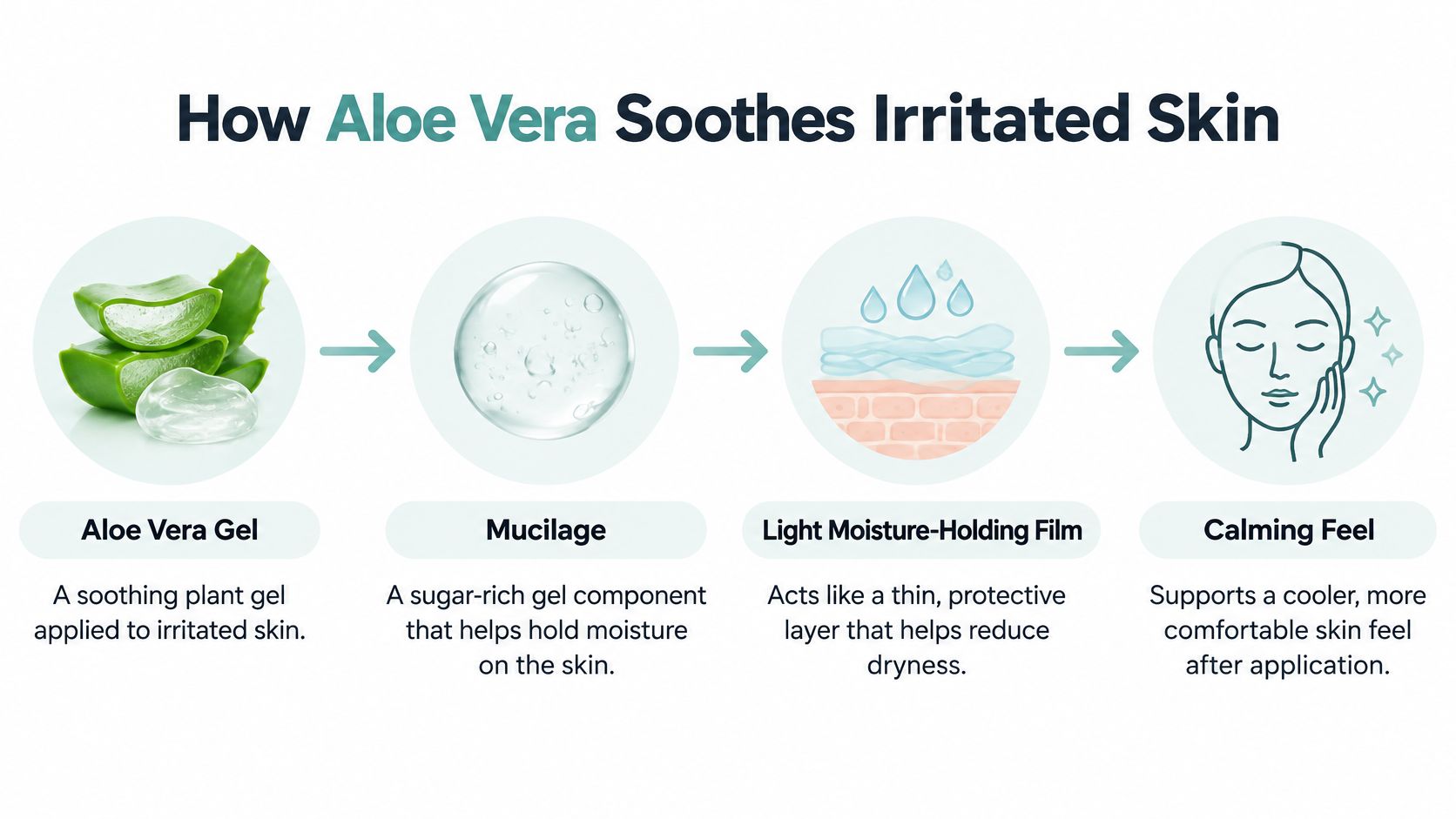
Think of aloe gel as a light, moisture-holding film laid over the skin's surface. That analogy explains its most practical role: helping mildly irritated skin feel less dry and tight without suggesting that it repairs every kind of damage.
The gel contains mucilage, a sugar-rich material that includes glucomannan. A clinical review of aloe's properties describes its moisture-retaining action, possible effects on tissue-rebuilding cells, and laboratory findings involving inflammatory pathways.
The simplest effect comes first. Mucilage acts as a humectant, meaning it helps retain water at the surface. Skin may feel softer or more comfortable when surface dryness contributes to irritation.
The relationship between gel and surface moisture is illustrated below.
What the deeper mechanisms mean
Preclinical findings suggest glucomannan can influence fibroblasts, cells involved in making collagen and rebuilding tissue. Those observations help explain why researchers study aloe in wound care, but they aren't proof that a consumer gel will close an anal fissure.
Reported anti-inflammatory activity includes effects on the cyclooxygenase pathway and reduced production of prostaglandin E2, a chemical involved in inflammation. Laboratory activity doesn't make aloe equivalent to an anti-inflammatory medicine.
Keep the claim modest: A soothing feeling is useful, but it doesn't tell you whether the underlying problem is improving.
These mechanisms plausibly support:
- Surface comfort when mild dryness or friction contributes to irritation.
- Moisture support from a well-formulated gel that your skin tolerates.
- An additional comfort measure alongside appropriate care.
They can't replace diagnosis, infection treatment, or assessment of persistent pain and bleeding. Around the anus, that distinction matters because several different problems can produce similar discomfort.
Who Should Avoid Aloe Gel
Being plant-based doesn't make aloe automatically suitable for sensitive skin. The National Center for Complementary and Integrative Health describes topical aloe as generally well tolerated but notes occasional burning, itching, rash, and eczema.
Your allergy history deserves attention before you try it. An evidence review of topical aloe advises caution for people allergic to plants traditionally grouped in the lily family, including onions and garlic.
Ask before applying
Skip self-testing and speak with a healthcare professional if any of these apply:
- Known plant allergy. If you've reacted to aloe, avoid it; with relevant plant allergies, get advice before experimenting.
- Open or severely damaged skin. Bleeding tissue, an open wound, or suspected infection needs assessment rather than another home remedy.
- A condition needing targeted care. Chemical burns, radiation-related skin injury, and an active eczema flare shouldn't be managed by choosing a soothing gel alone.
- Pregnancy or breastfeeding. Ask your healthcare professional before using aloe or medicated products for perianal symptoms.
- Medicine use. Discuss herbal products with your provider, particularly if you're considering anything taken by mouth; oral and topical aloe aren't interchangeable.
For home care around the anus, keep aloe on the outer skin only. Don't insert ordinary aloe gel into the rectum, and don't swallow aloe products to relieve hemorrhoid or fissure symptoms.
You don't have to tolerate discomfort to give a product a fair chance. New or worsening symptoms deserve attention, especially when the area is already tender.
Choosing an Aloe Product for Sensitive Skin
Choose the formula, not the picture of an aloe leaf on the bottle. A review of aloe's clinical uses and safety describes irritation and contact reactions and supports caution with poorly characterized whole-leaf preparations.
Use these checks when comparing labels.
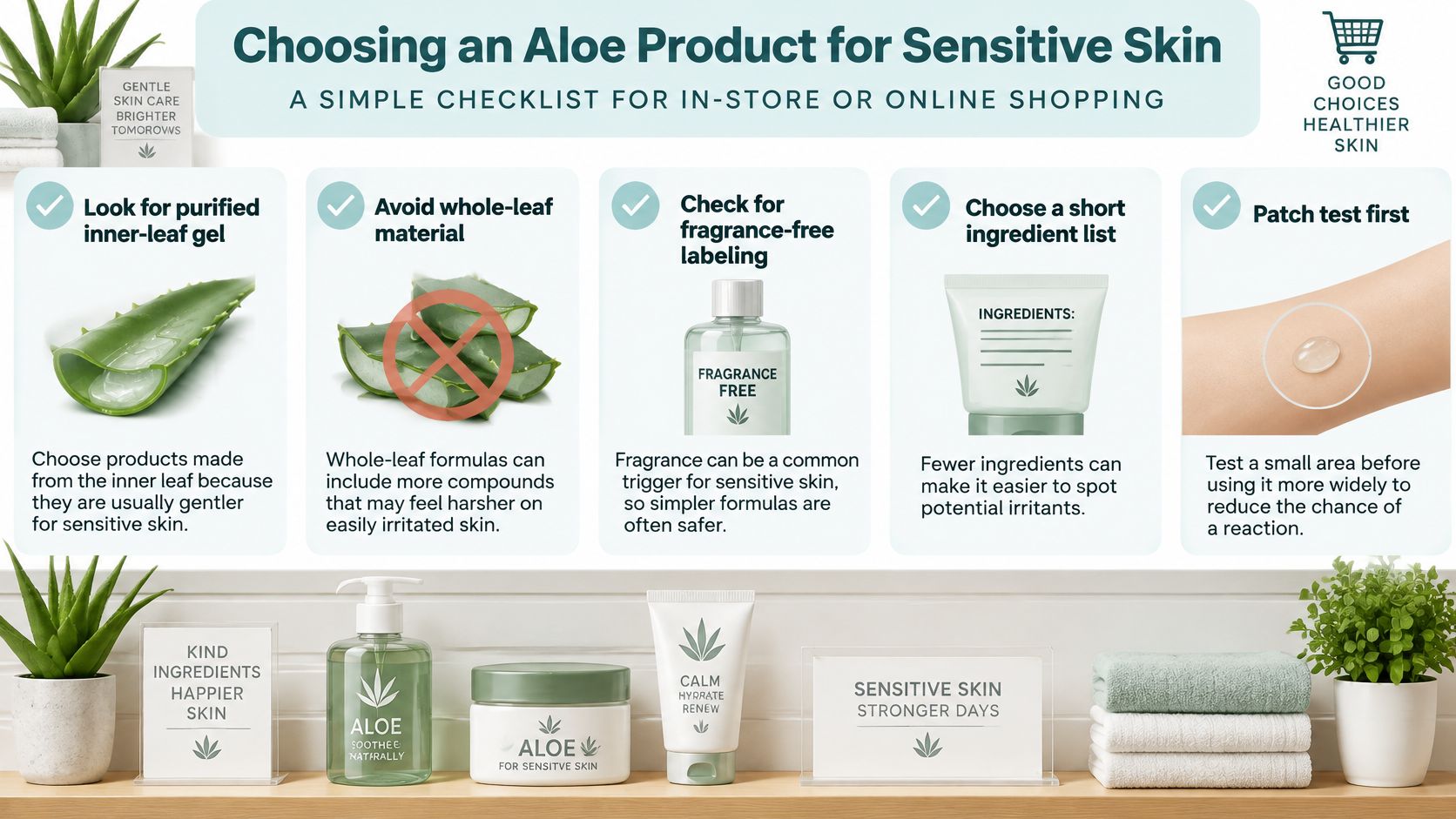
- Look for purified inner-leaf gel. Prefer clearly identified, processed inner-leaf material over a poorly described whole-leaf preparation.
- Read the complete ingredient list. Aloe near the top helps identify an aloe-focused formula, while a simpler list makes potential triggers easier to track.
- Choose fragrance-free options. Avoid strong essential oils and ingredients you've reacted to before; don't assume that all preservatives are harmful or that preservative-free means safer.
- Check the intended area. The label should allow external skin use and be suitable for where you plan to apply it.
- Review your allergy history. A previous reaction matters more than reassuring words such as natural or gentle.
A short ingredient list doesn't guarantee tolerance. Skin around the anus, postpartum tissue, and abraded skin may respond differently from intact arm skin.
Keep cleansing simple too
If you're also considering wipes, our guide to witch hazel wipes can help you assess another part of the routine. Don't introduce a new wipe, gel, and cream together, because identifying a trigger becomes harder.
For a visual companion to product selection, watch the video below.
Try one new product at a time. That makes a reaction easier to recognize and respond to.
How to Apply Aloe Vera Safely to Irritated Skin
Application is a sequence, not a single swipe: clean skin, a measured test, a thin layer, then time to settle. Start only when the skin is suitable for home care and the product label permits use on the intended area.
The basic application process is shown below.
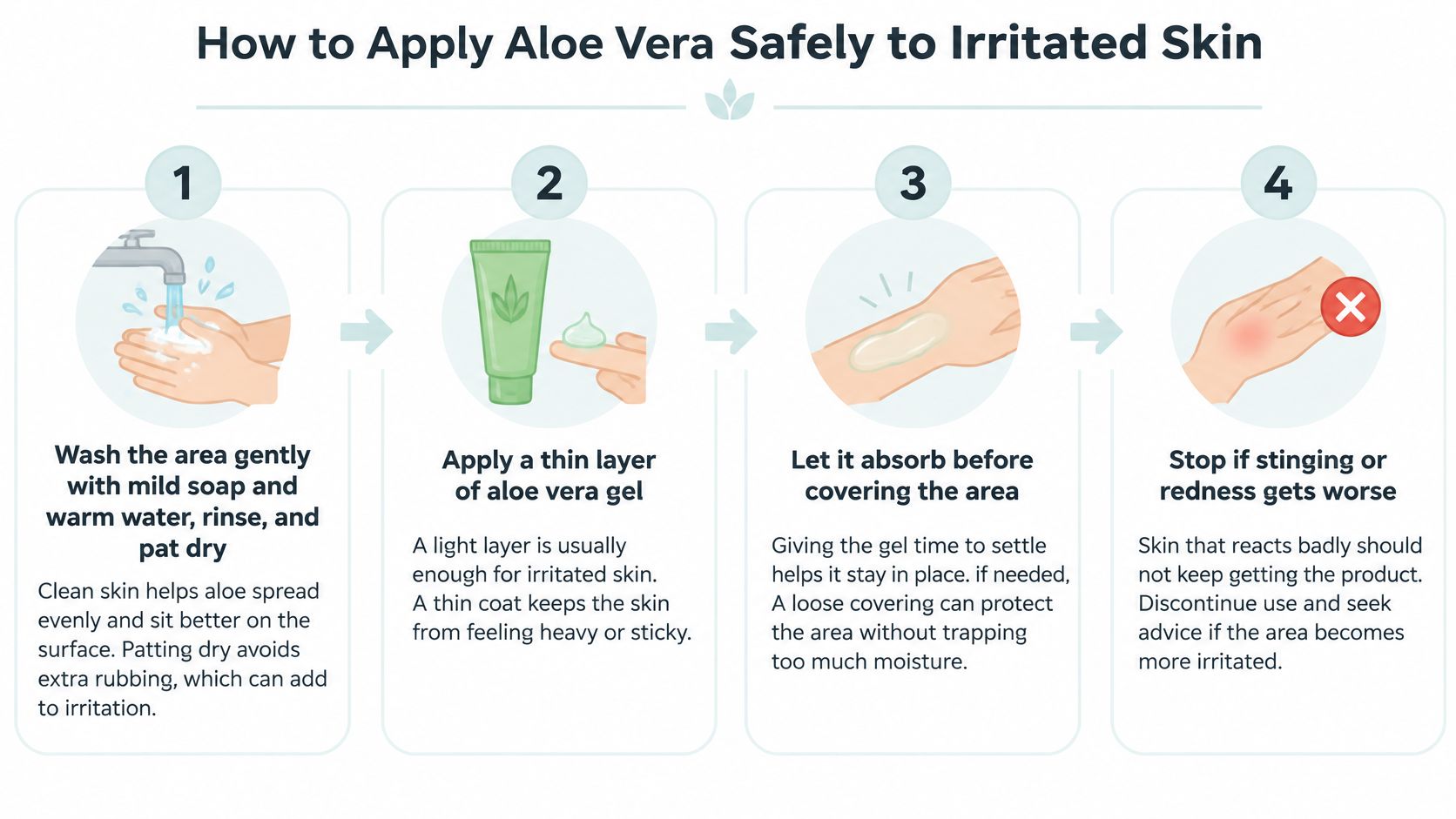
A gentle application routine
- Clean without scrubbing. Gently wash with mild soap and warm water, rinse thoroughly, and pat dry. Keep soap away from the anal opening, and avoid repeated washing that leaves the skin feeling raw.
- Run a 24-hour forearm test. Apply a pea-sized amount to the inner forearm and leave it uncovered for 24 hours. Check for redness, itching, or raised bumps. This can reveal an obvious sensitivity, though it cannot predict every reaction on perianal skin.
- Use a thin layer. Spread the gel lightly over the external area instead of rubbing it in firmly. A thin coat behaves like a thin coat of paint: it settles evenly, while a heavy smear stays tacky and keeps skin folds damp.
- Let it settle before covering. Allow the gel to absorb before dressing, sitting down, or going to bed. Avoid tight coverings that keep the area wet.
- Follow the label frequency. Use the number of applications stated on the label rather than adding extra whenever discomfort returns. Repeatedly needing more relief is a reason to reassess the cause, not just increase the amount.
- Keep it off damaged tissue. Do not apply aloe to open, bleeding, or severely damaged skin unless a clinician advises it. Around the anus, use it only on outer skin, and do not insert gel with a finger or applicator.
- Treat a growing sensation as a stop signal. A mild tingle that fades may be harmless, but it does not prove the product is working. If burning, stinging, or itching builds or lasts, stop and check the reaction table below. That table separates a transient sensation from skin changes that need medical care.
A reasonable result is mild, steady comfort without new irritation, not a dramatic overnight change.
Do not deliberately reapply a product to confirm that it caused a reaction. Save the packaging or ingredient list so a healthcare professional can help you assess what happened.
Telling a Normal Sting From a Reaction
A brief, mild tingle isn't proof that aloe is working. It also doesn't automatically establish an allergy, but you can't reliably distinguish irritation from allergy by sensation alone.
The useful questions are whether the feeling settles, persists, or grows, and whether you can see new skin changes. Don't dismiss increasing discomfort as something you need to push through.
Skin signs, what they may mean and what to do
These are action guides, not diagnoses.
| Sign | What it may mean | What to do |
|---|---|---|
| Mild warmth or brief tingle that fades | A transient sensation that may be harmless, but doesn't prove benefit | Keep watching; continue only if it settles completely and no other symptoms appear |
| Burning, stinging, or itching that grows or lasts | Possible sensitivity to the product | Stop use, rinse with plain water, and pat dry |
| Rash, hives, or raised bumps | Possible allergic or contact reaction | Stop use and contact a healthcare provider |
| Swelling, blistering, or spreading redness | Worsening irritation or another problem needing evaluation | Stop use and see a provider promptly |
| Pus, fever, or severe pain | Signs needing prompt medical evaluation | Seek medical care the same day |
| Rectal bleeding, or no improvement within 7 days | Symptoms beyond what continued self-care should handle | Stop use and consult a doctor; this is also the stopping rule for our OTC creams |
A fading sensation without visible changes is different from burning that intensifies with every application. Even so, there's no reason to continue a gel that feels unpleasant just because the sensation is mild.
Why the location changes the decision
Say you've used aloe comfortably on a minor sunburn before. That experience doesn't establish that the same product belongs on sore perianal skin, where friction, moisture, and damaged tissue can change how an application feels.
Likewise, raised bumps or spreading redness shouldn't be interpreted as the product drawing out irritation. Stop adding new products and seek advice rather than trying to counter one reaction with another topical.
Our OTC monograph creams are intended for temporary relief. Stop using the cream and ask a doctor if the condition worsens, an allergic reaction occurs, rectal bleeding develops, or symptoms don't improve within the label's stated period.
Severe symptoms shouldn't wait for a deadline. If swelling comes with breathing difficulty or faintness, seek emergency help.
Pairing Aloe With Other Care for Hemorrhoid and Fissure Pain
Aloe is a soothing, moisture-supportive helper. Other measures have different roles, and you don't need to use every option together.
How each type of care fits into the routine
| Care | What it does | How it fits the routine |
|---|---|---|
| Aloe gel | Soothes and holds moisture at the surface | Use a thin layer on suitable clean, dry skin after testing |
| Lidocaine cream | Temporarily numbs pain and itching | Apply externally as its label directs |
| Protectants, such as glycerin or petrolatum | Help protect against moisture loss and friction | Use as directed; don't automatically layer over another medicine |
| Warm sitz bath | Eases discomfort and may reduce sphincter tension | Soak first, then pat dry before applying cream |
| Fiber and bathroom habits | Help reduce constipation and straining | Build these habits into daily care rather than relying only on topicals |
A review of pregnancy and postpartum anorectal problems reports that hemorrhoids and anal fissures affect about 40% of pregnant or postpartum women, with symptoms commonly appearing in the third trimester or the first one or two days after delivery. This is a common recovery concern, not something to feel embarrassed about.
For a practical routine, start with warm, not hot, water and pat dry afterward. Our guide to sitz baths for hemorrhoid relief explains how soaking fits into comfort care.
An optional bath additive is shown below.
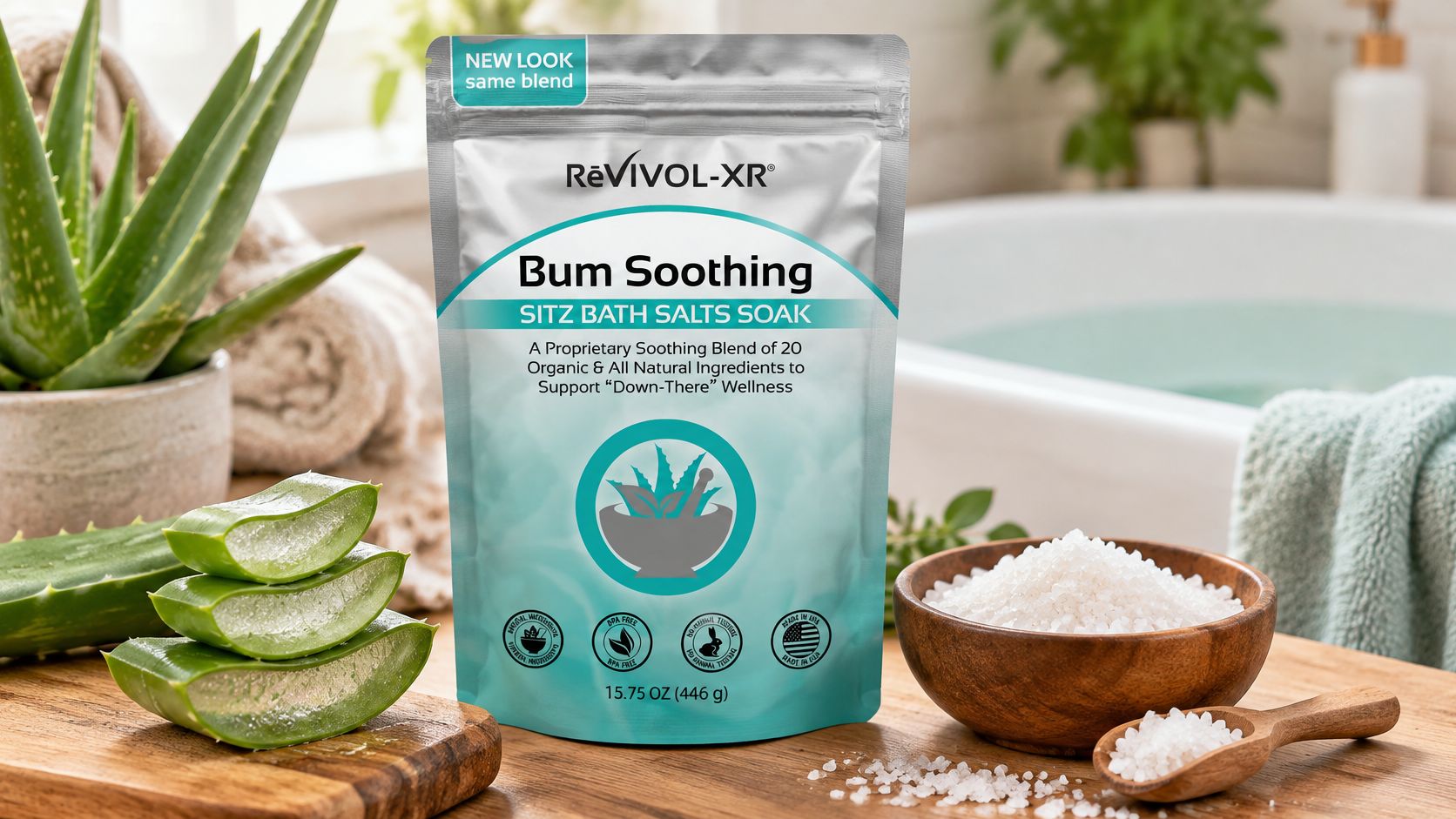
Revivol-XR® Sitz Bath Soak Mix contains ingredients including Epsom salt, aloe vera, witch hazel, and essential oils for soothing comfort. It's external-use only as a bath-water additive; patch test before first use, and consult your physician first if you have sensitive skin or essential-oil allergies. People with diabetes should ask their physician before warm baths.
If using our Advanced Hemorrhoid & Fissure Cream, soak first, then apply it to clean, dry skin. Don't combine multiple medicated products without checking their directions.
Bathroom habits deserve equal attention. A review of conservative hemorrhoid care recommends 20 to 30 grams of fiber daily, avoiding straining, and limiting prolonged toilet sitting.
Persistent, severe, or bleeding symptoms need professional assessment, not topical products alone.
Next Steps and Common Questions
Picture a typical week three: the itch has faded to an occasional tingle, the skin looks less angry, and nothing new has appeared. That is a reasonable point to keep using a thin layer after each bowel movement, as long as the trend stays in that direction. The questions below cover the decisions that come up next.
Does aloe vera stop itching quickly?
Not reliably. It may feel soothing, but the clinical evidence doesn't establish predictable, rapid relief for perianal itching. What you can track is the pattern: an itch that eases a little each day is different from one that intensifies within minutes of applying anything.
Can I use aloe inside the anal canal?
No. Keep ordinary aloe gel on appropriate outer skin only. A product formulated and labeled for external use shouldn't be inserted into the rectum.
Can I use aloe every day?
Daily use is reasonable when the skin stays calm, but there is a ceiling. A medicated cream labeled for this area allows up to six external applications a day for adults and children 12 and older, and stacking more than that doesn't help the skin settle faster. Use the fewest applications that keep you comfortable. Stop and ask a clinician if redness spreads, a raised rash or blistering appears, or pain builds after each application rather than fading. A tingle that passes within a minute or two and a reaction that grows are two different signals, and only the first one means you can continue.
What if I think the pain is from a fissure?
Pain alone can't confirm the cause. Our guide to anal fissure care without surgery explains conservative options; persistent pain or bleeding still needs a healthcare provider.
Your next action: Check whether home care is appropriate before testing a new product. You don't need to wait for symptoms to become unbearable to ask for help.
For temporary symptom comfort, Revivol-XR® 5% Lidocaine Numbing Cream is an OTC topical anesthetic for temporary relief of hemorrhoid pain, burning, and itching. It contains aloe and vitamin E as inactive ingredients and the same maximum-strength lidocaine as our Advanced cream, without a vasoconstrictor; it's for pain and itching rather than swelling.
Neither a numbing topical nor a warm-soak option replaces medical care. If any of the warning signs on the sting-versus-reaction list show up, or symptoms worsen, bleed, or don't improve within seven days, stop and consult a doctor.
Revivol-XR offers external numbing care and warm-soak options for soothing relief and comfort when hemorrhoid-related irritation makes daily routines difficult. Visit Revivol-XR to compare ingredients, directions, and warnings, then choose only what suits your skin and your healthcare provider's advice.