Supositorio Para Hemorroides: How to Use Them Safely

A hemorrhoid cream may seem like the whole answer, but the swelling behind the worst pain usually sits where cream never reaches. A supositorio para hemorroides is a small solid dose placed inside the rectum, and it works on a different part of the problem than anything you dab on the outside. This guide explains what's in one, how to use it without discomfort, and the specific situations where the honest answer is to call a clinician first.
Table of Contents
- What a Hemorrhoid Suppository Is and Who Uses One
- Ingredients in Hemorrhoid Suppositories and What They Do
- How to Use a Supositorio para Hemorroides Step by Step
- Suppositories Compared With Creams and Sprays
- Pregnancy, Postpartum and Breastfeeding Use
- Witch Hazel, Sitz Baths and Other Comfort Steps
- Frequently Asked Questions About Hemorrhoid Suppositories
- When to See a Clinician and How to Decide
What a Hemorrhoid Suppository Is and Who Uses One
Start with the name. A supositorio para hemorroides is a small solid dose, usually about 2 grams, that you place into the rectum. Body heat softens it within a few minutes, and it melts against the lower bowel wall so the medicine reaches swollen tissue directly instead of resting on skin outside.
Where the swelling sits decides which form helps. Internal hemorrhoids form inside the anal canal, above the area you can easily see or feel. External hemorrhoids sit under the skin around the anus and often show up as a tender lump. A suppository reaches internal swelling far more directly than a cream does, which is why it exists as a separate product rather than a thicker ointment.
A sealed dose looks unremarkable, which is exactly why people aren't sure how to handle one.
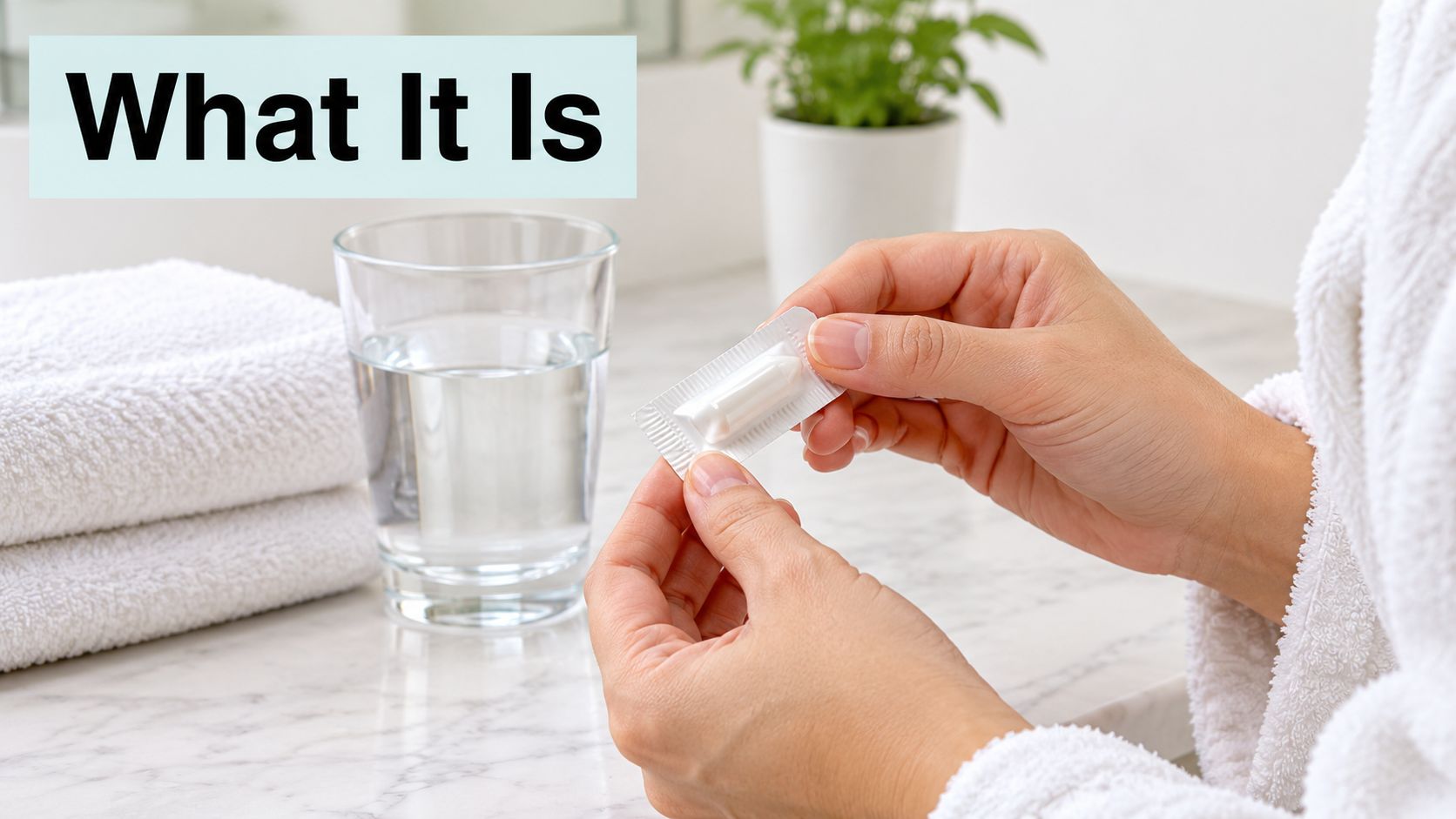
This is a common problem, not a rare one. The American Society of Colon and Rectal Surgeons 2024 guideline on hemorrhoid management reports clinical estimates that roughly 75% of Americans get hemorrhoid symptoms at some point, while published prevalence swings from 4% to 40% because so many people self-treat or never get a diagnosis. The same guideline notes more than 2.2 million outpatient evaluations for hemorrhoids each year.
Most cases trace back to pressure and straining:
- Long hours sitting or driving. Desk work and long commutes keep steady pressure on the veins in the anal canal.
- Straining at the toilet. Pushing, or sitting there scrolling for twenty minutes, both make swelling worse.
- Chronic constipation. Hard stools mean more bearing down.
- Pregnancy and childbirth. Pressure from the growing uterus plus the pushing of delivery.
A suppository is a symptom-relief option for mild, short-term trouble. It eases pain, itching, burning and swelling while you deal with what's causing them.
It can't reshape stretched veins, fix a prolapse, or dissolve a clot. Knowing that up front saves a lot of disappointment.
Ingredients in Hemorrhoid Suppositories and What They Do
The active ingredient and the suppository's base do different jobs. A typical U.S. product may combine a medicine aimed at swelling with a material that melts and coats the tissue.
| Ingredient | Typical label amount | Role in the suppository | Symptom it targets |
|---|---|---|---|
| Phenylephrine hydrochloride | 0.25% (about 5 mg in a 2 g suppository) | Vasoconstrictor that temporarily narrows blood vessels in the tissue | Swelling and pressure |
| Cocoa butter | A base; the amount varies by product | Solid at room temperature and melts at body temperature | Helps coat irritated tissue |
| Other protectants or soothing agents | Stated on each label | Cushions and soothes the surface | Itching and dryness |
Phenylephrine is included to temporarily reduce swelling by narrowing blood vessels in the treated tissue. It can affect the body beyond the target area, so people with heart disease or high blood pressure should check with a clinician or pharmacist before using a product containing it.
Cocoa butter serves as a base for the medicine. It stays solid at room temperature, then melts at body temperature and helps coat the tissue. Other products may use different bases or include protectants and soothing agents.
Match the symptom you want to address with the active ingredients listed on the label. Phenylephrine targets swelling; protectants and soothing agents may help with irritation or dryness. Products differ, so check the drug facts panel rather than relying on the package's appearance.
The FDA OTC monograph for anorectal drug products sets requirements for permitted active ingredients and amounts. Revivol-XR Advanced Hemorrhoid Cream is marketed as an OTC drug product under this framework (21 CFR Part 346).
No ingredient here cures hemorrhoids or corrects a prolapse or thrombosis. Check the ingredient list for anything you have reacted to before. If you are unsure whether an ingredient is suitable for you, ask a pharmacist or clinician.
How to Use a Supositorio para Hemorroides Step by Step
The first attempt is where many get stuck, usually because they rush it. Done slowly, insertion takes seconds and shouldn't hurt.
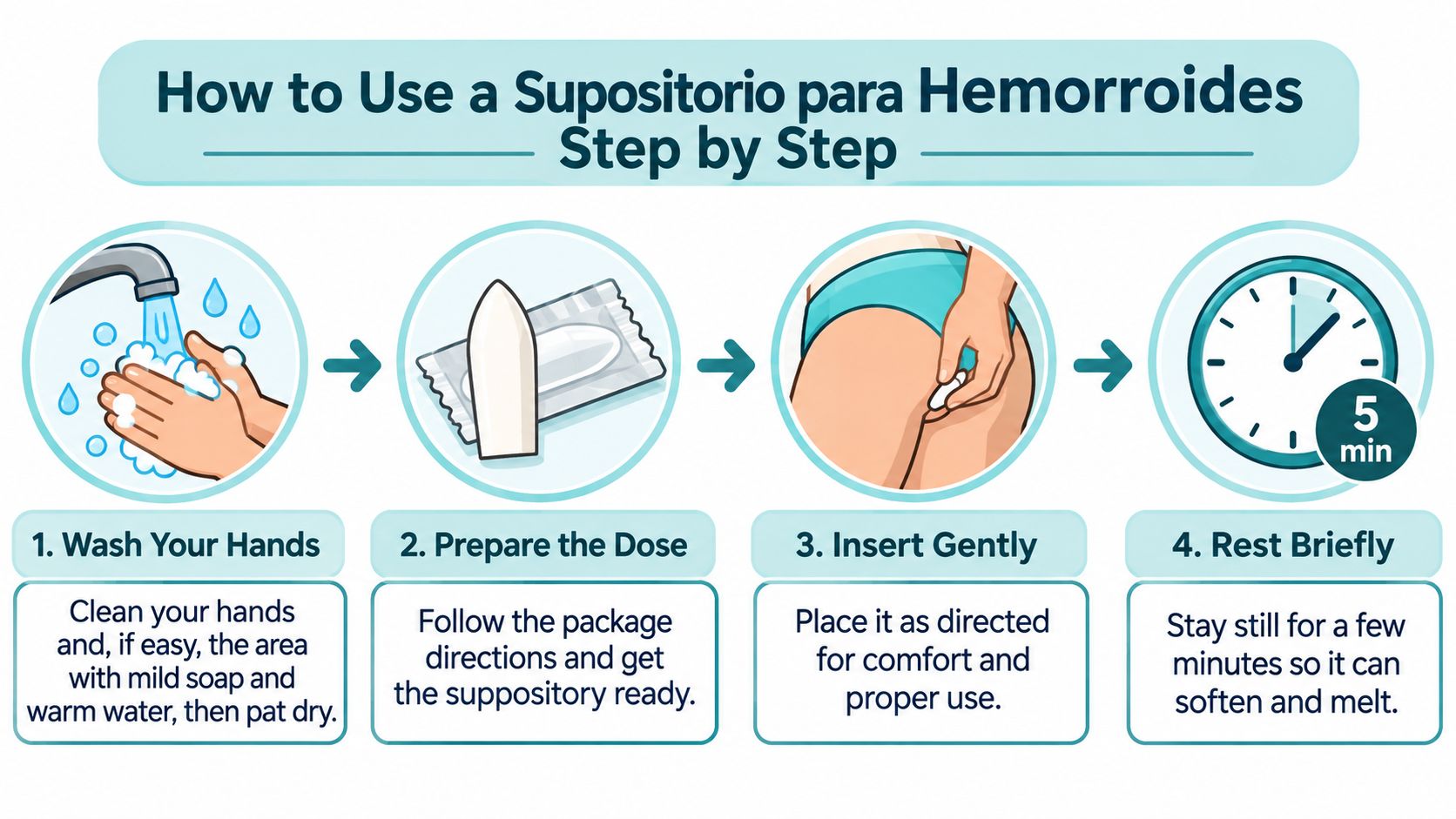
The six steps, in order
- Wash your hands, then the area if it's easy. Mild soap and warm water, rinse, pat dry. Dry skin handles the dose better, and clean hands keep bacteria away from irritated tissue.
- Take the dose out of the foil completely. A torn wrapper left on the tip makes insertion scratchy and painful.
- Pick a position that opens the area. Lying on your side with knees bent works well, and so does standing with one foot up on the tub or a chair. Choose whichever feels less awkward.
- Insert the pointed end slowly, aiming toward the tailbone. That angle follows the natural line of the rectum. Push gently and stop if it hurts.
- Stay still for a few minutes. Lying down for three to five minutes lets the dose melt and settle instead of sliding back out.
- Wash your hands again. Simple, and skipped far more often than you'd think.
U.S. labeling for phenylephrine suppositories permits use up to four times a day and states plainly that you must not exceed the recommended dose, according to the DailyMed drug facts labeling for a hemorrhoidal suppository. That's a ceiling, not a target.
Three mistakes that cause most of the trouble
- Forcing it. Tensing makes the sphincter tighten. Breathe out slowly, relax, and try a different position instead of pushing harder.
- Skipping the handwashing step. Both ends of the process matter, especially if you're prone to irritation or infection.
- Adding extra doses to speed things up. More product doesn't mean faster relief, and it's outside the labeled directions.
If you'd rather watch the process than read it, this short demonstration covers the same ground.
Track, don't chase: note how you feel on day one, day three and day seven. If discomfort returns between doses, that's information, not a reason to double up.
A good response looks like less swelling, less itching, and easier sitting within the label schedule. Brief mild discomfort can happen, but sharp pain, bleeding or no change at all means stop and call a clinician. If comfort hasn't improved by the seventh day, that's your signal to stop self-treating.
Suppositories Compared With Creams and Sprays
The main difference is where each product can reach. A suppository is inserted into the rectum, while creams and sprays are applied around the outside.
| Form | Where it goes | Best fit | Main limit |
|---|---|---|---|
| Suppository | Inside the rectum | Internal swelling, pain or pressure | Requires insertion, which some users find uncomfortable |
| Cream or ointment | Outside the anal opening | Visible itching, irritation or external swelling | Does not reach internal tissue |
| Spray | Outside the anal opening | Quick application while sitting or traveling | Applied outside only, so it cannot reach swelling inside the rectum |
A suppository can reach internal tissue, but insertion may feel awkward or uncomfortable. Creams and ointments are applied to external symptoms, such as visible itching or irritation, and are easier to reapply during the day.
Revivol-XR Advanced Hemorrhoid & Fissure Cream is for external use only and must not be inserted into the rectum. For more on OTC hemorrhoid ointments, check that the product's directions match where your symptoms are.
Sprays also stay outside. Their touch-free application may suit situations where applying cream is inconvenient, but they do not reach internal swelling.
Some people consider using an internal product and an external product together. Ask a pharmacist before combining treatments, since their active ingredients may overlap. If you cannot tell whether symptoms are internal or external, consult a clinician rather than guessing.
Pregnancy, Postpartum and Breastfeeding Use
Pregnancy is the most predictable window for this problem, and it's rarely mentioned at prenatal visits. A peer-reviewed review indexed in the National Library of Medicine reports that hemorrhoids or anal fissures occur in approximately 40% of pregnant women and women during the postpartum period. The same review cites a dataset in which the third trimester was the most common time of onset, at 61%, with 34% of cases starting on the first or second day after childbirth.
Many of these symptoms settle over the weeks after delivery as pressure and straining drop. That timeline is worth holding onto when you're uncomfortable at 3 a.m. with a newborn.
What the label says matters more than what a friend used. OTC labeling for phenylephrine suppositories advises asking a health professional before use during pregnancy or breastfeeding, rather than describing the product as automatically suitable, as shown in the DailyMed product information for a hemorrhoidal suppository. Availability on a shelf is not the same as suitability for you.

"Natural" ingredients aren't automatically risk-free either. A botanical base still contains compounds your body absorbs, and breastfeeding means anything you use deserves a quick professional check.
| Situation | Guidance for suppositories | Who to ask first |
|---|---|---|
| Pregnancy | Ask a health professional before use | OB-GYN or pharmacist |
| Breastfeeding | Ask a health professional before use | Pharmacist or OB-GYN |
| Recovering after vaginal delivery | Talk with your provider before any suppository | OB-GYN or midwife |
| Bleeding, a tender lump or pain after delivery | See a clinician promptly rather than self-treat | OB-GYN or midwife |
That last row matters most. A tender lump or new bleeding after delivery can point to a fissure or a thrombosed hemorrhoid, and neither is something to manage alone.
Witch Hazel, Sitz Baths and Other Comfort Steps
Gentle measures work alongside a suppository, and some work fine on their own. MedlinePlus guidance on hemorrhoid self-care recommends applying witch hazel to the affected area with a cotton swab to calm itching, skipping perfumed or colored toilet tissue, not scratching, and sitting in a sitz bath of a few inches of warm water for about 10 to 15 minutes.
- Witch hazel tightens and soothes the surface. Keep it on a cotton swab, not a scented wipe.
- Sitz baths are the most underrated step. A shorter soak, followed by a gentle pat dry, suits many people better.
- Toilet paper choices matter more than people expect. Plain, unperfumed paper, or a cleansing lotion instead of dry paper, reduces friction.
- Hands off. Scratching tears skin and makes itching worse the next day.
Our sitz bath guide walks through temperature, timing and how to fit a soak into a workday.
Diet and fluids do the quiet, slow work. MedlinePlus postpartum discharge guidance advises a high-fiber diet and about 8 cups, or 2 liters, of water daily to prevent constipation, along with individualized advice on stool softeners or bulk laxatives. The same guidance notes that warm baths, cold compresses, and OTC pain relievers can ease symptoms in the weeks after delivery.
None of this diagnoses anything. If itching or discomfort keeps returning, comfort steps buy time but don't replace an exam.
Frequently Asked Questions About Hemorrhoid Suppositories
How long can I use a hemorrhoid suppository?
Most clinicians suggest about one week of OTC use. Follow the daily maximum on the panel, never exceed it, and stop if the area gets worse rather than better.
Does a suppository cure hemorrhoids?
No. It temporarily eases swelling, pain, burning and itching. It doesn't repair stretched veins, correct a prolapse, or remove whatever is causing the pressure in the first place.
Can I use one while breastfeeding or right after delivery?
Ask a health professional first. Labeling says exactly that, and postpartum recovery is a period when a clinician should weigh in before you use anything rectally.
Is it safe if I take blood pressure medicine?
Check with a clinician or pharmacist before the first dose. Phenylephrine labeling flags heart disease, high blood pressure, and prescription medicines for hypertension or depression as reasons to get advice first.
When to See a Clinician and How to Decide
A suppository may suit mild internal symptoms, but ongoing bleeding, worsening pain, or symptoms that persist need more than a change in product. For OTC hemorrhoid medicines, follow the label and consult a healthcare professional if symptoms have not improved after seven days.
Seek medical advice for rectal bleeding, even if you suspect hemorrhoids. Bleeding can have other causes, including a fissure or bowel condition, so it should not automatically be attributed to hemorrhoids. Get evaluated if symptoms worsen, a hard and tender lump appears suddenly, or an applied product causes a rash or marked dryness.
Before using a product containing phenylephrine, ask a clinician or pharmacist if you have heart disease or high blood pressure, or take prescription medicine for hypertension or depression. Pregnancy and breastfeeding also call for individual guidance. OTC availability does not mean a medicine is suitable for everyone.
A useful first decision is whether symptoms are internal or external. A suppository is intended for internal symptoms, while a cream is applied to external skin. Bleeding, worsening symptoms, or uncertainty about medicines are reasons to check with a healthcare professional rather than choosing a product on your own. If you are unsure whom to contact, this guide to who treats hemorrhoids explains the options.
For external symptoms, Revivol-XR offers its Advanced Hemorrhoid & Fissure Cream; its Sitz Bath Soak Mix is another option for a soak. Find the current product line at Hemorrhoid.com.