Does a Hemorrhoid Suppository Make You Poop? The Truth Revealed

Most people don’t realize that the fear of a sudden bathroom emergency keeps them from getting fast, effective hemorrhoid relief.
I once spoke with a customer, a young teacher named Mark, who was in absolute agony from internal hemorrhoids. He’d bought a box of suppositories but was terrified to use them before his first class of the day. He kept picturing a nightmare scenario where he’d have to sprint out of his own classroom, leaving a room full of second graders unattended. The fear was so intense that he chose to suffer in silence rather than risk the unknown.
Fear of the unknown is often worse than the reality of the treatment.
Mark’s story is a perfect example of how a simple misunderstanding can prevent people from getting the help they need. The anxiety about a suppository causing an immediate bowel movement is common, but it's based on confusing two completely different types of products. His relief was sitting in his medicine cabinet the whole time, but fear kept the door shut.
Here's what you need to know to use suppositories with confidence:
- Actionable Advice: The key is understanding that hemorrhoid suppositories are for soothing, not stimulating.
- Trustworthy Information: We will break down exactly how they work and what you should expect.
- Clear Guidance: For external discomfort, our brand, Revivol-XR, offers creams designed for temporary relief.
The Critical Difference Between Relief and Urgency
It's a common fear, and a completely understandable one. The last thing you want when you're already in pain is the added anxiety of a sudden, uncontrollable bowel movement.
You're already dealing with enough discomfort. Your mind starts racing: "What if I use this and immediately have to go? What if it happens at work?" This anxiety is real, but it’s based on a simple mix-up between two very different types of products.
Two Kinds of Suppositories... Two Different Jobs
The confusion comes from the fact that there are two kinds of suppositories out there, and they do opposite things. A hemorrhoid suppository is a delivery system for medicine. A laxative suppository is a trigger for a bowel movement.
Thinking they’re the same is like confusing a pain relief patch with a caffeine patch. Both stick to your skin, but their jobs are worlds apart.
The key takeaway is this... A hemorrhoid suppository’s job is to soothe and shrink, not to stimulate. It's built for localized healing, making sure the active ingredients stay exactly where you need them.
This simple diagram shows the two very different paths a suppository can take.
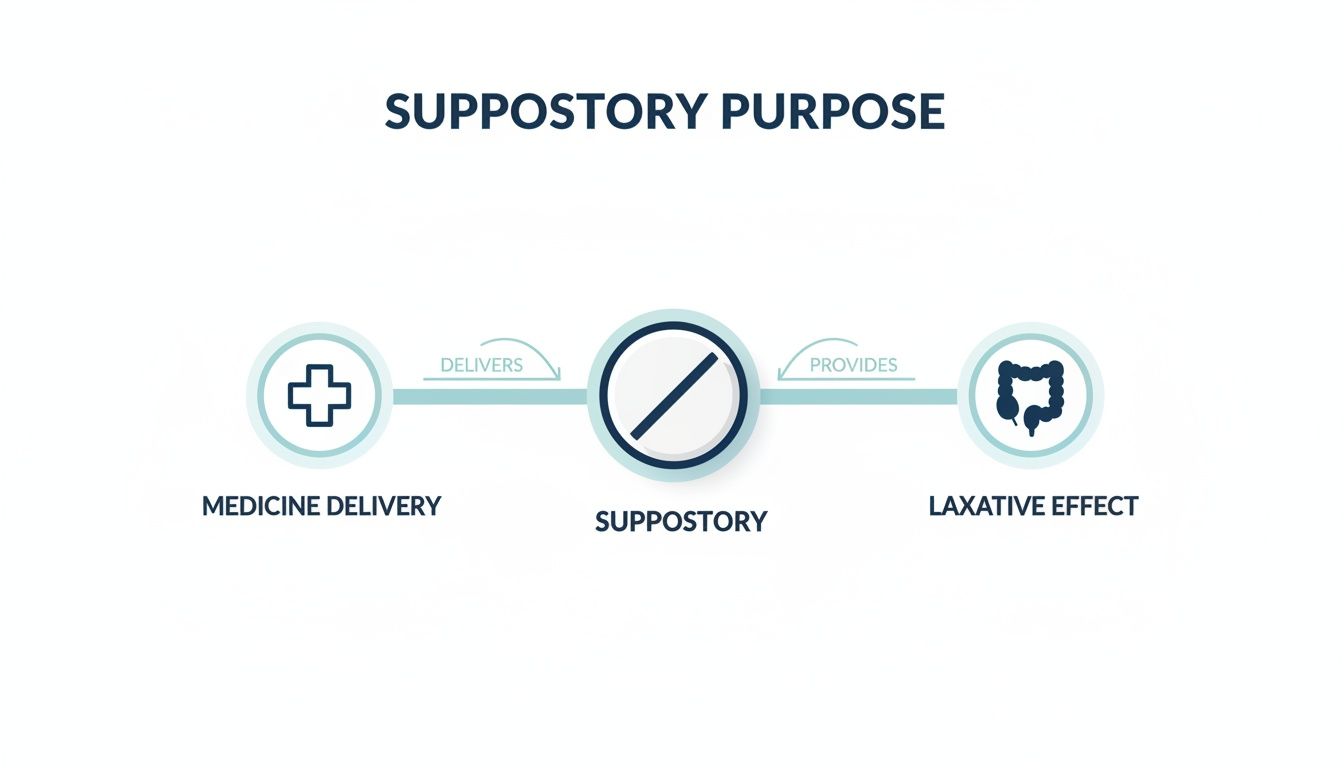
As you can see, even though the delivery method is the same, their purposes... delivering medication versus creating a laxative effect... are fundamentally different.
To clear up any lingering doubt, it helps to see a side-by-side comparison. Understanding their core differences can give you the confidence to choose the right product for your needs. One is for hemorrhoid symptoms, and the other is for constipation.
Here’s a simple table that breaks it down.
Hemorrhoid Suppositories vs Laxative Suppositories At A Glance
| Feature | Hemorrhoid Suppositories | Laxative Suppositories (e.g., Glycerin) |
|---|---|---|
| Primary Function | Delivers medication to reduce swelling, pain, and itching from internal hemorrhoids. | Stimulates the bowels to cause a bowel movement and relieve constipation. |
| Active Ingredients | Vasoconstrictors (like phenylephrine) and protectants (like an aloe vera base). | Stimulants or lubricants (like glycerin or bisacodyl). |
| Expected Outcome | Soothing relief and a gradual reduction in hemorrhoid symptoms. No urgent need to poop. | A bowel movement, usually within 15 to 60 minutes after use. |
Seeing it laid out like this makes the distinction crystal clear. When you reach for a hemorrhoid suppository, you can rest assured it's there to provide comfort, not cause an emergency trip to the restroom.
How Hemorrhoid Suppositories Actually Deliver Relief
So, if a hemorrhoid suppository isn’t designed to make you poop, what does it actually do? Think of it as a tiny, targeted delivery system. Its main job is to get soothing medicine right to the source of your internal discomfort.
Once inserted, your natural body heat gets to work, melting the suppository. This process releases the active ingredients exactly where they’re needed most... onto the swollen and irritated hemorrhoid tissue inside your rectum.
The Science of Shrinking and Soothing
The real magic happens in the ingredients. Many effective suppositories contain something called phenylephrine, which is a vasoconstrictor. That’s just a technical way of saying it shrinks swollen blood vessels.
It works a lot like putting an ice pack on a sprained ankle. The cold makes the blood vessels constrict, which brings down the swelling and eases that throbbing pain. Phenylephrine does the same thing for the swollen veins of an internal hemorrhoid, delivering direct, localized relief.
The entire process is about targeted symptom relief, not digestive stimulation. This is the fundamental reason why using one won't send you rushing to the bathroom.
This targeted approach is key. A hemorrhoid suppository is formulated to melt and release active ingredients like phenylephrine, but it doesn't contain any laxatives or stimulants. For mild to moderate hemorrhoids, symptoms often start to improve within a few days of using suppositories two to four times daily. Using them after a bowel movement helps maximize the medicine's contact time with the tissue.
Creating a Protective Barrier for Healing
Beyond just shrinking the swelling, a quality suppository also provides a protective coating. The base of the suppository... the stuff that holds the active ingredients... is just as important as the medicine itself.
For example, some hemorrhoid suppositories are made with a soothing base. As the suppository melts, this base coats the irritated tissue and creates a gentle barrier that helps in a few important ways:
- It reduces friction when stool passes, which prevents things from getting more irritated.
- It calms inflammation and provides a much-needed cooling sensation.
- It creates an ideal environment for that delicate tissue to start healing.
This dual-action approach of shrinking and soothing is what makes suppositories so effective for internal hemorrhoids. To really get the full picture, you can learn more about what a hemorrhoid suppository does in our detailed guide. It all comes down to delivering the right medicine to the right spot without causing any unwanted side trips to the bathroom.
What to Expect When Using a Suppository

So, we've established that the answer to "does hemorrhoid suppositories make you poop" is a clear no. But it's still completely normal to wonder what you will feel. Using a suppository for the first time can feel a little strange, and knowing what’s normal helps get rid of any anxiety.
The first thing you’ll probably notice is a temporary sensation of fullness or mild pressure inside your rectum. This isn't a sign that you need to go to the bathroom. It’s just the physical presence of the suppository before it starts dissolving. This feeling usually fades within a few minutes as your body gets used to it and the suppository begins to melt.
What you're feeling is part of the healing process, not a signal for a bowel movement. Understanding this difference is key to using suppositories with confidence.
Once the suppository melts, the soothing medicine gets released directly where it's needed. But the melted base has to go somewhere, and this can sometimes lead to minor leakage. Don’t be alarmed if you notice a small amount of oily or waxy residue. This is perfectly normal and just means the product is doing its job.
Take Action: Preparing for Normal Sensations
Knowing what to expect helps you stay calm and get the most out of your treatment. The feelings you experience with a hemorrhoid suppository are completely different from the urgent cramping you’d get from a laxative suppository.
To make the experience go smoothly, here are a couple of practical tips:
- For Fullness: Try lying down on your side for 15-20 minutes after insertion. This helps you ignore the sensation and gives the medicine time to absorb without getting pushed out of place.
- For Leakage: A simple panty liner or a small piece of folded toilet tissue placed in your underwear can catch any minor residue. This can give you peace of mind, especially if you're using a suppository before work or overnight.
By learning to distinguish these normal, mild experiences from the urgent signals of a bowel movement, you can use hemorrhoid suppositories without any worry. These sensations are simply signs that targeted relief is on its way.
Who Can Safely Use Hemorrhoid Suppositories
When you’re dealing with hemorrhoid pain, the last thing you want is another thing to worry about. This is especially true during certain times in life... like pregnancy, postpartum recovery, or as we get older... when we're naturally more cautious about what we put in our bodies.
For new and expecting mothers, this concern is completely valid. A staggering 40% of women get hemorrhoids during pregnancy or after childbirth. All the physical pressure and hormonal shifts create a perfect storm for this incredibly uncomfortable condition.
The good news is that hemorrhoid suppositories are generally considered safe and effective for most people, especially when you pick the right formula.
A Safe Choice During Pregnancy and Postpartum
I recently talked to a new mom, Sarah, who was at her wit's end. Between a newborn who refused to sleep and the sharp, distracting pain from postpartum hemorrhoids, she felt like she was completely falling apart. She was terrified of taking anything that might affect her baby or... even worse... cause more straining, which her doctor had warned her to avoid at all costs.
Her OB-GYN recommended a gentle, steroid-free suppository. She needed something that would provide real relief without adding more stress to her already overwhelmed body.
Formulas designed for this sensitive time focus on two key things: safety and targeted relief. Clinical trials have shown that hemorrhoid suppositories are designed to constrict blood vessels and protect tissue, not to trigger a bowel movement. With ingredients like phenylephrine to shrink swelling and soothing aloe, they provide comfort without causing that dreaded urgency. You can learn more about these effective treatments and their long-standing safety record from digestive health experts.
The Goal Is Gentle Relief... Not Added Strain. A non-stimulant suppository supports your body's healing process without forcing bowel movements, which is absolutely crucial for a comfortable postpartum recovery.
If you're navigating this challenging time, our guide on treating hemorrhoids during pregnancy offers more compassionate advice and practical tips.
Considerations for Older Adults
As we age, hemorrhoids can unfortunately become a more frequent problem. Many older adults are also managing other health conditions and taking multiple medications, which makes safety the number one priority.
In this case, choosing a steroid-free suppository is often a very wise decision. While steroids can be effective at reducing inflammation, long-term use can sometimes lead to the thinning of delicate rectal tissue. A formula that relies on a vasoconstrictor and protective ingredients offers effective relief for recurring flare-ups without that specific concern.
For older adults, the key benefits are clear:
- Targeted Action: The medicine works right where you need it, minimizing the risk of interacting with any oral medications you might be taking.
- Predictable Results: They provide relief from pain and swelling without disrupting your normal bowel function, which is especially important for maintaining regularity.
- Ease of Use: Suppositories offer a simple, direct way to manage internal hemorrhoid symptoms without any complicated routines.
How To Use a Suppository for the Best Results
Getting the most out of your treatment really comes down to proper application. When you use a suppository the right way, you’re making sure the medicine stays exactly where it needs to be to soothe internal hemorrhoids and give you lasting relief.
Think of it like planting a seed. If you just toss it on top of the soil, it’s not going to grow. It needs to be planted at the right depth to take root. A suppository works the same way... proper insertion is key for it to dissolve and deliver relief right to the source of the problem.
Take Action: The Step-by-Step Application Process
Following a few simple steps can make the whole process more comfortable and way more effective. It only takes a moment, but it makes a huge difference.
- Start with Clean Hands: Always wash your hands thoroughly with soap and water before and after you handle the suppository.
- Prepare the Suppository: If it feels too soft, you can run it under cold water (still in the wrapper) or pop it in the fridge for a few minutes. This firms it up for an easier insertion.
- Find a Comfortable Position: The best way is to lie on your side, keeping your bottom leg straight and bending your top leg up toward your chest. This position helps relax the anal muscles.
- Insert Gently but Firmly: With your finger, gently push the suppository, pointed end first, about one inch into the rectum. You want to get it just past the muscular sphincter, which will help hold it in place so it doesn’t slip back out.
For a more detailed walkthrough, check out our complete guide on how to use hemorrhoid suppositories.
The Most Important Tip for Success
If you remember only one thing, make it this: always try to use a suppository after you’ve had a bowel movement.
Why is this so critical? Using it on an empty rectum means the medicine has direct, uninterrupted contact with the inflamed tissue. There’s no stool getting in the way, and you’re far less likely to have another bowel movement that could push the suppository out before it has fully dissolved.
The secret to effective relief is giving the medicine time to work. Lying still for 15-20 minutes after insertion allows the suppository to melt and the active ingredients to absorb properly.
This simple timing trick is the key to letting the medication do its job, giving you powerful, targeted relief without any surprise trips to the bathroom. By following this one piece of advice, you can be confident you’re getting the full benefit from every single application.
When You Should See a Doctor for Your Symptoms
Over-the-counter treatments are a fantastic first line of defense for most hemorrhoid flare-ups. But it's crucial to know when your symptoms are signaling something that needs a doctor's eye. Knowing the difference puts you in control of your health.
While OTC suppositories can provide targeted relief, only a proper diagnosis from a doctor can confirm you’re treating the right thing. Some serious conditions can mimic hemorrhoid symptoms, and you don’t want to miss those.

Take Action: Clear Signs It Is Time to Call Your Doctor
Think of at-home care as having about a one-week window. If things aren't getting better after 7 days of using an OTC product, it’s time to make an appointment. Your long-term health is what matters most.
You should definitely seek medical advice if you experience any of these red flags:
- Severe or Worsening Pain: If the pain is intense, won't let up, or is getting worse instead of better, a doctor needs to figure out why.
- Heavy or Recurring Bleeding: A little bright red blood on the toilet paper can be normal with hemorrhoids. But any heavy bleeding, dark-colored blood, or bleeding that keeps happening needs a professional opinion.
- A Hard Lump That Doesn't Improve: This could be a thrombosed hemorrhoid, which feels like a hard, painful lump. These often require medical attention to resolve.
- No Improvement After 7 Days: If you've been consistent with at-home treatment for a week and you’re not feeling any relief, it’s the right time for a professional evaluation.
Medical reviews show that suppositories are great at controlling symptoms without making you go to the bathroom... that's a key part of their design. In fact, studies show a 56% reduction in persistent symptoms compared to a placebo, which confirms how well they work for temporary relief. You can learn more about the specific types of rectal suppositories and see the clinical data for yourself.
This makes it pretty clear: if they aren't working for you, something else might be going on.
Frequently Asked Questions About Hemorrhoid Suppositories
Let's clear up a few other common questions people have when they start using hemorrhoid suppositories. Getting these answers straight will help you use them correctly and with total confidence.
Can you poop with a suppository in?
Technically, yes, but it’s definitely not ideal. If you have a bowel movement right after inserting a suppository, you'll almost certainly push it out before it has a chance to dissolve and get absorbed.
That’s why the best practice is always to use the bathroom before you use a suppository. If the urge to go hits you unexpectedly, don’t strain to hold it in. Just know that you'll likely need to insert another one afterward to get the medicine’s full effect.
How long does it take for a hemorrhoid suppository to work?
You should start to feel some initial, soothing relief within 30 to 60 minutes. As the suppository dissolves, active ingredients like phenylephrine get to work fast, helping to shrink swollen tissues and calm that awful itching and pain.
For a real, noticeable reduction in swelling and overall discomfort, you’ll need to use them consistently for a few days as directed.
The initial relief is fast, but the real healing comes from consistent application over time. Sticking to the recommended schedule gives the medication the best chance to calm the flare-up completely.
Is a cream or suppository better for hemorrhoids?
This is a great question, and the answer comes down to one thing: location, location, location. The best choice depends entirely on where your hemorrhoids are.
- Creams: A product like Revivol-XR Advanced Hemorrhoid & Fissure Cream is your go-to for external hemorrhoids. It’s designed to be applied externally for temporary relief of pain and itching and to temporarily shrink swollen hemorrhoidal tissue.
- Suppositories: These are made specifically for internal hemorrhoids. They deliver medication deep inside the rectum, right where it’s needed and where creams simply can’t reach.
For many people dealing with the misery of both internal and external symptoms, using a cream and a suppository together is a powerful one-two punch for complete relief.
That moment of fear Mark, the teacher, felt wasn’t about a real medical risk... it was about not having the right information. Once he understood the difference between a medicated suppository and a laxative, he used the treatment with confidence and finally found the relief he deserved. That knowledge is the key to taking control of your health without unnecessary anxiety.
For temporary relief of external hemorrhoid pain, itching and burning, try Revivol-XR® Advanced Hemorrhoid Cream. Explore our full line of products at https://hemorrhoid.com and get back to feeling like yourself again.